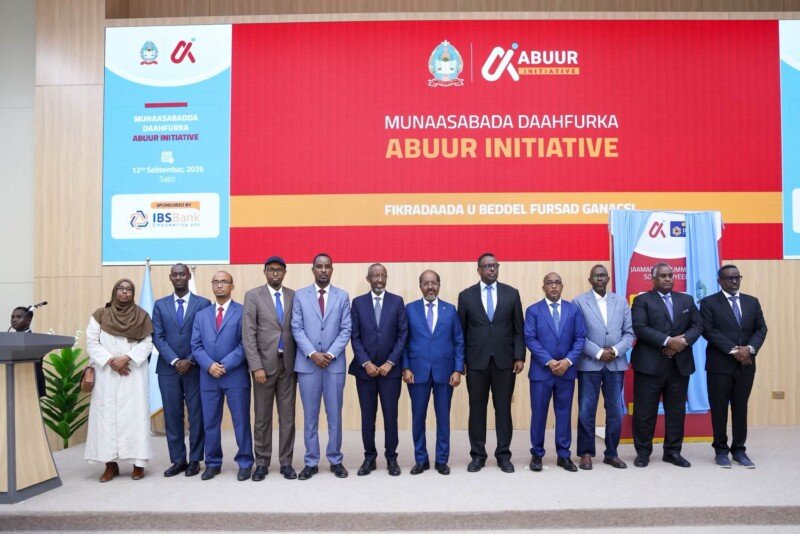
MOGADISHU — President Hassan Sheikh Mohamud attended the official opening ceremony of the 2026/2027 academic year for Somalia’s higher education institutions at the headquarters of Somali National University on Saturday, where he launched a new initiative aimed at fostering innovation and entrepreneurship among Somali students.
The President emphasized that Somalia’s development is closely linked to improving the quality of education, advancing knowledge, and investing in the country’s youth. He highlighted the vital role of universities in preparing a skilled and knowledgeable generation capable of leading the country and contributing to its development.
During the ceremony, President Hassan Sheikh launched the ABUUR Initiative, a programme designed to promote innovation, creativity, and entrepreneurial skills among Somali students.
New Facilities and Infrastructure
The President inaugurated several newly constructed university facilities, including buildings for academic faculties, a centre for Arab health affairs, and an emergency and critical care centre.
He also laid the foundation stones for a guesthouse at the Somali National University and a new Innovation and Research building. These projects are intended to strengthen higher education, medical training, and research capacity in Somalia.
ABUUR Initiative and Private Sector Partnership
The ABUUR Initiative, launched in partnership with IBS Bank, selected 110 students through a competitive process to participate in a six-month programme designed to help them turn innovative ideas into businesses. IBS Bank will finance projects considered viable and beneficial to Somalia.
University President Mohamed Mohamud stated that the programme would give students an opportunity to develop their ideas into businesses and contribute to the country’s economy. The university, which resumed operations in 2014, has since enrolled more than 16,000 students and graduated approximately 6,000.
President Hassan Sheikh, who also serves as chancellor of the university, said universities should not only produce knowledge but ensure that research has a practical impact on society. He called for recruitment and promotion to be based on qualifications and ability rather than personal or clan connections.
Expanding Higher Education Partnerships
The government has also intensified efforts to reclaim and rehabilitate university infrastructure, with the Minister of Education ordering residents occupying property belonging to the Somali National University to vacate the premises as part of broader efforts to restore the institution’s Gaheyr campus.
President Mohamud appointed Dr. Mohamed Mahmoud Mohamed as the new Rector of the Somali National University in September 2025, reflecting the government’s commitment to revitalizing public education and producing skilled professionals capable of driving national development.
Critical Note
The opening of the academic year and the launch of the ABUUR Initiative reflect the government’s recognition that Somalia’s long-term development depends on building human capital. The partnership with IBS Bank represents a welcome shift toward connecting academic training with private-sector financing, addressing a persistent weakness in Somalia’s education system where graduates often lack pathways to employment or entrepreneurship.
The challenge, as the President himself acknowledged, lies in implementation. Somalia’s higher education sector has expanded rapidly since the collapse of the central government, with more than 130 universities now operating across the country. Yet quality assurance remains uneven, and the sector lacks a robust regulatory framework to ensure that degrees meet international standards. The ABUUR Initiative’s focus on practical outcomes, including business creation and intellectual property, is a step in the right direction, but its success will depend on whether the selected projects receive sustained mentorship and access to markets beyond the initial six-month programme.
The President’s call for merit-based recruitment and promotion in universities touches on a deeper governance challenge that extends beyond education. If clan affiliation continues to influence academic appointments and student admissions, the credibility of Somalia’s higher education institutions will remain compromised. The ABUUR Initiative’s emphasis on innovation and entrepreneurship offers an opportunity to demonstrate that talent and effort, rather than connections, determine success.
Recommended Reading On ftlsomalia.com
- Somali National University Celebrates 10th Anniversary of its Re-Establishment
- Somali National University Forges Key Academic Partnerships with Chinese Institutions
- Education Minister Orders Evacuation of University Land for Redevelopment
- President Mohamud Appoints New Rector for Somali National University
- Somali and Qatar Universities Sign MoU on Improved Cooperation