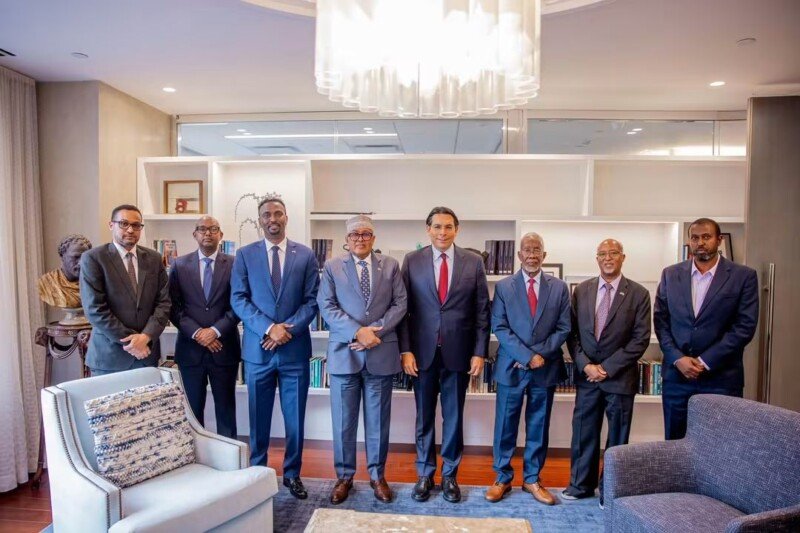
NEW YORK — Somaliland President Abdirahman Mohamed Abdullahi (Irro) met with Israel’s Ambassador to the United Nations, Danny Danon, on the sidelines of the UN General Assembly this week, with discussions focused on strengthening security, trade, technology, agriculture and investment cooperation.
The meeting is the latest in a series of high-profile engagements between Hargeisa and Israeli officials since Israel became the first UN member state to formally recognise Somaliland in December 2025. But rather than advancing Somaliland’s long-standing campaign for international recognition, the deepening alliance with Israel appears to be isolating Hargeisa from the very international bodies it needs to win over.
A Strategic Bet That Has Not Paid Off
Somaliland’s recognition campaign has historically rested on three pillars: its democratic governance, its stability relative to southern Somalia, and the moral argument of the alleged genocide committed by former dictator Siad Barre against the Isaaq clan in the late 1980s. Israel’s recognition was framed by its advocates as a vindication of that third pillar, a closing of a moral circle between two peoples who had suffered persecution.
The reality has been different. The alliance with Israel has shut down one of Somaliland’s most important diplomatic avenues: the genocide narrative. For decades, Somaliland officials and advocates argued that the international community owed recognition as a moral debt for its silence during Barre’s scorched-earth campaign, which allegedly killed tens of thousands of civilians and reduced Hargeisa and Burao to rubble. That argument resonated particularly in Western capitals, where the moral case for protecting vulnerable populations carries weight.
Teaming up with Israel, a state currently facing international prosecution for genocide at the International Court of Justice, has fatally undermined that moral authority. South Africa has submitted a comprehensive filing to the ICJ documenting Israel’s non-compliance with provisional measures ordered by the court, and Amnesty International has confirmed that Israeli authorities have continued to commit genocide against Palestinians in Gaza even after the October 2025 ceasefire.
By aligning with a state accused of committing the very crime Somaliland claims to have suffered, Hargeisa has created a paradox that its critics are exploiting. The argument now writes itself: Somaliland demands recognition on the basis of genocide, yet partners with a state facing genocide charges. The moral high ground has been surrendered.
Regional Condemnation, Not Emulation
The diplomatic backlash was swift and overwhelming. More than 50 countries condemned Israel’s recognition, and the UN Security Council held an emergency session. The African Union, Arab League, Organisation of Islamic Cooperation, and IGAD all rejected the move as a violation of Somalia’s sovereignty and territorial integrity.
A joint statement by the Foreign Ministers of Jordan, Egypt, Algeria, Comoros, Djibouti, Gambia, Iran, Iraq, Kuwait, Libya, Maldives, Nigeria, Oman, Pakistan, Palestine, Qatar, Saudi Arabia, Somalia, Sudan, Türkiye, Yemen and the OIC described the recognition as “a grave violation of the principles of international law” and “a serious precedent” that “threatens international peace and security”.
None of these states have followed Israel’s lead. Not one. The recognition that was supposed to be the beginning of a wave has instead become a diplomatic liability.
Even within Somaliland, the alliance is deeply unpopular. Tens of thousands reportedly marched in Borama carrying Palestinian flags, rejecting Israel’s recognition and opposing any attempt to turn Somaliland into a destination for displaced Palestinians or a base for regional military operations, as reported in FTL Somalia’s coverage of the Borama protests. The internal divisions exposed by the Israel alliance undermine the narrative of Somaliland as a cohesive, stable polity worthy of recognition.
Washington Has Not Followed
The central objective of Irro’s Washington visit in September was to parlay Israel’s recognition into American support. That objective has not been achieved. Irro himself acknowledged that Washington has made no commitment to recognition, telling a local source that he “cannot say that there is currently any American promise regarding recognition”.
A State Department report to Congress in June 2026 reaffirmed that Washington recognises “the sovereignty and territorial integrity” of the Federal Republic of Somalia, including Somaliland. President Donald Trump said in December 2025 that he was not ready to recognise Somaliland, and a congressional source told Middle East Eye there had “never” been a sign that Trump would move ahead with recognition.
Irro’s appearance at the Hudson Institute in September was widely panned, as reported in FTL Somalia’s coverage of the Hudson Institute event. He struggled to answer basic questions about Somaliland’s strategic value, minerals, and regional dynamics. Cameron Hudson, a former US intelligence official, said Irro “did himself and his country a major disservice by being unprepared or incapable of being able to respond convincingly to serious topics”.
Critical Note
Somaliland’s decision to align with Israel was presented as a pragmatic diplomatic move, a way to break the decades-long deadlock on recognition by seizing an opening that others had refused. The evidence now suggests the opposite has occurred. The alliance has not produced a wave of recognition. It has produced condemnation from more than 50 countries, an emergency UN Security Council session, and a moral paradox that undermines the core of Somaliland’s historical case.
The genocide argument was never merely rhetorical for Somaliland. It was the emotional and legal foundation of a claim that the international community owed recognition as a debt for its silence during Barre’s atrocities. By partnering with a state facing genocide charges at the ICJ, Hargeisa has forfeited the moral authority that argument depended on. Its critics no longer need to dispute the historical record of the Barre-era killings. They need only point to the company Somaliland now keeps.
Ambassador Danny Danon’s meeting with Irro at the UN will be read in many capitals as further proof that Somaliland has chosen a side in a regional and international conflict that most of the world opposes. That may be a strategic choice. But it is not a choice that is delivering recognition. It is a choice that is narrowing Somaliland’s diplomatic options to a single, controversial ally while alienating the broader international community whose acceptance it has sought for 35 years.
Recommended Reading On ftlsomalia.com
- Israel Recognizes Somaliland as Independent State
- Somaliland President Pitches Strategic Partnership to Washington at Hudson Institute
- U.S. Congressional Report Reaffirms Somalia’s Sovereignty While Outlining Deeper Security and Trade Engagement with Somaliland
- Borama Returns to Calm After Deadly Protests as Somaliland Blames External Forces
- Somaliland Bans Armed Mobilisation in Awdal and Salal as Tensions Persist