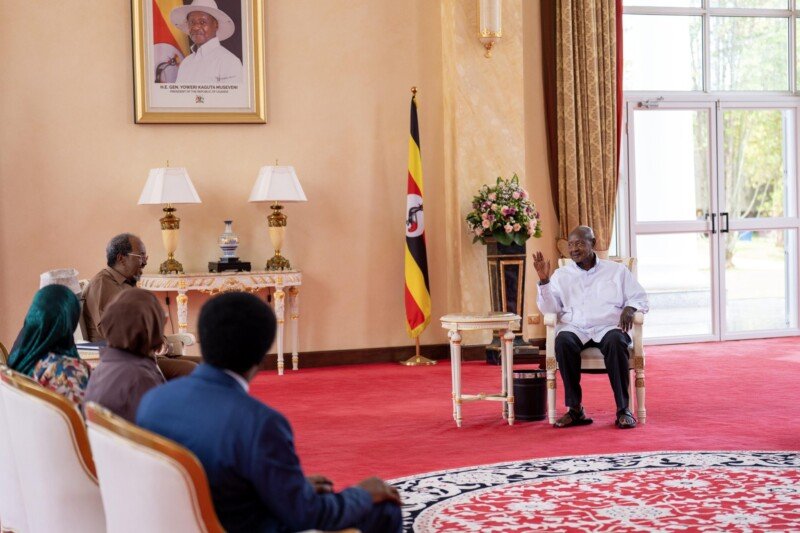
ENTEBBE, Ugandan President Yoweri Kaguta Museveni has urged Somali leaders to unite against Al-Shabaab, warning that ideological divisions and a failure to correctly diagnose the country’s problems have undermined efforts to achieve lasting peace. His remarks came during a meeting with President Hassan Sheikh Mohamud at State House in Entebbe on Monday, a visit that underscored both the depth of the security partnership and the urgency of Somalia’s transition as international support mechanisms wind down.
“The problem of Somalia is ideological and a misdiagnosis of problems,” Museveni said, drawing parallels with Sudan. “Unite the many to defeat the few, but some Africans want to annoy the many to stay with the few.”
A History of Blunt Advice
Museveni’s advice is not new. As reported in FTL Somalia’s coverage of their 2023 meeting, the Ugandan leader previously urged President Mohamud to prioritize peace and build a national army on the right ideology, arguing that Somalia needed stability to raise resources for self-sustenance. His latest remarks suggest that, in his view, the fundamental political challenges remain unresolved.
The relationship has also seen friction. In July 2026, during an AUSSOM summit in Kampala, President Mohamud objected to provisions in the draft communiqué that addressed Somalia’s internal political affairs, insisting that domestic politics must not be internationalized. Museveni, who chaired the session, instructed officials to revise the draft accordingly, as reported in FTL Somalia’s coverage of the summit. The exchange highlighted a tension between Museveni’s willingness to offer political advice and Mogadishu’s insistence on sovereign control over its internal processes.
The Security Transition and a Request to Stay
During Monday’s meeting, President Mohamud commended the Uganda People’s Defence Forces for their contributions to peace and expressed hope that Ugandan troops would remain in Somalia longer to help achieve full pacification.
That request comes at a critical moment. Uganda has previously signaled its intention to withdraw after nearly two decades of deployment, with General Muhoozi Kainerugaba announcing in January 2026 that the mission was concluding, as reported in FTL Somalia’s coverage of the announcement. The AUSSOM mission itself faces an uncertain future, with its mandate set to expire at the end of 2026 and funding from the United States for the UN logistical support office (UNSOS) being withdrawn, as detailed in FTL Somalia’s coverage of the transition planning.
The request for Ugandan troops to stay longer is a tacit acknowledgment that the Somali National Army is not yet ready to assume full security responsibility, despite the government’s public statements of readiness.
Coffee Diplomacy and Economic Ties
The leaders also discussed expanding trade, with Museveni welcoming Somalia’s decision to permit Uganda to establish a warehouse for processed coffee. Somalia currently imports coffee from European countries, with Ugandan beans passing through intermediaries before reaching Somali consumers. The warehouse initiative aims to create a direct trade route.
The economic discussion reflects a broader effort to complement security cooperation with commercial ties. Somalia’s Ambassador to Uganda noted that approximately 8,000 Somalis operate businesses in Uganda and 15,000 students are enrolled in Ugandan universities, underscoring the deep people-to-people links between the two countries.
Critical Note
Museveni’s diagnosis of Somalia’s crisis is characteristically direct: the problem is ideological, and the solution is political unity. His warning that “divisions among the majority could allow a minority to maintain influence” is a pointed critique of the factionalism that has defined Somali politics for decades.
But the advice sits uneasily alongside the reality of the relationship. In July, President Mohamud explicitly rejected the internationalization of Somalia’s domestic politics when Museveni and other African leaders sought to include governance and reconciliation provisions in a summit communiqué. Now, in Entebbe, Museveni is again offering political counsel, and Mohamud is again listening politely while requesting more troops. The dynamic is one of dependence: Somalia needs Uganda’s soldiers, and Uganda’s president feels entitled to offer advice in return.
The timing of the meeting is significant. The UN political mission in Somalia is closing its doors on October 31, ending more than three decades of international political stewardship, as reported in FTL Somalia’s coverage of the transition. The AUSSOM mission faces a funding cliff and a potential withdrawal of Ugandan forces. Somalia is entering a phase where it will have fewer international buffers and more direct responsibility for its own security and political stability.
In that context, Museveni’s call for unity is not just advice. It is a warning. The international community is stepping back, and the divisions that Museveni describes are precisely the ones that will determine whether Somalia can hold together without the scaffolding of foreign missions. The coffee warehouse is a small economic step. The request for troops to stay is a recognition of dependency. The question that neither leader addressed publicly is what happens when the troops do leave, and whether the political unity Museveni demands will materialize before they do.
Recommended Reading On ftlsomalia.com
- Prioritize Peace, Museveni Urges Somali President
- African Leaders Endorse Phased AUSSOM Withdrawal as Somalia Rejects Internationalization of Domestic Politics
- Uganda Announces Intent to Withdraw Troops from Somalia After 19 Years
- National Security Adviser and AUSSOM Chief Meet at Villa Somalia to Discuss Transition
- UN to Close Somalia Political Office, Extend AU Mission Until 2026