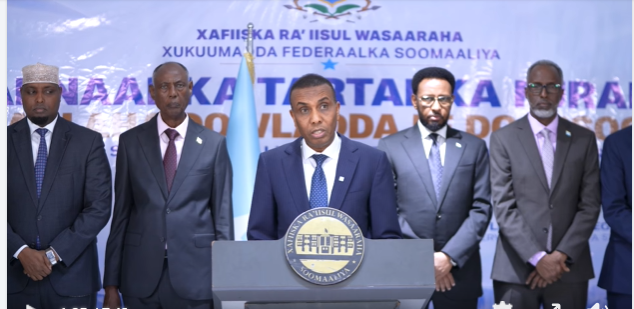
MOGADISHU — The Federal Government of Somalia held its annual Cabinet accountability session on September 13, 2026, during which ministries and government agencies presented their achievements over the past year to the Prime Minister.
Prime Minister Hamza Abdi Barre emphasized that accountability and performance evaluation are essential pillars of good governance, and urged ministries and agencies to redouble their efforts to deliver quality services to the public.
President Hassan Sheikh Mohamud, who attended the session, praised the DanQaran government’s leadership and achievements over its four years in office. He stressed the importance of continuous accountability, evaluation of government agency performance, and accelerating plans to deliver services and development.
“The government must reward those who bring effort and performance, and those who work hard should not be treated the same as those who fall short. Where you stand today is far higher than where you were yesterday,” President Mohamud said.
Merit-Based Hiring Directive and Internal Criticism
On September 17, Prime Minister Hamza issued a directive calling for the full implementation of merit-based recruitment and appointment procedures across all government ministries and agencies. The directive cited Article 161(1) of the Provisional Constitution and Article 7 of the Civil Service Law, and instructed all ministers and government officials to apply merit-based and competitive processes without exception or delay.
The Prime Minister instructed the Civil Service Commission to begin the first phase of the process on September 20, starting with the directors who run the departments of government institutions, with those posts to be reassessed on competence, knowledge, experience, leadership and performance . Ministries and agencies were told to fill director posts through an open competitive process, give every serving civil servant who qualifies an equal opportunity to compete, and fill any vacant government post through open competition in accordance with the laws and regulations of the government .
The directive drew immediate criticism from within government circles. Omar Hashi, a Member of the Federal Parliament and the Special Presidential Envoy for Stabilization and Civilian Protection [citation:1][citation:5][citation:8], questioned the timing and consistency of the government’s commitment to merit-based appointments. Writing on social media, Hashi noted that the government had promised the public that senior appointments would be merit-based, advertised, and selected through a competitive process, and asked: “So, what has changed?” He added that filling positions should not be seen as clan-centric political rewards but should add value to the country.
The criticism followed the Cabinet’s approval on September 10 of the Director General and Deputy Director General of the Somalia Investment Authority, as well as the appointment of a Director General for the Halmeel Integrated Services Centre. Critics pointed out that these appointments were made through the same process the government now says it is reforming.
Digital Performance Management System
The accountability session showcased progress in implementing the government’s Unified Performance Management Policy and the Government Integrated Performance Management System (GIPMS), developed by the Prime Minister’s Office to strengthen monitoring, evaluation, and accountability across government agencies.
Critical Note
The government’s emphasis on accountability and merit-based appointments is a positive signal, but the track record on civil service reform in Somalia has been uneven. The fact that a sitting MP and presidential envoy has publicly challenged the government’s commitment suggests that skepticism about the reform agenda extends beyond anonymous online commentary and into the institutions of government itself.
The Cabinet session also celebrated the performance of specific ministries, with the Ministry of Foreign Affairs among those recognized for good performance. The award ceremony itself raises questions about consistency: if merit-based recruitment is not universally applied, recognition based on institutional performance may also be inconsistently awarded. Sustainable reform requires transparent, consistently applied standards for both hiring and evaluation, not selective recognition.
The timing of the directive, issued as the government’s mandate draws to a close, has fueled perceptions that the announcement is a late attempt to rewrite the government’s record. Whether the Civil Service Commission can conduct a genuinely competitive process, and whether the results will be respected, will be the test of whether this is meaningful reform or a political gesture.