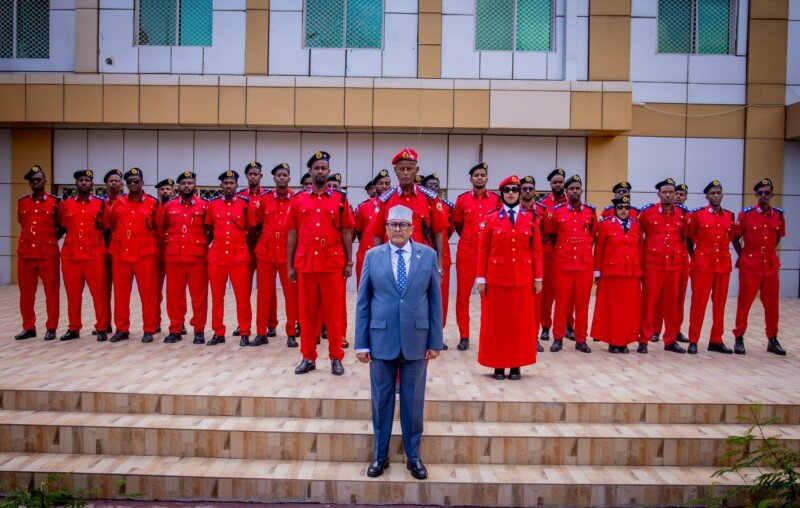
MOGADISHU, Somalia’s Minister of Internal Security, Abdullahi Sheikh Ismail (Fartaag), inspected Aden Adde International Airport on Tuesday, chairing the fifth coordination meeting of security and aviation agencies and directing officials to accelerate plans to relocate or demolish structures near the airport perimeter.
The meeting focused on improving cooperation among government agencies, strengthening passenger safety, and advancing the clearance of designated facilities near the facility. The minister emphasized the need to expedite the evacuation plan for structures slated for relocation or demolition, describing Aden Adde as a vital entry point and an important symbol of Somalia’s international connectivity.
The inspection was attended by the State Minister for Transport and Civil Aviation and other senior officials.
A Pattern with Precedent
The government’s push to clear structures around the airport is not new. The facility’s location within Mogadishu’s urban fabric has long presented security challenges, particularly given the persistent threat from Al-Shabaab, which has targeted the airport and the surrounding area with mortars in the past.
What is notable about the current plan is its resonance with a broader, well-documented pattern of forced evictions and land seizures in Mogadishu. A Heritage Institute for Policy Studies report published in October 2026 found that between 2017 and September 2026, 2,136,420 people were evicted across Somalia, with 64 percent of those evictions occurring in the Benadir region, which encompasses the capital.
The report documents a shift in the nature of evictions. In 2021, only 11 percent of evictions from Mogadishu’s displacement camps occurred on government-owned land. By 2025, that figure had risen to 44 percent. The state has transitioned from bystander to evictor, with demolitions often conducted without adequate notice, consultation, or compensation.
In August 2026, violence erupted in Mogadishu’s Tookiyo neighbourhood when government forces clashed with residents protesting the demolition of their homes, leaving nearly 10 people injured, as reported in FTL Somalia’s coverage of the clashes. Similar confrontations occurred in Wabari, where government forces used live ammunition against residents resisting eviction, and in Daynile, where rival security factions clashed over demolitions in the Warlaliska neighbourhood.
The Heritage Institute report attributes the crisis in part to a governance vacuum. The Benadir Regional Administration and the Ministry of Public Works dispute responsibility for urban land, creating what the report describes as an opening for “predatory political and commercial elites” to enrich themselves at the public’s expense. Developers use administrative decrees to acquire valuable land without competitive tendering or verification of ownership, and connected buyers rely on state security forces to evict occupants.
The Union of Somali Islamic Scholars Councils intervened in August 2026, calling on the government to halt demolitions and investigate land seizures. The scholars said they had received complaints from residents who claimed to possess legal ownership documents but had their property challenged, seized, or subjected to fees with no clear legal basis, as reported in FTL Somalia’s coverage of the scholars’ intervention.
What the Airport Plan Does Not Say
Authorities have not disclosed the number of structures affected by the airport clearance plan, the specific neighbourhoods targeted, or the timeline for the proposed relocation and demolition exercise. The lack of detail leaves residents in the vicinity of the airport facing uncertainty about whether their homes or businesses will be affected, and what compensation or resettlement arrangements, if any, will be offered.
Historical precedent offers little reassurance. In 2010, Somali security agents demolished approximately 500 homes near the airport, citing fears that they could be used as cover for insurgent attacks. Hundreds of families were left without shelter, and a BBC reporter at the time noted there was no evidence the government provided the land it had promised and Somali Political Elites ended up benefiting from the projects and building villas in the cleared area near the airport..
Critical Note
The security rationale for clearing the airport buffer zone is genuine. Aden Adde serves as Somalia’s principal international gateway, and its proximity to densely populated areas increases the risk of collateral damage from any attack. A major security incident at the airport would be devastating for the government’s credibility and for the country’s connections to the outside world.
But the government’s approach to land clearance in Mogadishu has a documented history that makes skepticism reasonable. The Heritage Institute’s findings, the pattern of violent confrontations in Tookiyo, Wabari, and Daynile, and the scholars’ intervention all point to the same conclusion: demolitions and evictions in the capital have too often served private interests rather than public ones. If the airport clearance follows the same pattern, it risks becoming another chapter in a land crisis that has already displaced more than two million people.
The government has not yet published the details of this plan. Until it does, the residents of the airport zone have no way of knowing what will happen to them, and the public has no way of assessing whether the security benefits justify the human costs. The minister’s meeting produced a directive. It did not produce accountability, transparency, or a compensation framework. Those are the elements that would distinguish a legitimate security measure from another episode of state-enabled land capture.
Share your story. FTL Somalia is continuing to follow security developments at Aden Adde International Airport and the broader land crisis in Mogadishu. If you have information or insights to share, contact us at info@ftlsomalia.com. Your identity will be protected.
Recommended Reading On ftlsomalia.com
- Mogadishu’s Eviction Crisis: New Report Reveals 2.1 Million Displaced Nationwide
- Violence Erupts in Mogadishu as Residents Protest Demolition of Homes in Tookiyo Neighbourhood
- Religious Leaders Call on Government to Halt Land Grabs and Protect Property Rights in Mogadishu
- Former President Sharif Condemns Government Evictions, Calls Military Actions “Cowardly”