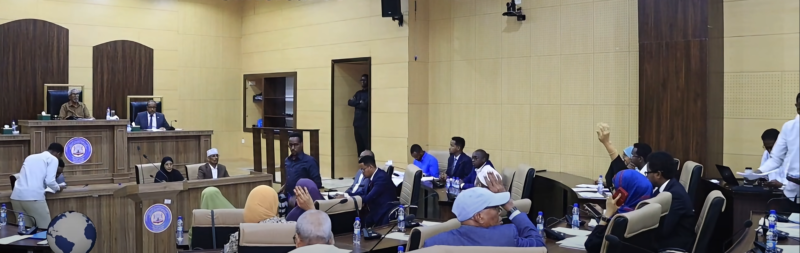
MOGADISHU, Somalia’s Upper House of Parliament on Monday unanimously approved a bill establishing a dedicated Environmental Management Authority, with all 28 senators present voting in favor and no abstentions or opposition recorded.
The bill is intended to create a specialized institution responsible for environmental management and protection. Its provisions will take effect once the legislation completes the remaining legal procedures required for it to become law.
The unanimous vote in a chamber that rarely reaches full attendance is notable. The Upper House has 54 members, and sessions that draw only 28 senators reflect the broader challenges of maintaining quorum and legislative momentum in Somalia’s federal parliament. That the bill passed without a single objection, however, suggests that the case for a dedicated environmental authority has broad political support.
The new authority will be tasked with addressing a range of environmental challenges that Somalia has struggled to manage through existing institutions. Deforestation for charcoal production, illegal wildlife trade, unregulated fishing, and the impacts of recurrent droughts and floods have all placed pressure on the country’s natural resources. The authority’s mandate will presumably include oversight of these areas, though the specific powers and budget allocated to it will depend on how the legislation is implemented.
A Speaker Critical of the House He Leads
The vote comes amid sustained criticism from within the Upper House’s own leadership about how the chamber functions. Speaker Abdi Hashi Abdullahi has repeatedly expressed strong disapproval of senators for consistently arriving late to sessions and leaving early, emphasizing that punctuality and full attendance are essential for the effective functioning of the Senate. As FTL Somalia reported on the Speaker’s remarks, his warnings reflect broader concerns about commitment and accountability within the legislative process.
The Speaker’s criticism is not confined to attendance. In April 2026, he accused government institutions of systemic lawlessness, stating: “The government must enforce the law, but we ourselves are the government, and yet we do not follow the law.” As FTL Somalia reported at the time, the Speaker’s return to public life after a health-related absence signaled that the Upper House would play an active and potentially confrontational role in the political process.
The Environmental Management Authority bill was previously reviewed by the Senate’s National Resources Committee, chaired by Senator Saynab Ismail Mohamed, who presented the committee’s report detailing amendments and corrections made during its review. As Shabelle Media reported, senators debated the bill and offered recommendations on provisions they believed required further revision to ensure consistency with the Constitution.
A Structure Without a Strategy
The creation of a new agency is a familiar response to governance gaps in Somalia. The country has established a proliferation of ministries, agencies, and commissions across federal and state levels, many of which operate with limited capacity and unclear coordination with existing institutions. A report by the World Bank’s 2026 Public Finance Review noted that the proliferation of government institutions, including an estimated 153 ministries across jurisdictions, stretches an already limited fiscal envelope.
Environmental governance is particularly vulnerable to this fragmentation. Somalia has a Ministry of Environment and Climate Change, state-level environmental bodies, and a patchwork of regulations that are inconsistently enforced. Whether a new authority will clarify responsibilities or add another layer of institutional overlap is an open question.
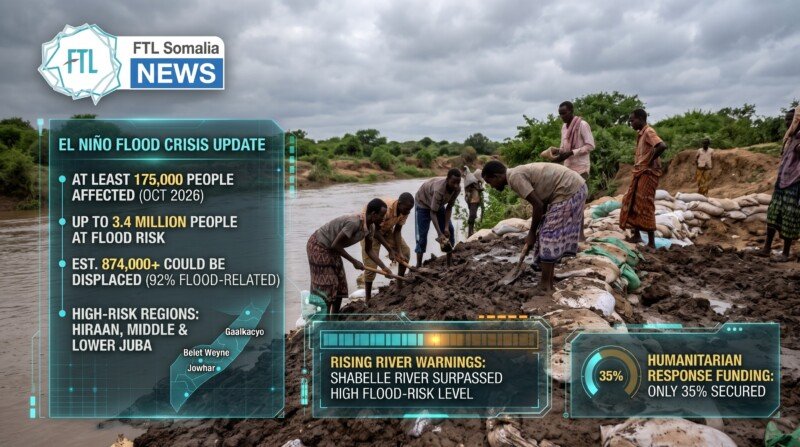
The recent humanitarian crisis has underscored the urgency of environmental management. Floods and droughts have displaced hundreds of thousands of people in the past year, and the federal government’s response has been heavily dependent on international humanitarian agencies. An effective environmental authority could play a role in disaster risk reduction, land use planning, and climate adaptation. But the authority will need a budget, technical staff, and a legal framework that allows it to enforce regulations, none of which are guaranteed.
Critical Note
The unanimous approval of the Environmental Management Authority bill is a welcome signal that parliament can act decisively when legislation commands broad support. The environment is an area where Somalia has urgent needs and weak institutions, and a dedicated body with a clear mandate could be a step forward.
But the establishment of an agency is not the same as the establishment of environmental governance. Somalia’s record of creating institutions that exist on paper but lack the capacity, funding, and political backing to function is long. The World Bank’s warning about institutional proliferation is not abstract. It is a description of the fiscal and administrative reality that the new authority will inherit.
The Speaker’s own criticism of the House he leads is a reminder that the problem is not only the executive branch. If senators cannot maintain attendance, if sessions are routinely delayed by absent members, and if the Speaker must repeatedly remind his colleagues of their basic obligations, then the oversight role that the Upper House is supposed to perform will remain weak. The Environmental Management Authority will need parliamentary oversight to function. A chamber that struggles to convene cannot provide it.
The test of this bill will not be the vote in the Upper House. It will be whether the authority is funded in the next budget, whether it is staffed with qualified professionals, whether its regulations are enforced against powerful interests, and whether it coordinates with the Ministry of Environment rather than duplicating its work. Until those questions are answered, the authority is a legal framework, not an environmental solution. The Senate has done its part. The government must now show that it intends to make the authority real.
Recommended Reading On ftlsomalia.com
- Senate Speaker Chairs Second Meeting of 8th Session Standing Committee
- Senate Speaker Accuses Government of Lawlessness
- Senate Approves Payment System Bill Amid Drought Concerns
- The UN Political Mission Ends: Somali Institutions Inherit the Mandate Without the Budget
- Governance Vacuum Fuels Clan Mobilisation in Lower Shabelle Following Al-Shabaab Withdrawal