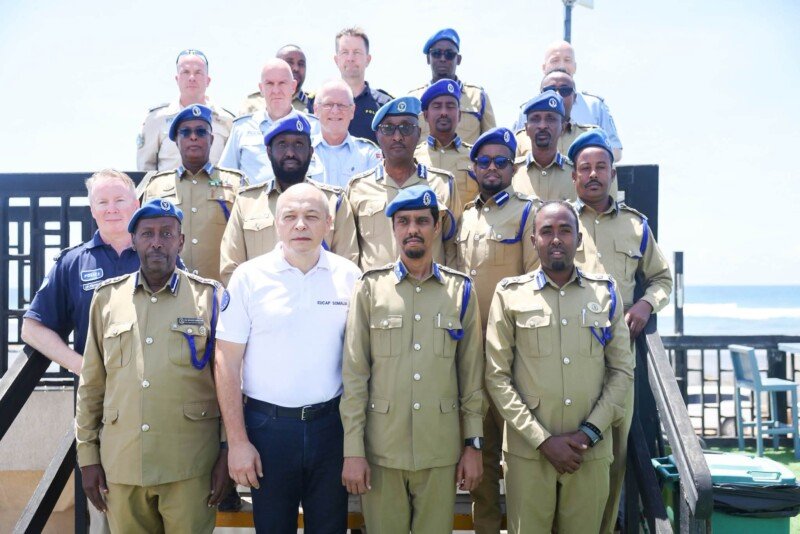
MOGADISHU — The Commander of the Somali Police Force, Major General Asad Osman Abdullahi, presided over the closing ceremony of a leadership and management training program for senior officers of the Somali Police Force on Wednesday.
The training was delivered by experts from the European Union Capacity Building Mission (EUCAP), with officers instructed in modern techniques and strategies related to administration and leadership.
Focus on Modern Policing and Technology
During the training, officers focused on how to keep pace with changes in the modern world, particularly technological developments and how they can be applied to the work of the police force and the management of security institutions.
Police Commander Asad Osman Abdullahi said that developing the knowledge and skills of personnel is among the priorities he has set for the Somali Police Force leadership.
The commander also emphasized the importance of extending training and capacity-building to all levels of the police force, from rank-and-file officers to senior leadership. The training is part of broader efforts to improve the capability and professionalism of the Somali Police Force so that it can keep pace with modern approaches to leadership, management, and security operations.
EU Capacity Building Mission Role
EUCAP Somalia has been actively involved in training Somali police and security personnel in recent months. In April 2026, EUCAP announced that it had trained more than 400 officers from the Federal Darwish force, including a significant number of women. In May 2026, the mission conducted training on company leadership and training-of-trainers for 30 participants from the Federal Darwish and the Coast Guard.
As detailed in FTL Somalia’s coverage of the Darawiish training, Somali security forces have been undergoing advanced training programs aimed at strengthening their operational capacity. The training for senior police officers reflects EUCAP’s stated strategic shift from individual training toward institutional strengthening, with the aim of building a sustainable Somali-owned training capability.
Broader Police Reform Efforts
The leadership training comes amid ongoing efforts to reform and professionalize the Somali Police Force. In May 2026, the Police Commander met with a Turkish delegation to discuss strengthening security cooperation and expanding training programs for the Somali Police Force, particularly the Haramcad special unit.
As reported in FTL Somalia’s coverage of the Turkish delegation meeting, Turkey has been a key partner in training Somali security forces. The police leadership has also launched a leadership training admission exam for future commanders, as detailed in FTL Somalia’s coverage of the admissions process, indicating a systematic approach to developing a professional officer corps.
Critical Note
The leadership and management training for senior Somali police officers is a necessary step in a long process of institutional reform. It reflects a recognition within the police leadership that modern policing requires more than equipment and personnel numbers; it requires professional command structures, strategic planning capacity, and familiarity with contemporary security challenges.
However, training alone does not transform institutions. As with previous capacity-building programs funded by international partners, the critical question is not how many officers were trained, but whether the training produces measurable changes in the way the police operate. The gap between training and institutional reform is a recurring theme in Somalia’s security sector development.
It is also important to ensure that training programs of this kind are sustained over time and integrated into a coherent reform strategy. If they remain isolated, one-off events without follow-up, mentoring, or changes to institutional structures, their impact will be limited. Building a modern, accountable, and trusted Somali police force requires not only improved skills but also strengthened accountability mechanisms, respect for human rights, and transparent management of resources.