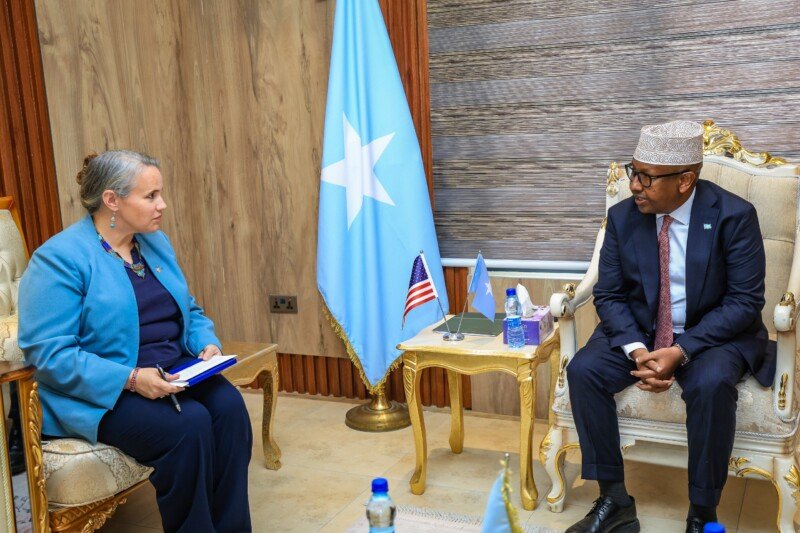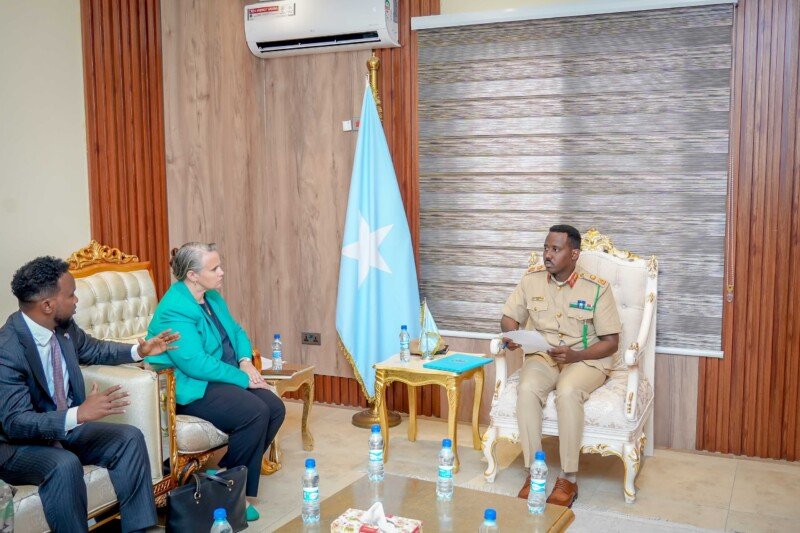
MOGADISHU, The Commander of the Somali National Army, Brigadier General Ibrahim Mohamed Mahmoud, met with Ruth Anne Stevens-Klitz, the Chargé d’Affaires of the U.S. Embassy in Somalia, on Monday to discuss strengthening defence cooperation and accelerating bilateral collaboration in security, training, and capacity-building.
The meeting focused on U.S. support for the Somali National Army and the importance of continuing military cooperation to develop the force’s capabilities. Both sides emphasized that strengthening the SNA would contribute to the country’s security and stability.
The discussions come as Washington continues to signal its commitment to Somalia’s security sector while simultaneously pressing Mogadishu to assume greater responsibility for its own defence. The United States has been a central partner in training and equipping Somali forces, particularly the elite Danab Special Forces, which have been at the forefront of operations against Al-Shabaab.
A Relationship Under Strain and Transition
Stevens-Klitz assumed her role in September 2026, succeeding Justin Davis as the top U.S. diplomat in Mogadishu, as reported in FTL Somalia’s coverage of the diplomatic transition. Her meeting with General Mahmoud is one of her first high-level engagements with Somalia’s security leadership.
The partnership she oversees is substantial but increasingly conditional. The United States has invested billions in Somalia’s security sector over nearly two decades, yet Washington has grown frustrated with the pace of progress. In July 2026, the U.S. notified the African Union that it would end financial support for the UN Support Office in Somalia (UNSOS) beyond December 2026, a decision that threatens the logistical backbone of the AU-led AUSSOM mission, as detailed in FTL Somalia’s analysis of U.S.-Somalia security relations.
Despite these tensions, military-to-military cooperation has continued. General Mahmoud has maintained regular engagement with U.S. officials, including a February 2026 meeting with the U.S. Embassy’s Defence Attaché, Colonel Wills, to discuss joint counterterrorism operations and emerging security challenges, as reported in FTL Somalia’s coverage of the earlier talks.
The Danab Factor
The U.S.-Somali security relationship is most visible in the Danab Special Forces, which Washington has trained and equipped for years. General Mahmoud has presided over Danab graduation ceremonies and visited the Ballidoogle training base to oversee new cohorts, as reported in FTL Somalia’s coverage of the Danab training programme. The elite unit has been described by AFRICOM commanders as one of the most capable forces on the continent, though its effectiveness is constrained by the wider army’s logistical and command weaknesses.
The meeting with Stevens-Klitz is likely to have touched on the future of this partnership, including training schedules, equipment provisions, and the coordination of operations against Al-Shabaab. The U.S. has resumed Danab training after a suspension following a ration-diversion scandal, but the broader question of Somalia’s ability to sustain these forces without external support remains unresolved.
Critical Note
The meeting between General Mahmoud and Chargé d’Affaires Stevens-Klitz is a routine diplomatic engagement, but it takes place at a moment of significant uncertainty in U.S.-Somalia security relations. Washington is simultaneously reaffirming its support for the SNA and withdrawing the logistical funding that sustains the AU mission the SNA depends on. This is not a contradiction in American policy so much as a deliberate shift: the United States wants to help Somalia build its own forces while reducing its own financial exposure to the broader security architecture.
For Mogadishu, the challenge is to demonstrate that the support it receives is translating into sustainable capability. The Danab are effective, but they are a small elite unit. The regular SNA remains plagued by logistics gaps, payroll irregularities, and command-and-control weaknesses. A meeting between the army chief and the top U.S. diplomat can reaffirm good intentions, but it cannot resolve these structural problems.
The deeper issue is one of ownership. The United States has made clear that it expects Somalia to take increasing responsibility for its own security. That expectation is reasonable, but it is also constrained by the Somali government’s limited fiscal capacity and the ongoing political crisis that diverts attention and resources from security sector reform. If Washington withdraws its logistical support while Mogadishu is still fighting a political battle at home, the SNA’s operational readiness could deteriorate precisely when it is needed most. The meeting on Monday did not address this contradiction publicly. Whether it was discussed privately is unknown.
Recommended Reading On ftlsomalia.com
- Somalia and US Reaffirm Strategic Partnership as Diplomatic Leadership Transitions in Mogadishu
- US Reaffirms Support for Somali Forces as Army Chief and AFRICOM General Hold Talks in Mogadishu
- Elite Danab Commandos Complete Advanced Training as SNA Chief Praises U.S. Partnership
- Somali Army Chief, U.S. Official Discuss Security Cooperation