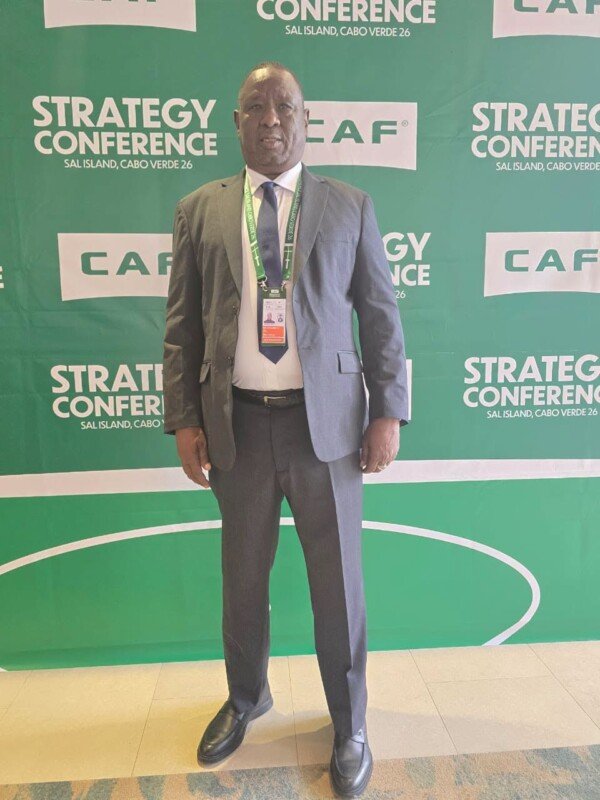
MOGADISHU — Somali Football Federation President and CECAFA Vice-President Ali Abdi Mohamed (Ali Shiine) led a Somali delegation to the CAF Strategy Conference in Cabo Verde this week, joining football leaders from across the continent to discuss the future of African football.
The delegation included national team coach Yusuf Ali Nur. The summit, held in Sal, Santa Maria from October 7 to 9, 2026, was chaired by CAF President Dr. Patrice Motsepe and brought together representatives of all 54 CAF member associations, regional football bodies, CAF Executive Committee members, national team coaches, and international football experts.
Key Agenda Items
The conference focused on the future and development of African football, with particular emphasis on player and coach development, strengthening football institutions, improving governance, increasing investment, and creating sustainable development pathways for African football.
FIFA President Gianni Infantino, who attended the opening session, called for greater opportunities for young African footballers. He said FIFA had invested approximately one billion US dollars in African football through its Forward development program over the past decade.
“African talent has shaped and is increasingly shaping the world. We must provide opportunities for that talent to shine on the global stage,” Infantino said.
CAF President Motsepe stressed the importance of cooperation among national football associations, governments, and sports ministries. He said the conference would give member associations an opportunity to discuss their concerns in greater depth than at ordinary general assemblies.
A key item on the agenda was the review of African teams’ performances at the 2026 FIFA World Cup and preparations for Africa’s plans for the 2030 World Cup. A record number of ten African teams participated in the 2026 tournament, with nine reaching the knockout stages, marking the continent’s best collective performance in the competition’s history.
Somalia’s Participation
Somalia’s participation in the summit reflects the country’s engagement with continental football leadership on development priorities and the institutional challenges facing national federations.
The Somali Football Federation has been affiliated with FIFA since 1962 and with CAF since 1968. Ali Shiine was elected as CECAFA Vice-President in February 2026, representing confidence in Somalia’s role in regional football governance. As reported in FTL Somalia’s coverage of the Vancouver strategy session, Mohamed took part in a high-level strategy meeting with African football leaders on the sidelines of the 76th FIFA Congress in Canada, underscoring Somalia’s expanding presence in continental and global football governance.
The SFF has overseen a series of milestones in recent years. In October 2025, FIFA granted the federation $4.5 million under the FIFA Forward Development Programme, one of the largest direct investments in Somali football in years, as detailed in FTL Somalia’s coverage of the funding. The funds are intended for infrastructure rebuilding, national team support, and grassroots expansion across all regions.
The national team, the Ocean Stars, secured a historic AFCON 2027 qualifier victory over Mauritius in March 2026, advancing to the group stage for the first time in the nation’s history, as reported in FTL Somalia’s coverage of the qualification. More recently, Somalia held Ivory Coast, the reigning African champions, scoreless for 89 minutes before conceding two late goals in a 2-0 defeat in Abidjan, as detailed in FTL Somalia’s coverage of the match.
No Somalia-specific commitments or funding agreements were announced at the conclusion of the summit.
Critical Note
Somalia’s participation in the CAF Strategy Conference is a positive signal of the Somali Football Federation’s engagement with continental football governance. The presence of Ali Shiine in his dual role as SFF President and CECAFA Vice-President demonstrates that Somalia has a seat at the table in discussions about African football’s future.
However, participation in conferences is not the same as transformation. The challenges facing Somali football remain substantial: limited infrastructure, insufficient funding, security constraints, and a domestic league that operates under difficult conditions. The CAF Strategy Conference’s emphasis on institutional capacity building, governance, and investment applies directly to Somalia’s situation, but the gap between continental declarations and domestic implementation remains wide.
The SFF’s recent record shows both ambition and achievement. The $4.5 million FIFA Forward grant, the historic AFCON qualification, and the competitive performance against Ivory Coast demonstrate that Somali football is making progress. But the Ocean Stars still play their home matches abroad due to the lack of a CAF-approved stadium in Somalia. Infrastructure remains the binding constraint. Whether the SFF can translate its growing international engagement into tangible domestic improvements, from youth academies to a functioning national league, will determine whether this progress is sustainable.
Recommended Reading On ftlsomalia.com
- Somali Football Head Attends African Leaders’ Global Strategy Session
- FIFA Grants Somalia Football Federation $4.5 Million Boost
- Somalia’s Ocean Stars Secure Historic AFCON Qualifier Victory Over Mauritius on Penalties
- Somalia Hold Ivory Coast for 89 Minutes Before Late 2-0 Defeat
- Somali Team Faces Ivory Coast, Ghana in AFCON Qualifiers
- Somalia Name Squad for Historic 2027 AFCON Qualifiers Against Gambia and Ivory Coast