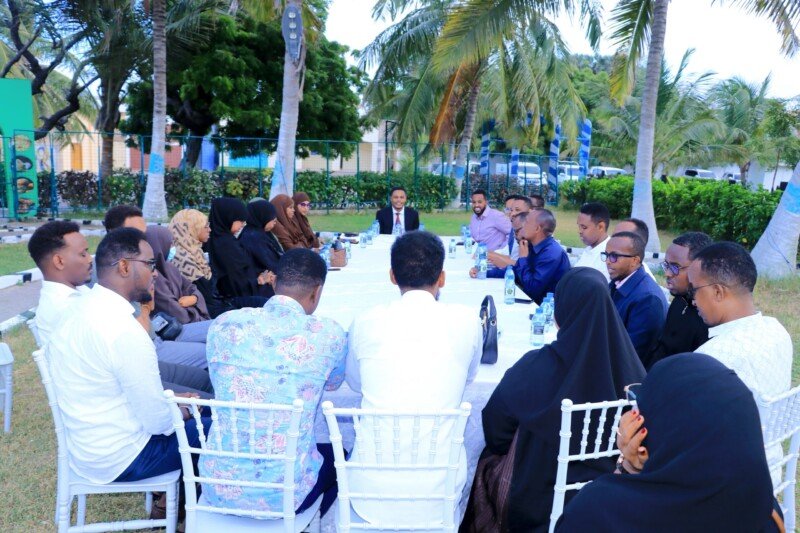
MOGADISHU — Somalia’s Minister of Information, Culture and Tourism, Abdifatah Qasim Mohamud, has bid farewell to a group of ministry staff and media personnel departing for a 21-day training programme in China, aimed at strengthening the skills of government media workers.
The trainees include staff from the Ministry of Information, government media offices at the federal and state levels, and the Banadir Regional Administration. The training will focus on modern media, the use of artificial intelligence (AI), emergency management and countering disinformation, with the goal of enhancing the knowledge and skills of government media personnel.
Minister Abdifatah urged the participants to make full use of the opportunity and to apply the knowledge and experience they gain to the modernisation of Somali media and the improvement of government media services.
The Ministry expressed its gratitude to the Chinese government for its continued support and for providing the valuable opportunity to strengthen the knowledge and skills of government media staff and to reinforce cooperation between the two countries in media and modern technology.
Somalia’s Growing Focus on AI and Media Modernisation
The training programme reflects Somalia’s broader efforts to integrate artificial intelligence and modern technology into its media and government communications. In August 2026, Minister Abdifatah attended the seventh Forum on China-Africa Media Cooperation in Beijing, where the agenda covered content innovation, technology transfer and the use of artificial intelligence in broadcasting. As reported in SONNA’s coverage of the Beijing forum, the programme was organised around four themes, including the application of artificial intelligence in radio, television and audiovisual work.
During the same visit, Minister Abdifatah held a bilateral meeting with Ms. Cao Shumin, Minister of the National Radio and Television Administration of China. As detailed in SONNA’s coverage of the ministerial meeting, the two sides discussed advancing a media cooperation and twinning agreement expected to be signed by the end of 2026, providing a framework for sustained institutional cooperation.
Somalia has also advanced AI governance at the regional and international levels. In July 2026, Minister of Communications and Technology Mohamed Adam Maalim led a Somali delegation to the International Dialogue on Artificial Intelligence Governance in Geneva, marking Somalia’s first participation in a global AI governance forum. As reported in FTL Somalia’s coverage of the Geneva summit, the minister called for strengthened international cooperation to ensure that all nations benefit equitably from AI’s potential.
At home, the Somali National Artificial Intelligence Centre (SNAIC) at Somali National University hosted a national debate in October 2026 on the future of AI in Somalia. As detailed in FTL Somalia’s coverage of the AI debate, participants identified five priorities: establishing dedicated AI centres, developing policies for responsible AI use, advancing AI literacy, producing high-level Somali experts, and developing local solutions in health, agriculture, education and trade.
China-Somalia Cooperation
The training programme is part of China’s broader engagement with Somalia on capacity-building and technology transfer. China has maintained a diplomatic presence in Mogadishu and has supported various development initiatives. As reported in FTL Somalia’s coverage of Somalia-China relations, the two countries established diplomatic relations in 1960, placing China among the earliest states to open a mission in Mogadishu. In January 2026, a joint statement issued by the two foreign ministries reaffirmed China’s firm support for Somalia’s territorial integrity, while Somalia reaffirmed its adherence to the One-China principle.
Economic cooperation between the two countries has expanded considerably. In July 2026, Somalia and China signed a landmark agreement granting Somali fishery products duty-free access to the Chinese market. As reported in FOCAC’s coverage of the fisheries agreement, the protocol covers tuna, lobster and other marine products, giving Somali exporters access to one of the world’s largest consumer markets.
The Somali government has sought to balance its international partnerships, engaging with China, Turkey, Egypt, Saudi Arabia, the United Arab Emirates and Western partners on different aspects of its development and security agenda. The media training programme represents a relatively low-profile but potentially significant dimension of that engagement.
Critical Note
The training of Somali government media personnel in China is a practical step toward strengthening the country’s media capacity. The focus on AI, emergency management and countering disinformation addresses real gaps in Somalia’s media landscape, where government communications have often lagged behind the sophisticated propaganda of Al-Shabaab and the rapid spread of misinformation on social media.
However, the programme also raises questions about the direction of Somalia’s media development. China’s model of media governance differs significantly from Western approaches, and the training may reflect Chinese priorities in information management, including content control and state-centric communication strategies. Whether this aligns with Somalia’s stated commitment to press freedom and independent journalism remains an open question.
The Ministry of Information has publicly emphasised collaboration with independent media and the importance of private outlets in public awareness. In May 2026, Minister Abdifatah highlighted private media as vital contributors to peacebuilding and national progress. If the China training programme reinforces these principles, it could strengthen Somali media. If it promotes practices that constrain independent journalism, it could undermine the very sector it aims to develop.
For Somalia, the challenge is to build media capacity that serves the public interest, not just the government’s messaging needs. The skills being taught, AI, emergency management, counter-disinformation, are important. But they must be applied within a framework that respects press freedom and the public’s right to access diverse sources of information.
Recommended Reading On ftlsomalia.com
- Somalia’s Information Minister Courts Independent Media Amid Allegations of State-Sponsored Digital Censorship
- Somalia’s Communications Minister Calls for Inclusive AI Governance at UN Summit in Geneva
- National AI Centre Convened in Mogadishu to Chart Somalia’s Tech Strategy
- Somalia Eyes Expanded Economic and Investment Ties With China
- Somalia and China Deepen Cooperation Across Security, Trade and Development
- Somalia Signs Satellite Deal with China