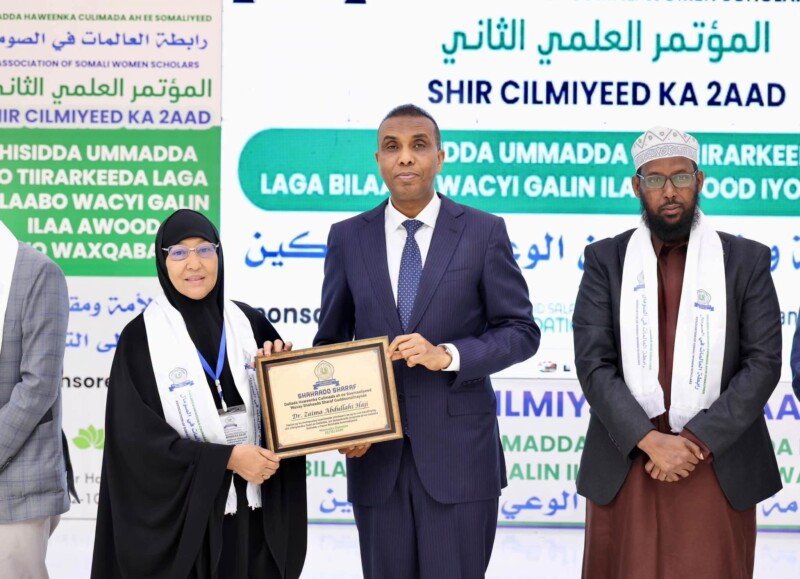
MOGADISHU, Prime Minister Hamza Abdi Barre attended the closing ceremony of the second annual conference of the Somali Women Islamic Scholars Assembly on Wednesday, praising the role of women in social awareness, capacity building, and national reconstruction.
The conference, held in Mogadishu, focused on community building and public awareness, with discussions centered on strengthening the moral and social fabric of Somali society. In his remarks, the Prime Minister described women as the “backbone” of the nation, emphasizing their contribution to rebuilding communities, education, and the upbringing of children.
Barre reflected on the damage caused by decades of conflict, stating that the collapse of the Somali state affected the country’s culture and religion, leaving citizens vulnerable to hardship and extremism. He specifically condemned the spread of “Khawarij” ideologies, using the term employed by the Somali government to describe Al-Shabaab’s militant doctrine, and the reckless shedding of blood that resulted from it.
“Somali women have served this country during difficult times,” the Prime Minister said. “They have played visible roles in building the statehood we have today, and they have produced leaders who have made significant contributions to the Somali nation. We commend Somali mothers who have stood firm during harsh circumstances.”
A Broader Push for Women’s Inclusion
The Prime Minister’s remarks align with the federal government’s broader efforts to promote women’s participation in public life, though progress remains uneven. The government has introduced a 30 percent quota for women in parliamentary seats, a provision that has increased female representation but still falls short of parity. As reported in FTL Somalia’s coverage of the Women’s Peace and Protection Joint Programme, the government and UN partners have launched a two-year initiative aimed at broadening women’s involvement in leadership and decision-making processes, with a focus on reaching up to 42,000 people across the country.
However, the implementation of the quota has faced persistent challenges. In the South West State parliamentary elections, women secured only 16 of 92 seats, approximately 17 percent, falling well below the mandated 30 percent threshold, as reported in FTL Somalia’s coverage of the quota shortfall. This gap between legal commitment and electoral outcome has been a recurring issue across federal member states.
Women’s organizations and international partners have also pushed for greater inclusion in peacebuilding and governance. The Deputy Prime Minister has engaged with UN Women on strengthening collaboration to promote women’s leadership, as reported in FTL Somalia’s coverage of the meeting. The government has also launched a landmark scholarship program for women pursuing Master’s degrees, as reported in FTL Somalia’s coverage of the initiative.
The Islamic Scholars Assembly represents a distinct avenue for women’s leadership, one rooted in religious authority and moral persuasion rather than formal political office. Female scholars in Somalia have historically played significant roles in education, dispute resolution, and community guidance, though their public visibility has often been constrained by cultural norms.
Barre concluded by urging the women scholars to take a major role in state-building, improving cultural practices, and strengthening community faith. He pledged that the DanQaran government would play a visible role in supporting the development of female scholars into leaders.
Critical Note
Prime Minister Barre’s attendance at the Women’s Islamic Scholars Assembly is a welcome signal of high-level recognition for a constituency that is often overlooked in Somali political discourse. His language, describing women as the “backbone” of society and acknowledging their contributions during the hardest years of the conflict, is more than rhetorical courtesy. It is an acknowledgment that the state’s rebuilding project has depended on the labor and leadership of women whose contributions are rarely recognized in formal political structures.
But the government’s record on translating this rhetoric into policy is mixed. The 30 percent quota remains a ceiling rather than a floor, and the South West State election results demonstrate that legal provisions alone are insufficient without enforcement mechanisms. Women’s participation in regional administrations and security institutions lags far behind their representation in parliament. The government has also faced criticism for the slow pace of implementing the National Action Plan on Women, Peace, and Security.
The Prime Minister’s specific reference to “Khawarij” ideology is consistent with the government’s security framing, but it also raises a question about the role of women scholars in countering extremism. Female religious leaders have unique access to households and communities that male clerics do not, and their potential contribution to preventing radicalization is significant. Whether the government is prepared to fund and support that role institutionally, rather than simply praising it at a closing ceremony, is the test of whether the Prime Minister’s words reflect a genuine policy shift or a timely political gesture.
Recommended Reading On ftlsomalia.com
- Somalia Launches New Women’s Peace Initiative
- Southwest Parliament Women’s Representation Below 30% Quota
- Deputy Prime Minister Meets UN Women Delegation to Boost Women’s Empowerment Efforts
- Somalia Launches Landmark Women’s Scholarship Program to Boost Higher Education
- Somalia Strengthens Security by Empowering Women in Armed Forces