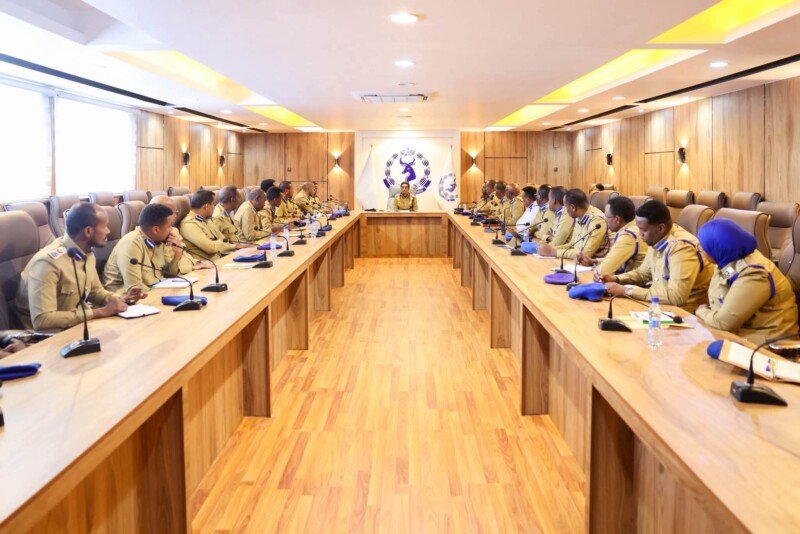
MOGADISHU — Somali Police Commissioner Brigadier General Asad Osman Abdullahi chaired the force’s weekly leadership meeting on Wednesday, bringing together senior commanders and representatives from various police departments, divisions and independent units to assess the country’s security situation, review piracy-related threats, and discuss budget planning.
The meeting was attended by Deputy Police Commissioner Brigadier General Osman Abdullahi Mohamed alongside other senior officers responsible for overseeing different branches of the police force. According to the Somali Police Force’s official channels, the discussions form part of the force’s regular efforts to assess security developments, coordinate operational priorities, and address administrative and financial matters affecting its work.
The meeting focused on three main areas: the overall security situation across Somalia, threats posed by pirate groups operating off the Somali coast, and financial priorities to support the force’s operations. Police leaders also examined preparations for the force’s budget, highlighting the importance of financial planning in supporting security operations and maintaining institutional capacity.
Piracy Resurgence Raises Concerns
The police leadership’s focus on piracy comes amid a documented resurgence of attacks off the Somali coast. According to the International Maritime Bureau’s nine-month report, Somali pirates were responsible for eight vessel hijackings from January to September 2026 and accounted for 94 percent of all crew members taken hostage globally.
“While incident levels are at their lowest in more than three decades, the recent uptick in Somali piracy activity is a reminder that the threat remains,” IMB Director Michael Howlett said. “Continued vigilance is essential to safeguarding seafarers and the vital trade routes on which the global economy depends.”
The security situation on the coast has been compounded by regional instability. Puntland’s maritime police force liberated the oil tanker Sibu 1 in late September after it was hijacked in August, in an operation that lasted 48 hours. One pirate was killed, four were injured, and 15 others were detained. However, three other hijacked vessels — the Honour 25, MT Eureka, and MT Asana — remained in pirate custody, having been moved south toward the coastal town of Hobyo.
Diplomatic and naval sources attribute the resurgence to a combination of factors, including instability on land, the presence of Al-Shabaab providing safe havens for maritime criminal networks, and the diversion of international naval assets to the Red Sea to counter Houthi attacks. This has left patrol gaps in the Somali basin that pirates have exploited.
Institutional Reforms Underway
The weekly meeting reflects a broader effort by General Asad to institutionalise command and accountability within the Somali Police Force. Since assuming command in September 2024, he has established regular strategic meetings bringing together directorates, regional divisions, and independent commands to assess security conditions, review performance, and issue operational directives.
As reported in FTL Somalia’s coverage of the Police Chief’s engagement with international partners, General Asad has prioritised cooperation with foreign counterparts to strengthen the force’s capacity. According to an assessment published in September 2026, the Police Commissioner has placed particular emphasis on command discipline, regular operational reviews, officer training, institutional modernisation, community policing, and cooperation with international law-enforcement partners.
International support for these reforms has continued. In early 2026, EUCAP Somalia handed over substantial equipment to the Somali Police Force, including utility vehicles, ambulances, protective equipment, and other operational supplies. The Police Commissioner personally signed the donation agreement with EUCAP Somalia’s Head of Mission.
Cooperation with UNDP has also included institutional reform, training, infrastructure development, and work on a secure electronic identification system for police officers — a measure intended to strengthen payroll integrity, command accountability, and prevent unauthorised individuals from presenting themselves as police.
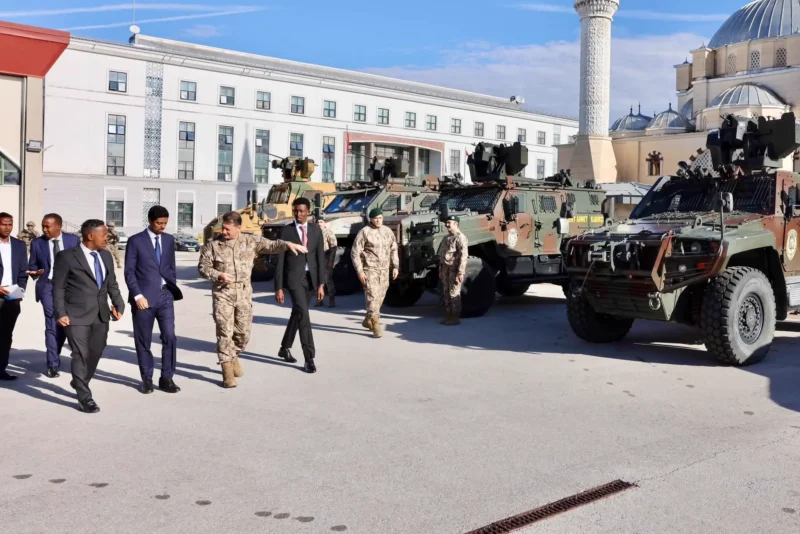
In May 2026, General Asad met with a high-level Turkish delegation in Mogadishu to discuss enhancing bilateral cooperation in the security sector, with particular emphasis on advancing training programs and building the capacity of the Somali Police Force, especially the elite Haramcad unit.
The force has also invested in developing its future leadership. As detailed in FTL Somalia’s coverage of the leadership training programme, the Somali Police Force has launched a leadership training admission exam for future commanders, a measure intended to professionalise the officer corps and strengthen the chain of command. Elite units have also received advanced training, as reported in FTL Somalia’s coverage of the Darawiish commandos’ training.
Critical Note
The Somali Police Force’s weekly leadership meeting is a routine command function, but the agenda reflects the extraordinary pressures facing the institution. Piracy has returned to levels not seen in a decade, and the police force is being asked to respond to a maritime threat that traditionally falls outside its core mandate of domestic law enforcement.
The meeting’s focus on budget planning is particularly significant. The police force continues to operate under severe resource constraints, and international support, while valuable, has declined alongside broader humanitarian funding cuts. The force’s ability to respond to the piracy surge, maintain public order, and continue its institutional reforms depends heavily on whether it can secure predictable financing.
General Asad’s emphasis on institutionalising command through regular meetings, performance reviews, and accountability mechanisms represents a notable shift from the emergency-driven approach that has characterised Somali security institutions for decades. Whether these reforms can be sustained amid the current security pressures, piracy, Al-Shabaab, political instability, and the looming El Niño floods, remains uncertain. But the weekly meeting itself is evidence that the force is attempting to build routine and predictability into its operations.