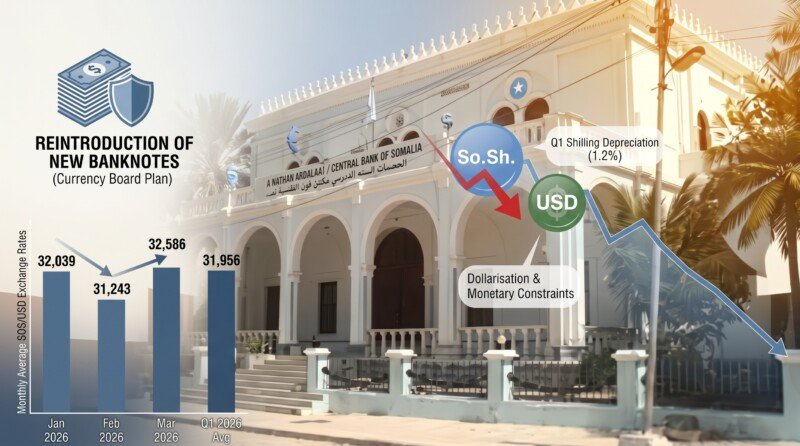
MOGADISHU — The Somali shilling depreciated by 1.2 percent against the US dollar during the first quarter of 2026, with the average exchange rate reaching SOS 31,956 per US dollar, according to the Central Bank of Somalia’s Quarterly Economic Review.
The depreciation continues a pattern of gradual weakening observed over recent years. The relative stability of the nominal exchange rate reflects the high degree of dollarisation in the domestic economy, where a substantial share of transactions is conducted in US dollars rather than the local currency.
Monthly Movements
| Month | Average Rate (SOS/USD) |
|---|---|
| January 2026 | 32,039 |
| February 2026 | 31,243 |
| March 2026 | 32,586 |
| Q1 2026 Average | 31,956 |
Source: Central Bank of Somalia, Quarterly Economic Review 2026 Q1
The shilling fluctuated against the dollar over the quarter, strengthening in February to SOS 31,243 before weakening to SOS 32,586 in March. The February appreciation was unusual in the context of the longer-term trend, which has been consistently toward depreciation.
Longer-Term Depreciation Trend
The quarterly figures are consistent with a longer trajectory of gradual shilling weakness. In January 2025, the average exchange rate stood at approximately SOS 29,023 per US dollar. By December 2025, it had reached SOS 32,043. That represents a depreciation of approximately 10.4 percent over the course of the year.
The first quarter of 2026 maintained that trajectory. The average rate of SOS 31,956 in Q1 2026 is slightly stronger than the December 2025 level of SOS 32,043, but the quarter ended with the shilling at its weakest point of the year so far, reaching SOS 32,586 in March.
As reported in FTL Somalia’s coverage of the shilling’s depreciation, traders in Baidoa have raised concerns about the weakening currency, noting that the depreciation affects import costs and consumer prices for essential goods.
Dollarisation and Monetary Policy Constraints
The Central Bank’s analysis attributes the relative stability of the nominal exchange rate to the high degree of dollarisation in the economy. Because a large share of transactions is conducted in US dollars, demand for shillings is less sensitive to changes in economic conditions than it would be in a more fully localised currency environment.
This dollarisation creates a paradox for monetary policy. It limits the Central Bank’s ability to influence domestic liquidity conditions through interest rate adjustments, because borrowers and savers are less responsive to changes in shilling-denominated rates. It also means that exchange rate movements have a more direct impact on household purchasing power than they would in a less dollarised economy, since shilling depreciation raises the local-currency cost of imported goods.
The Central Bank is preparing to reintroduce new Somali shilling banknotes under a currency board arrangement, as reported in FTL Somalia’s coverage of the currency reform. A currency board would tie the supply of new shillings to foreign exchange reserves, potentially imposing greater discipline on monetary policy but also limiting the Central Bank’s room to respond to domestic economic shocks.
Critical Note
The 1.2 percent depreciation in the first quarter is modest by the standards of Somalia’s recent history, but it is part of a longer trend that has seen the shilling lose more than 10 percent of its value against the dollar over the past year. That gradual weakening has consequences that are not immediately visible in the headline figures.
For households, shilling depreciation raises the cost of imported food and fuel, both of which Somalia relies on heavily. The country imports approximately 90 percent of what it consumes, and most of that trade is conducted in dollars. When the shilling weakens, the local-currency cost of those imports rises, feeding through to consumer prices. The same dynamic affects businesses that rely on imported inputs.
The Central Bank’s proposed currency board could change this dynamic, but not necessarily in the way its advocates expect. A currency board would impose strict limits on money supply growth, which could help stabilise the exchange rate and anchor inflation expectations. But it would also remove the Central Bank’s ability to act as a lender of last resort or to respond to liquidity shocks. In an economy as fragile as Somalia’s, with a banking sector that remains shallow and a private sector that relies heavily on dollar cash transactions, the transition to a currency board carries significant risks.
The deeper issue is that Somalia’s monetary system reflects a broader reality: the country’s economy is not fully monetised. A large share of transactions takes place outside the formal banking system and in US dollars. Until that changes, the Central Bank’s influence over exchange rate and monetary conditions will remain limited, and the shilling’s gradual depreciation is likely to continue.