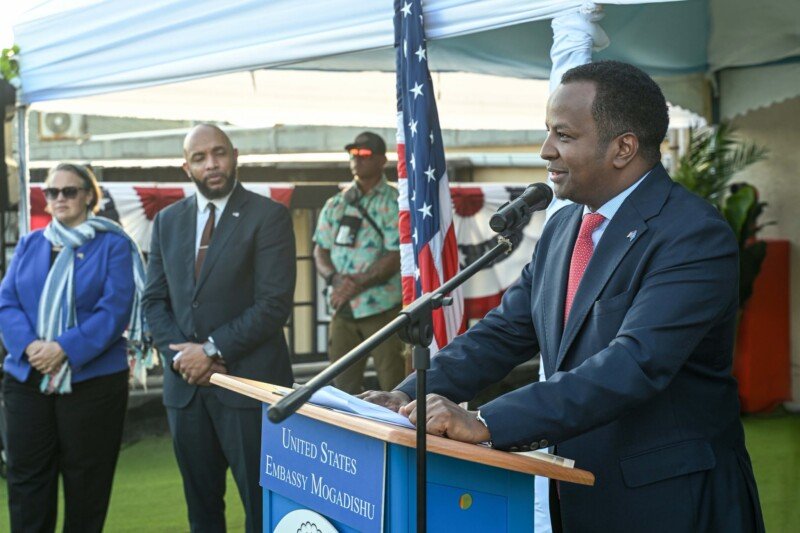
MOGADISHU — The Minister of Foreign Affairs and International Cooperation, Abdisalam Ali, attended a farewell ceremony honoring the outgoing Chargé d’Affaires of the United States Embassy in Somalia, Justin Davis, and welcomed his successor, Ruth Anne Stevens-Klitz.
Minister Abdisalam expressed gratitude to Mr. Davis for his work and efforts in strengthening relations between Somalia and the United States, and wished him success in his new assignment. The Minister also welcomed Ms. Stevens-Klitz to her new role.
The Minister reaffirmed the Somali government’s commitment to further strengthening the strategic partnership with the United States, particularly in the areas of security, counterterrorism, and economic cooperation.
A Partnership Under Strain
The diplomatic transition comes as the United States has reaffirmed its support for Somali forces, with AFRICOM Commander General Dagvin Anderson meeting Somali Army Chief Brigadier General Sahal Abdullahi Omar in Mogadishu in July 2026 to discuss strengthening counter-terrorism cooperation and accelerating coordination between Somali forces and their American counterparts.
President Hassan Sheikh Mohamud has also met with AFRICOM leadership to bolster U.S.-Somalia security cooperation, reaffirming the longstanding security partnership and discussing joint counter-terrorism initiatives.
The relationship, however, has faced significant challenges. The United States has contributed nearly $2 billion to the UN support mission in Somalia but has grown increasingly frustrated with what it views as insufficient progress by Somali leaders in assuming responsibility for their own security. Washington has notified the African Union that it will no longer finance the UN Support Office in Somalia (UNSOS) beyond December 2026, a decision that threatens to pull the logistical rug from under the 12,000-strong African Union Support and Stabilization Mission in Somalia (AUSSOM).
AFRICOM Commander General Dagvin Anderson has acknowledged that American airstrikes in Somalia have killed civilians in the past, while insisting that the military takes extensive precautions to avoid civilian casualties and investigates credible allegations of harm.
The United States has also announced a significant transformation in its approach to Somalia, departing from prolonged military involvement and aid dependency in favor of a collaborative framework emphasizing economic investment, regional stability, and respect for sovereignty, according to its 2025 National Security Strategy.
The U.S. has previously engaged with Puntland and Somaliland as “administrations within Somalia,” a formulation that allows military-to-military engagement outside formal State Department channels. AFRICOM Commander General Dagvin Anderson completed an unprecedented high-level visit to Somaliland and Puntland, labeling them “administrations within Somalia” and offering them military diplomatic engagement unavailable via formal U.S. State Department routes.
Critical Note
The transition in U.S. diplomatic leadership in Mogadishu comes at a pivotal moment for bilateral relations. The relationship has deepened significantly in recent years, particularly in the security domain, but it also faces challenges from political tensions within Somalia and the complexities of U.S. engagement with regional administrations.
Ms. Stevens-Klitz assumes her role at a time when Somalia’s diplomatic landscape is shifting. The country is navigating a complex web of partnerships, including with Turkey, which has its own substantial military presence in Mogadishu, and with the United States, which has taken a more direct role in counterterrorism operations.
The U.S. decision to end funding for UNSOS beyond December 2026 represents a significant challenge for Somalia’s security architecture. Without UNSOS, AUSSOM would lose critical logistical support, including food, water, fuel, transportation, medical services and casualty evacuation. For Somalia, maintaining a strong and balanced relationship with Washington is critical, particularly as the country seeks continued support for its security sector reform and counterterrorism efforts. The challenge will be to ensure that U.S. support is aligned with Somali priorities and that the relationship remains grounded in mutual respect for Somalia’s sovereignty and territorial integrity.
Recommended Reading On ftlsomalia.com
- US Reaffirms Support for Somali Forces as Army Chief and AFRICOM General Hold Talks
- President Mohamud Meets AFRICOM Commander to Bolster U.S.-Somalia Security Cooperation
- General Anderson: U.S. Takes Extensive Precautions to Avoid Civilian Harm
- US Prioritizes Investment Over Traditional Aid in Somalia