MOGADISHU — A member of the Central Bank of Somalia’s Board of Directors has said that the design of the country’s new currency will be kept secret for security reasons, to prevent counterfeiters from copying the new banknotes, and that the existing digital payment system will be used for small transactions in Somali shillings rather than US dollars.
Professor Hussein Warsame, a board member of the Central Bank of Somalia, said in a video statement that the new Somali shilling is being produced but that the design will not be disclosed to the public. He said the decision to withhold the design is a security measure intended to prevent the notes from being copied.
Professor Warsame also said that any amount below a certain threshold will be processed using Somali shillings rather than US dollars, and that the existing digital payment system will be utilised to facilitate these transactions. He said this approach would help push back against inflation by reducing reliance on the dollar for everyday payments.
A Dual Currency System with a Digital Backbone
The approach outlined by Professor Warsame aligns with the Central Bank’s stated strategy of maintaining a dual currency regime alongside the US dollar while promoting the use of the Somali shilling for lower-value transactions.
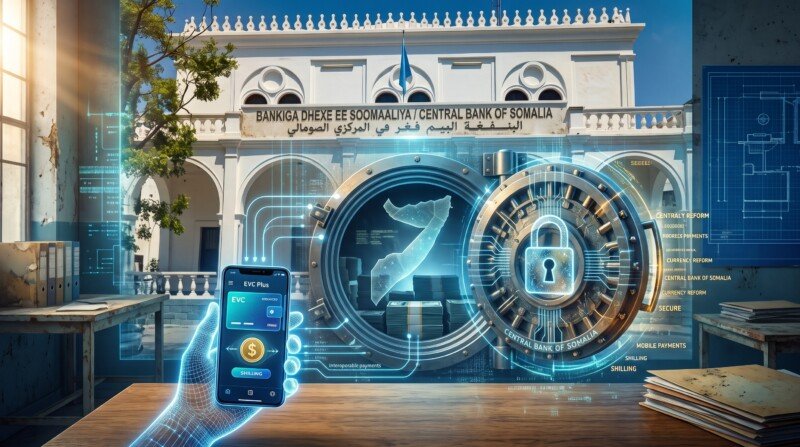
Somalia’s digital payment infrastructure has expanded significantly in recent years. The Somalia Instant Payment System, launched in January 2025, provides a real-time, interoperable platform for retail payments available 24 hours a day, seven days a week [citation:2]. Mobile money services such as EVC Plus have become ubiquitous, with over two-thirds of payments in Somalia already processed through digital platforms.
Under the Central Bank’s plans, the digital payment system would be used to process small transactions in Somali shillings once the new currency is introduced. This would reduce the need for physical dollar notes in everyday commerce and create a channel for the shilling to circulate more widely.
Counterfeiting Concerns Drive Secrecy
The decision to keep the design confidential reflects the Central Bank’s concern about counterfeiting. Somalia’s currency system collapsed in 1991, and in the decades that followed, counterfeit notes flooded the market. The International Monetary Fund estimates that approximately 98 percent of the currency circulating in Somalia was counterfeit.
The World Bank’s Somalia Currency Exchange Project, which supports the issuance of new banknotes, states that the new series will have “much improved security features” compared to the series from 1983-1990. The project documents note that the new notes will be “difficult and time-consuming to copy by both traditional and computer-based printing methods.”
The Central Bank has completed the currency specifications, including size and security features, but has not publicly released the design. As detailed in FTL Somalia’s coverage of the currency reform, the Central Bank has made “issuing a viable national currency and strengthening monetary policy tools” one of its strategic priorities.
Currency Reform Progress
The reintroduction of the Somali shilling is a national priority. As reported in FTL Somalia’s coverage of the currency reform, the IMF has urged Somalia to exercise extreme due diligence on the reform, emphasizing that introducing new banknotes alone will not restore confidence. The credibility of the reform will depend on the independence and capacity of the Central Bank, adequate foreign-exchange reserves, and strict limits on monetary financing of government spending [citation:7].
The Central Bank’s broader financial sector reforms have advanced alongside the currency preparations. As detailed in FTL Somalia’s coverage of banking sector development, the Central Bank has authorized 15 commercial banks to operate in the country, comprising 14 domestic institutions and one foreign bank.
The National Payment System has also expanded significantly. As reported in FTL Somalia’s coverage of the payment system, the system processed 337,788 transactions with a combined value of approximately US$592.9 million during the first quarter of 2026.
Critical Note
The decision to keep the design of the new Somali shilling secret is a departure from standard practice in most countries, where new currency designs are publicly unveiled before issuance. The rationale, preventing counterfeiters from preparing copies in advance, is understandable in Somalia’s context, where counterfeiting has been rampant for decades.
The plan to use the digital payment system for small transactions in Somali shillings represents a pragmatic approach to currency reform. By leveraging existing mobile money infrastructure, the Central Bank can promote the use of the shilling without requiring a complete overhaul of payment habits. The threshold-based approach, where small amounts are processed in shillings and larger amounts may continue in dollars, reflects the reality that dollarisation cannot be reversed overnight.
However, the secrecy also raises questions. Currency design is typically a matter of public interest, and citizens have a right to know what their money will look like. The Central Bank has not explained how it will educate the public about the new notes, how it will distinguish genuine notes from counterfeits, or how the exchange process will work if the design is not disclosed until the notes are distributed.
The security rationale is valid, but it must be balanced against the need for public confidence. Somalia’s currency reform will succeed only if citizens trust the new shilling. Trust requires transparency, clear communication, and a credible exchange process. Keeping the design secret may reduce the risk of counterfeiting, but it does not, by itself, build the public confidence that the reform needs.
Share your story. FTL Somalia is continuing to investigate Somalia’s currency reform and the Central Bank’s plans for the new shilling. If you have information or insights to share, contact us at info@ftlsomalia.com. Your identity will be protected.