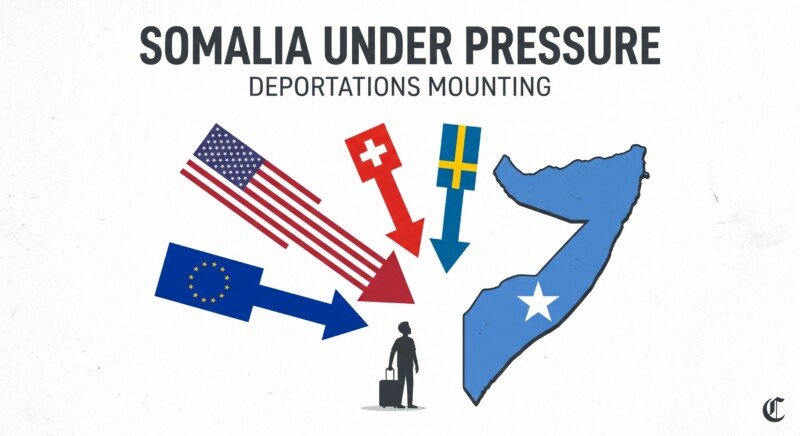
MOGADISHU — Somalia is facing mounting pressure from multiple directions as the United States and several European countries intensify deportation efforts targeting Somali nationals, creating a complex diplomatic and humanitarian challenge for a government already grappling with internal security and political crises.
The pressure comes from at least four distinct sources: the United States, which has terminated Temporary Protected Status and fast-tracked asylum cases; Switzerland, which has faced allegations of human rights violations in its deportation practices; Sweden, which has faced allegations of secret payments to facilitate returns; and the European Union, which has imposed visa restrictions on Somali citizens over what it describes as insufficient cooperation with readmission.
United States: TPS Termination and Fast-Tracked Deportations
The United States has become the most aggressive source of deportation pressure. In January 2026, the Department of Homeland Security terminated Temporary Protected Status for Somalia, a designation that had been in place since 1991, as reported in FTL Somalia’s coverage of the TPS termination.
More than 1,000 Somali asylum-seekers have been ordered deported since February, with more than half the deportation orders involving Somalis living in Minnesota. A federal judge allowed the TPS termination to proceed despite a lawsuit from Somali immigrants and advocacy groups, as reported in FTL Somalia’s coverage of the court decision.
Some Somalis ordered deported have been sent to Guantánamo Bay, Cuba, including Adam Abdullah, a 31-year-old mechanic from St. Paul who was held for nearly a month at the military detention facility before being flown to Mogadishu, as detailed in FTL Somalia’s coverage of the case. His account describes difficult conditions, including being placed in solitary confinement in an over-air-conditioned room after a hunger strike.
The administration has also pursued third-country deportations, sending Somalis to countries where they have no ties. As reported in FTL Somalia’s coverage of the third-country deportations, more than 25,000 people have been deported to countries where they have no ties since Trump returned to office, under secretive agreements with 35 nations.
Switzerland: Allegations of Human Rights Violations
Switzerland has faced scrutiny over its deportation practices targeting Somali nationals. The Swiss human rights organization Augenauf has condemned Switzerland’s plan to forcibly deport a seriously injured Somali citizen, describing the case as part of a broader pattern of human rights violations during forced deportations.
The man, a father of three children living in Europe who has been in Switzerland for 11 years, suffered multiple skull fractures, a traumatic brain injury, and injuries to his eyes after an alleged attack at an underground asylum accommodation. Two further operations scheduled for the week of September 7 were reportedly prevented by Swiss authorities, as detailed in FTL Somalia’s coverage of the Swiss case.
Augenauf said the Somali Immigration and Citizenship Agency issued the man a provisional travel document without considering his medical condition, and that the person pictured on the document does not resemble the individual concerned. The man’s lawyer has demanded that the deportation be suspended.
Augenauf described Switzerland’s approach to Somalia as a “carrot and stick” strategy, combining financial and technical support to Somalia’s immigration agency with tightened visa restrictions.
Sweden: Allegations of Secret Payments
Sweden has faced allegations that it authorized secret payments to Somalia’s government to speed up deportations. Swedish media investigations revealed that 100 million kronor, about $9 million, in aid was redirected to a fund with close ties to the Somali Prime Minister’s Office, prompting allegations of corruption and concerns about the use of development assistance as leverage in migration policy, as reported in FTL Somalia’s coverage of the Swedish payments.
The Somali government has repeatedly denied any secret agreement with Sweden. In a statement from the Office of the Prime Minister, the government said claims of an undisclosed deal involving financial support in exchange for the return of Somali citizens are false, as reported in FTL Somalia’s coverage of the government’s denial.
Sweden’s policy of conditioning development assistance on deportations has been widely criticized. A Somali father of six children living in Sweden has appealed to President Hassan Sheikh Mohamud for help as he faces deportation, alleging that three individuals from the Office of the Prime Minister are involved in his forced removal, as detailed in FTL Somalia’s coverage of the case.
EU: Visa Restrictions Over Readmission Cooperation
The European Union has imposed temporary visa restrictions on Somali citizens, citing insufficient cooperation on readmission of Somali nationals residing illegally in the EU. The Council decision, adopted on June 25, 2026, means member states can no longer issue multiple-entry visas to Somali citizens, waive documentation requirements, or exempt holders of diplomatic and service passports from visa fees. The standard processing period for visa applications has been extended from 15 to 45 calendar days, as reported in FTL Somalia’s coverage of the EU visa measures.
The decision is temporary but has no specific end date. Its stated objective is to encourage Somalia to improve cooperation on readmission, with the European Commission continuing to assess progress.
Somalia’s Resistance and Diplomatic Constraints
President Hassan Sheikh Mohamud has clarified that the government is not opposed to repatriating its citizens, but insists on proper procedures to confirm the nationality of those being returned, as detailed in FTL Somalia’s coverage of the President’s position.
“I want to tell the European Union and the Somali people: we have not refused our people. Our people belong to this country, and we cannot reject them,” the President said. He stated that the government has questions about how individuals are being returned, particularly when their Somali nationality has not been clearly verified.
The United States government is simultaneously telling immigration courts that Somalia is safe enough for returns while the State Department maintains a “do not travel” advisory and prohibits its own employees from leaving the Mogadishu airport compound without armed escort.
Critical Note
Somalia is being squeezed between its international obligations and its domestic realities. The government cannot safely absorb large numbers of returnees into a country still grappling with Al-Shabaab attacks, drought, displacement, and political instability. Yet its refusal to cooperate with readmission has triggered punitive measures from the EU and strained relations with key partners.
The United States and European countries have legitimate interests in enforcing their immigration laws. But the methods being used, including fast-tracked hearings, third-country deportations to nations where deportees have no ties, and the use of military detention facilities like Guantánamo Bay, raise serious legal and ethical questions. The contradiction between the US government’s assertion that Somalia is safe and the State Department’s “do not travel” advisory is not a technicality. It is a question of whether governments are providing honest assessments of the risks returnees face.
For Somalia, the challenge is to manage these pressures without becoming a dumping ground for deportees from multiple countries. The government needs to engage diplomatically with the US, Switzerland, Sweden, and the EU to establish clear, humane, and legally sound frameworks for returns. That requires not only resisting pressure but also presenting credible alternatives that address the concerns of partner countries while protecting the rights and safety of Somali nationals abroad.
The long-term implications for Somalia’s stability are significant. The arrival of hundreds of returnees with no connections, housing, or livelihoods will add further strain to a country already struggling. The deportation policies pursued by the US and European countries are not just domestic matters. They have consequences for Somalia’s stability that these governments have shown little interest in considering.
Recommended Reading On ftlsomalia.com
- From Minnesota to Guantánamo: The Deportation of Adam Abdullah
- US Judge Allows End TPS for 1,100 Somali Nationals, Risking Deportations
- Swiss Authorities Accused of Human Rights Violations in Deportation of Somali Nationals
- Sweden Faces Backlash Over Secret $517,000 Payment to Somalia for Deportations
- EU Considers Stricter Visa Measures for Somali Citizens Over Repatriation Cooperation Concerns
- President Hassan Sheikh Defends Somalia’s Position on EU Visa Restrictions, Cites Identity Verification Concerns