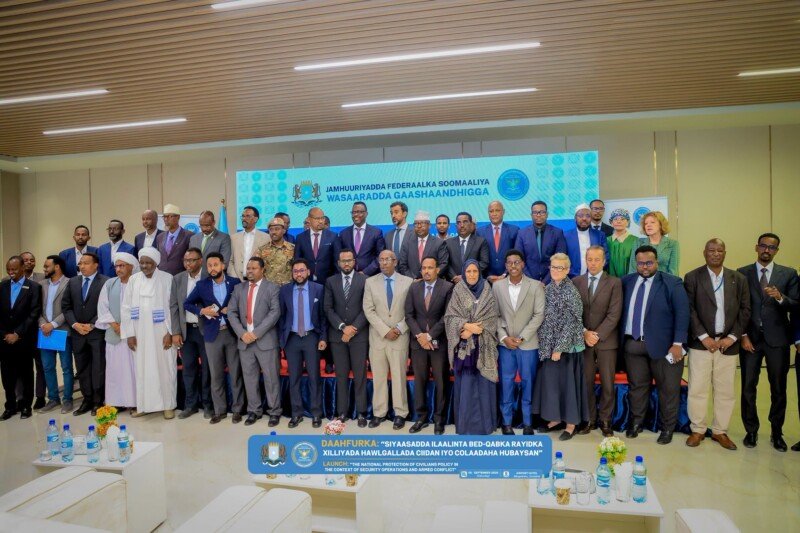
MOGADISHU — The Federal Government of Somalia has officially launched the National Policy on the Protection of Civilians during Military Operations and Armed Conflict, a landmark framework aimed at ensuring that civilian safety and rights are prioritized in the conduct of hostilities.
The policy was launched by Defence Minister Ahmed Moallim Fiqi during a ceremony attended by officials from the Federal Government and Federal Member States, diplomats, representatives of relevant institutions, and other distinguished guests.
Addressing the ceremony, Minister Fiqi said the Federal Government was reaffirming that the protection of civilians is both a national and constitutional obligation, adding that it is essential to building a professional, disciplined, and accountable national armed force committed to safeguarding the lives, dignity, and rights of Somali citizens.
A Framework for Accountability
Minister Fiqi described the launch of the policy as an important step towards strengthening state institutions, upholding the rule of law, and securing lasting peace and security for the Somali people. He reaffirmed the Federal Government’s commitment to protecting civilians and safeguarding their rights during military operations and armed conflict.
The policy comes amid ongoing military operations against Al-Shabaab, which have at times been marred by allegations of civilian casualties and human rights violations. Human rights organizations have documented cases of civilians being killed or injured in airstrikes and ground offensives, as well as reports of extrajudicial killings, arbitrary detention, and torture by security forces.
The policy also coincides with ongoing political tensions and armed confrontations between federal forces and regional administrations, including recent clashes in Baidoa that resulted in dozens of civilian casualties.
International Standards and Obligations
The policy aligns with Somalia’s obligations under international humanitarian law and human rights law, including the Geneva Conventions and their Additional Protocols. It also responds to repeated calls from the African Union, United Nations, and other international partners for Somalia to strengthen its protection of civilians in conflict zones.
The development of the policy follows a series of capacity-building initiatives by the African Union Support and Stabilization Mission in Somalia (AUSSOM), which has trained thousands of Somali soldiers on international humanitarian law and the protection of civilians. The African Union mission has also supported the integration of these principles into Somali military doctrine and Standard Operating Procedures.
Speaking at the launch ceremony, the head of the ICRC delegation in Somalia stressed the importance of the policy in mitigating the human cost of conflict and called for its translation into concrete operational guidelines for Somali forces.
Critical Note
The launch of the National Policy on the Protection of Civilians represents a significant step forward in Somalia’s efforts to professionalize its armed forces and align its military operations with international standards. The policy sends a clear signal that the Federal Government recognizes the importance of protecting civilians in conflict, a recognition that has been lacking in many past operations.
However, the success of the policy will depend on implementation and enforcement. A policy on paper is meaningless without the training, resources, and political will to ensure compliance at all levels of the military chain of command. The Federal Government must ensure that the policy is translated into clear operational guidelines, that soldiers are trained on its provisions, and that violations are investigated and punished.
Moreover, the policy’s effectiveness will be measured by its impact on the ground, particularly in ongoing military operations where civilian casualties have been reported. The Federal Government must also hold security forces accountable when they violate the policy. Without genuine accountability, the policy risks becoming a public relations exercise rather than a meaningful protection mechanism for Somalia’s civilians.