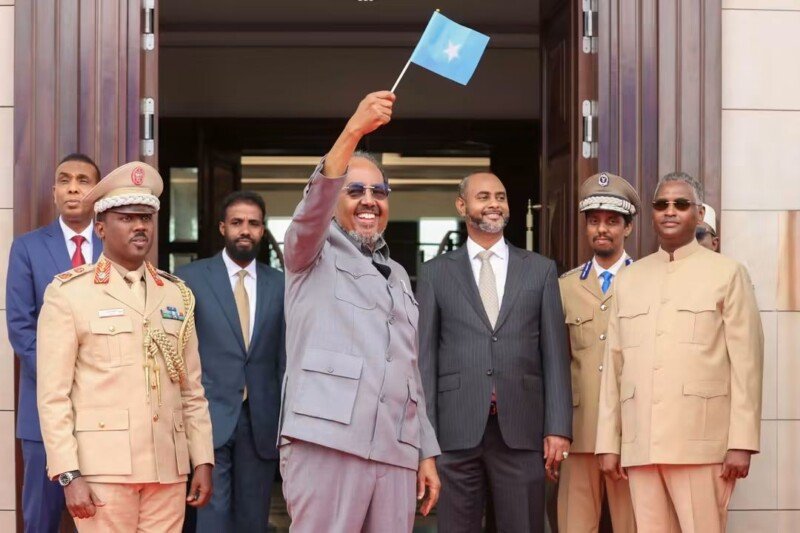
MOGADISHU — President Hassan Sheikh Mohamud attended a high-level national ceremony on Monday marking Somali Flag Day, a commemoration that symbolizes the nation’s independence, unity and the enduring existence of the Somali people.
The event, held at the Presidential Palace, was attended by units from the Somali National Army’s Land, Air and Naval forces, who demonstrated their commitment to defending the flag, national sovereignty, independence and the existence of the Somali people.
A Symbol of Unity and Freedom
President Hassan Sheikh highlighted the historical significance of 12 October and the role of the Somali flag in the honour and dignity of the Somali people. He said the flag is a symbol that reflects the unity of the people, the aspirations for freedom and the sacrifices of Somali fighters who struggled for independence.
Somali Flag Day, observed annually on 12 October, marks the day in 1954 when the flag of the Somali Republic was first raised in Mogadishu, then under Italian trusteeship. The distinctive light blue field with a white five-pointed star in the centre was designed to represent the five regions where ethnic Somalis live: Italian Somaliland, British Somaliland, French Somaliland (Djibouti), the Ogaden region of Ethiopia, and the Northern Frontier District of Kenya.
High-Level Attendance
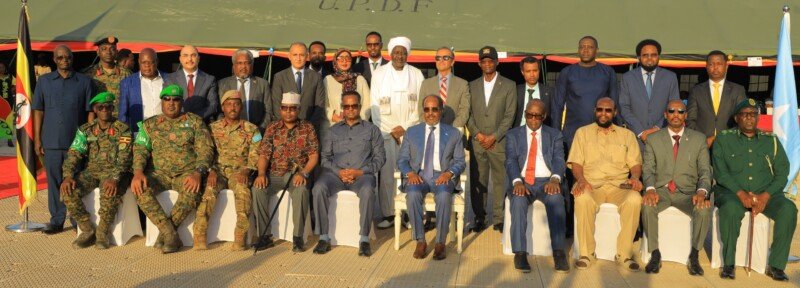
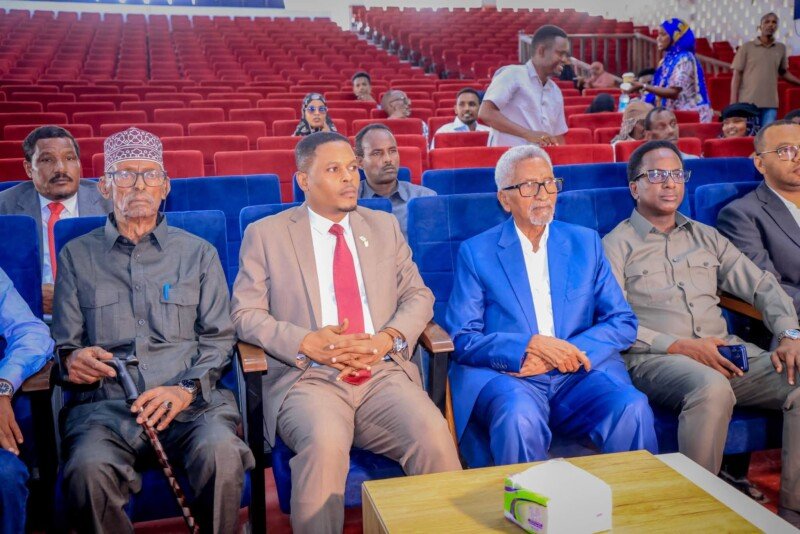
The ceremony was attended by Speaker of the House of the People Abdulkadir Mohamed Nur Jama, the First Deputy Speaker of the Upper House, Prime Minister Hamza Abdi Barre, the Chief Justice of the Supreme Court, and commanders of the Somali National Armed Forces.
The participation of senior leadership from all three branches of government and the military underscores the symbolic importance of the occasion in Somalia’s political calendar.
Critical Note
Flag Day in Somalia is more than a ceremonial occasion. It commemorates a symbol designed to represent a nation that, at the time of its creation, did not yet exist as a unified state. The five-pointed star represented the aspiration for unity among Somali-inhabited territories, an aspiration that has shaped Somalia’s politics, foreign policy and regional relations for decades.
Today, that symbolism carries complex meanings. Somaliland, which declared independence in 1991, uses the same flag but with different political connotations. The Ogaden region remains part of Ethiopia. Djibouti is an independent state. And the Northern Frontier District is part of Kenya. The vision of a unified Somali nation, enshrined in the flag, remains unfulfilled.
The ceremony at Villa Somalia brought together the leadership of the federal government and the military. But the event also highlights the gap between symbolic unity and political reality. Somalia remains divided among federal member states, with ongoing disputes over the constitution, elections and the distribution of power and resources. Al-Shabaab controls significant territory in the south and centre. And the question of Somaliland’s status remains unresolved.
Flag Day is an occasion to remember the sacrifices made for independence. It is also a reminder of what remains to be done. The flag represents a nation that is still being built, and the challenges of that project are as real today as they were in 1954.