MOGADISHU — Somalia’s federal government and the North Eastern State administration have issued directives banning passengers from carrying weapons on flights between Mogadishu and Laascaanood, following a security incident linked to the return of North Eastern State President Abdikhadir Ahmed Ali (Firdhiye) to Laascaanood on Sunday.
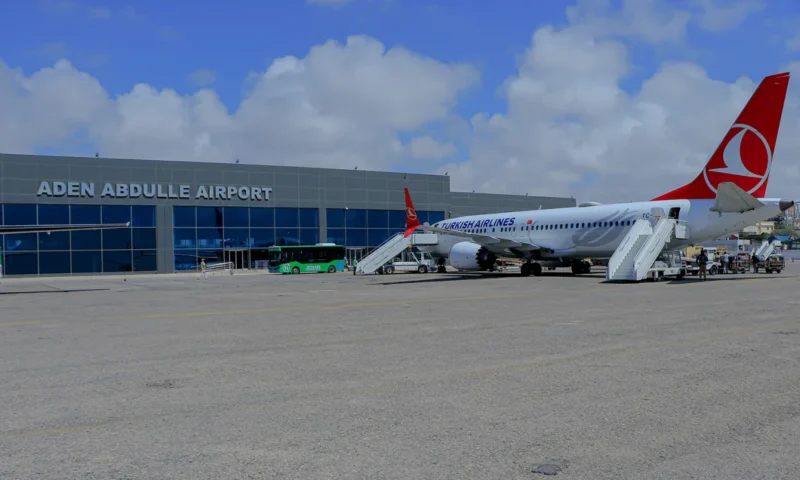
According to reports circulating on social media, armed individuals suspected of involvement in the incident attempted to board the aircraft that was carrying President Firdhiye. The incident reportedly occurred at Aden Adde International Airport in Mogadishu and prompted federal and regional authorities to tighten security procedures on the route.
Dual Directives from Mogadishu and Laascaanood
The Office of the Director General of the North Eastern State Ministry of Security issued a letter dated October 4, 2026, addressed to aviation companies operating in the region. The directive states that all aviation companies operating flights to and from North Eastern State airports are prohibited from transporting anyone carrying weapons, unless they have prior authorization from the Ministry of Security.
The letter further stipulates that the person carrying the weapon must be legally authorized and must inform the Ministry of Security at least three days before travel, while also presenting official documents proving such authorization.
A separate directive from the Office of the Director General of Aden Adde International Airport, dated October 8, 2026, was addressed to the Chairperson of the Reflector Hotel, which serves as the terminal for Daalo Airlines and other carriers operating on the Laascaanood route. The airport authority instructed the hotel management to implement four specific measures: display a visible notice at the entrance within 10 days prohibiting anyone other than authorized personnel from entering with weapons; ensure that any authorized person with a weapon has prior authorization from the relevant authority; cooperate fully with airport security personnel; and ensure that no weapons are brought into the terminal under any circumstances.
The airport directive warned that the hotel’s operating license would be revoked if the instructions were not implemented within 10 days.
Context of the Laascaanood Route
The Laascaanood-Mogadishu air route is a critical link for the North Eastern State, connecting its capital to the federal capital. The route has become increasingly important since the establishment of the North Eastern State as Somalia’s sixth federal member state, a process formally recognised with the inauguration of President Firdhiye in January 2026, which President Hassan Sheikh Mohamud attended.
The North Eastern State’s formation has been contested by both Somaliland and Puntland, which claim the Sool, Sanaag, and Cayn regions. The administration has relied on federal support to consolidate its authority, and air travel between Mogadishu and Laascaanood has become a key logistical and political channel.
The security incident on Sunday underscores the fragility of these arrangements. The presence of armed individuals attempting to board a presidential flight raises questions about screening procedures at both ends of the route and about the coordination between federal airport authorities and regional security officials.
Critical Note
The dual directives from the North Eastern State Ministry of Security and the Aden Adde airport authority are a reactive measure to a specific security breach. They address the immediate problem by imposing new rules on weapons carriage and terminal access. But the underlying questions remain unanswered.
How did armed individuals come close enough to attempt boarding a flight carrying a sitting regional president at Somalia’s main international airport? Who were they, and what was their intent? Neither federal nor regional authorities have provided details on the incident beyond the existence of the new directives. The lack of transparency leaves room for speculation and does not build confidence in the systems meant to protect senior officials and ordinary travelers alike.
The new rules also raise practical questions. The North Eastern State directive requires three days’ advance notice and official authorization for anyone traveling with a weapon. The Aden Adde directive bars weapons from the terminal entirely. These two requirements could conflict if a federal official authorized to carry a weapon seeks to travel to Laascaanood through the Reflector terminal. Coordination mechanisms between the two authorities are not specified in either document.
For the North Eastern State, which depends on air links to Mogadishu for political and administrative connectivity, the incident and its aftermath highlight the vulnerabilities that come with contested authority and incomplete control over security infrastructure. The directives may close the immediate gap, but they do not resolve the underlying contest over who controls security at airports serving the region.
Recommended Reading On ftlsomalia.com
- North Eastern State Security Minister Engages U.S. AFRICOM on Counterterrorism Efforts
- Somali President to Visit Lasanod, Risking Somaliland Tensions
- Deadly Sanaag Clan Conflict Exposes Fragility of Peace in Northeastern Somalia
- Somaliland Welcomes Defection of North Eastern State MP Who Once Fought Against Hargeisa