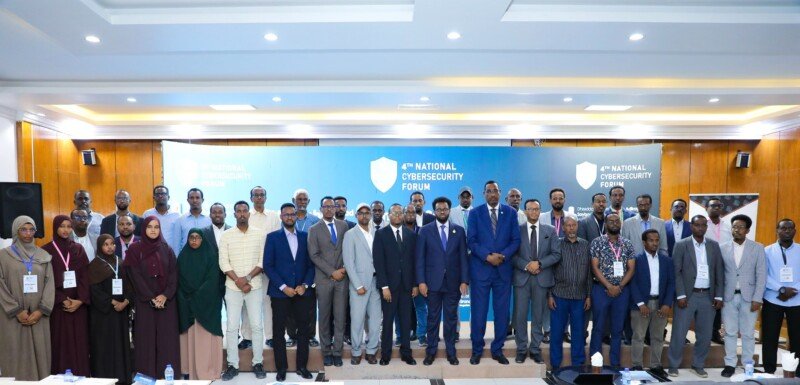
MOGADISHU, The fourth National Cybersecurity Forum opened in Mogadishu on Tuesday, bringing together the National Communications Authority, Mogadishu University, and a broad coalition of government officials, telecommunications companies, banks, universities, and cybersecurity experts to address Somalia’s growing digital vulnerabilities.
The two-day forum, held under the theme “Building Trust and Cyber Resilience Through Security by Design,” aims to strengthen the country’s capacity to prevent cyber threats, protect digital infrastructure, and promote cooperation between the public and private sectors.
Communications and Technology Minister Mohamed Adan Mo’allin, who officially opened the forum, commended the NCA and Mogadishu University for organizing the event for the fourth consecutive year. He highlighted the launch of the Somali Computer Incident Response Team (SOMCIRT) in March 2026 and announced plans to launch a National Cybersecurity Academy later this year.
Institutional Progress and Persistent Gaps
NCA Director General Mustafa Yasin Sheikh outlined the authority’s achievements, including the establishment of SOMCIRT, capacity-building programs for government officials, and public awareness initiatives. He described these as “an important foundation for strengthening cybersecurity in Somalia.”
SOMCIRT, inaugurated on March 7, operates as Somalia’s first national center dedicated to coordinating the prevention, detection, and response to cyber incidents. It is responsible for receiving incident reports, issuing alerts, and coordinating responses to threats affecting government institutions and critical infrastructure. The NCA has also completed its first cybersecurity certification program, training IT professionals from 21 public institutions in internationally recognized standards.
The forum’s emphasis on “security by design,” integrating protections into digital systems from the outset rather than after vulnerabilities are exploited, reflects a maturing approach to cybersecurity governance. As reported in FTL Somalia’s coverage of the national cybersecurity framework consultation, the NCA has been developing a comprehensive risk management and compliance framework since April 2026, bringing together government agencies, private sector representatives, and technical experts.
The E-Visa Breach and Its Lessons
The forum’s focus on security is not abstract. Somalia’s digital infrastructure has already suffered significant breaches. In late 2025, the country’s electronic visa website was found to lack adequate security measures, potentially enabling malicious actors to download thousands of e-visas containing sensitive personal information. The US and UK governments issued warnings about a data breach that exposed information on more than 35,000 individuals.
Federal authorities initially denied the breach, then acknowledged it. The incident exposed the gap between Somalia’s digital ambitions and its security capacity, and it underscored the need for the kind of institutional framework the NCA is now building.
Somalia’s digital economy has expanded rapidly, largely through private sector initiative. Mobile money services like EVC Plus are ubiquitous, and the national payment system processed 337,788 transactions worth $593 million in the first quarter of 2026 alone, as reported in FTL Somalia’s coverage of the payment system. That growth has made cybersecurity a precondition for economic stability, not a luxury.
AI and the Next Frontier of Digital Risk
The forum’s agenda includes discussions on emerging cyber threats, and the NCA’s engagement with artificial intelligence is expanding. Mogadishu University President Dr. Ibrahim Mohamed Mursal highlighted the university’s establishment of a new Department of Cybersecurity and Artificial Intelligence, describing it as part of efforts to develop Somalia’s digital knowledge and skills.
Somalia has also been positioning itself as a regional leader in AI governance and adoption. As reported in FTL Somalia’s coverage of Somalia’s AI integration in the EAC, the Ministry of Information has implemented advanced AI systems in national media operations, and the country has presented plans for AI adoption at regional summits.
The Madrid Dialogue in May 2026 saw Somalia’s Presidential Special Envoy for Preventing and Countering Violent Extremism emphasize how insurgent groups exploit digital platforms and AI for propaganda and recruitment, as reported in FTL Somalia’s coverage of the Madrid talks. The intersection of cybersecurity and counterterrorism is not theoretical. It is operational.
Critical Note
The fourth National Cybersecurity Forum is a welcome sign that Somalia’s government is taking digital security seriously. The establishment of SOMCIRT, the certification program for government IT officials, and the planned National Cybersecurity Academy are tangible steps, not just rhetorical commitments. The forum’s focus on “security by design” reflects an understanding that cybersecurity cannot be an afterthought in a country racing to digitize its economy and services.
But the gap between institutional frameworks and operational reality remains wide. The e-visa breach demonstrated that Somalia’s digital systems were vulnerable even as the government was drafting legislation and convening forums. A national incident response team and a cybersecurity law are necessary, but they are not sufficient. They require trained staff, secure infrastructure, inter-agency coordination, and a culture of accountability that does not treat data breaches as public relations problems to be denied and then quietly acknowledged.
The forum’s emphasis on collaboration between government, academia, and the private sector is correct. Somalia’s digital economy is driven by private companies, particularly in telecommunications and mobile money, and their security practices matter as much as the government’s. But collaboration cannot substitute for regulation. The NCA has the legal mandate to oversee cybersecurity, but its capacity to enforce standards across the private sector remains untested.
Somalia’s digital transformation is real, and it is accelerating. The question is whether its security architecture can keep pace. The forum in Mogadishu is a step in that direction. Whether it produces concrete outcomes, not just recommendations, will determine whether Somalia’s digital future is built on trust or exposed to the next breach.
Recommended Reading On ftlsomalia.com
- Somalia Establishes Cybersecurity Framework Through National Consultation
- Somalia Leads AI Integration in East African Community
- Somalia Advances Counter-Terrorism and AI Governance at Madrid Dialogue
- Somalia’s Payment System Processes 337,788 Transactions Worth US$593 Million in Q1 2026
- Somalia Participates in Moscow’s Global Digital Forum Alongside 100 Countries