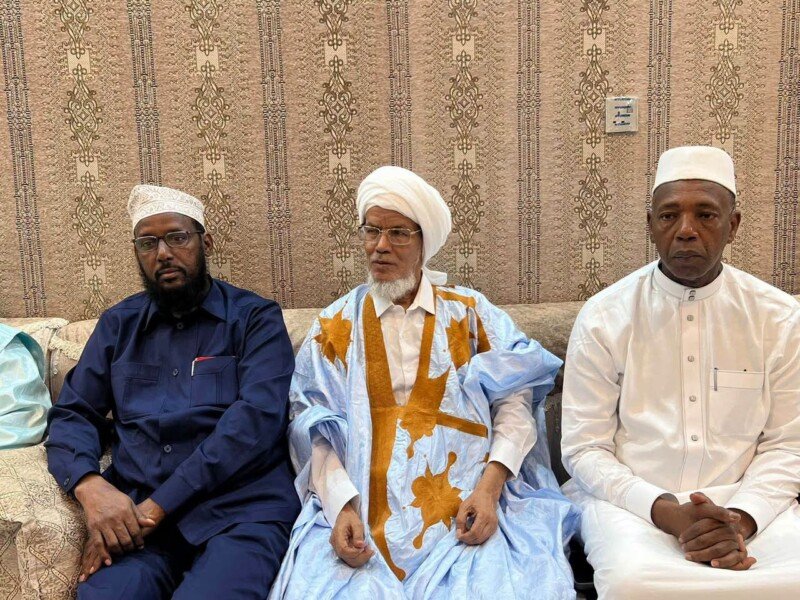
NOUAKCHOTT — Somalia’s Minister of Religious Affairs and Endowments, Sheikh Mukhtar Robow Ali, is participating in the 39th International Conference on the Prophet’s Sira, which opened in Nouakchott, Mauritania, on Monday.
The three-day conference brings together more than 50 countries, with scholars, officials, and representatives from various Islamic nations. The forum focuses on studying and spreading the guidance of the Prophet’s biography, with particular emphasis on the role of monotheism, morality, and the correction of creed, and how these principles can be reinforced in Muslim societies.
Sheikh Mukhtar Robow is representing Somalia at the international gathering, participating in sessions and discussions on religious affairs, preaching, and cooperation between governments and Islamic institutions.
Conference Theme and Objectives
This year’s conference is held under the theme “Prophetic Guidance in Managing Diversity and Differences, and Consolidating Common Ground.” The sessions address topics including human, religious, and social diversity in the Prophetic tradition, the Prophet’s approach to dealing with differences among people, the jurisprudence of mutual understanding and coexistence, and managing diversity within and outside the Islamic community.
The conference also examines the concept of disagreement and its regulations in the Prophetic tradition, the etiquette of disagreement and dialogue, ways to manage disputes and transform them from a source of division into an arena for integration, and Prophetic models for addressing intellectual, social, and political differences. A key focus is confronting extremism and radicalism through the Prophetic approach.
Mauritanian President Mohamed Ould Cheikh El Ghazouani presided over the opening ceremony at the International Conference Centre in Nouakchott. The event was attended by Mauritania’s Prime Minister, the President of the National Assembly, government ministers, military and security leaders, and members of the diplomatic corps accredited to Mauritania.
Somalia’s Religious Diplomacy
Minister Robow’s participation in the conference follows his delivery of a special message from Somali President Hassan Sheikh Mohamud to Mauritanian President Mohamed Ould Cheikh El Ghazouani. That meeting, held on September 13, focused on strengthening relations between the two brotherly nations and expanding political and diplomatic engagement.
The conference comes just days after the Secretary-General of the Muslim World League and Chairman of the International Union of Muslim Scholars, Sheikh Dr. Mohammed bin Abdulkarim Al-Issa, met with prominent Somali scholars in Mogadishu. That gathering concluded with an agreement on a joint project to enhance scholarly and intellectual cooperation between the Muslim World League and Somali scholars, focusing on confronting extremist ideas [citation:2].
Critical Note
Somalia’s participation in the 39th International Conference on the Prophet’s Sira reflects the government’s continued engagement with Islamic institutions and its emphasis on religious diplomacy. The conference theme, focused on managing diversity and consolidating common ground, aligns with Somalia’s efforts to counter extremist narratives that exploit religious differences and to promote a moderate understanding of Islam.
The context of Minister Robow’s participation is notable. His personal journey from co-founder of Al-Shabaab to Minister of Religious Affairs represents a significant transformation that the Somali government has sought to leverage in its counter-extremism strategy. His presence at an international Islamic conference signals that the government views his experience as an asset in promoting a counter-narrative to extremist ideology.
However, the effectiveness of these international engagements depends on their translation into domestic impact. Somalia’s religious authorities have taken important steps, including the fatwa against extremism and the proposed Ulema Council, but the reach of these initiatives at the community level remains uneven. For religious diplomacy to deliver meaningful results, it must be accompanied by sustained investment in local religious education, support for moderate clerics, and efforts to address the socio-economic conditions that extremist groups exploit for recruitment.