MOGADISHU — Somalia’s Ministry of Health and Human Services announced on Monday that it had quarantined a Somali citizen who travelled with a Kenyan man later confirmed to have died of Ebola in Nairobi on October 5, 2026.
The citizen was taken to the Ebola Quarantine and Treatment Centre at Forlanini Hospital in Mogadishu for medical assessment, according to an official statement from the Ministry. The individual has not tested positive for Ebola.
The Ministry said Somalia’s IHR office received an official notification from Uganda on the evening of 10 October 2026, stating that a Somali citizen and a Kenyan citizen had travelled together from the Democratic Republic of Congo through Uganda. The two men reportedly stayed in the same hotel and then took the same taxi to Entebbe Airport in Uganda.
The two men then separated. The Somali citizen flew to Mogadishu via Addis Ababa, while the Kenyan citizen travelled to Kenya, where he was later confirmed to have died of Ebola in Nairobi on 5 October 2026 while receiving medical care at a health facility in Kenya.
The Ugandan report included the Somali citizen’s name, passport number, flight details and seat number, which facilitated his identification and tracing. The Ministry said the information was handled by officials designated for the investigation and follow-up.
24-Hour Joint Investigation
Following an emergency meeting of Ministry leadership on the morning of 11 October, the Ministry of Health requested the Ministry of Interior to have the Immigration Agency trace the citizen’s entry and location in the country. On the evening of 11 October, the Immigration Agency confirmed that the Somali citizen had arrived at Mogadishu airport on 3 October 2026, passing through normal travel procedures.
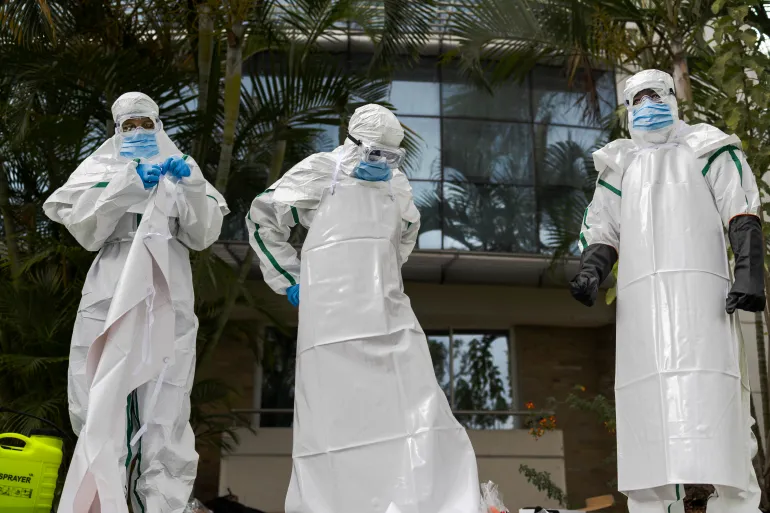
A joint investigation and tracing operation lasting nearly 24 hours, involving the Immigration Agency, the Criminal Investigation Department (CID), the Ministry of Health, and the National Institute of Health (NIH), succeeded in safely quarantining the citizen and transferring him to the Ebola Quarantine and Treatment Centre at Forlanini Hospital in Mogadishu, where his health condition is being monitored.
The Ministry has designated the Forlanini centre in Mogadishu for the management of Ebola-related cases and has allocated a dedicated quarantine system. The medical team will determine next steps based on the assessment of the citizen’s condition and his contact history. Verification of his movements and the people he has been in contact with since entering the country is ongoing.
Public Advisory
The Ministry urged anyone who has been in contact with the quarantined citizen to call the toll-free number 995 or send a WhatsApp message to +252 61 022 4623, even if they feel healthy. The medical team will assess the information and determine appropriate follow-up or quarantine if needed. The Ministry emphasised that contact with the citizen does not mean the person has contracted the disease, but assessment and follow-up are important to prevent possible spread.
“Quarantining a citizen is a precautionary public health measure; it does not confirm that the person has Ebola or that the disease is spreading within the Somali community,” the Ministry said. “The public is asked to remain calm and cooperate with health teams.”
The Ministry also called on the public to avoid spreading unverified information, false names and images, and stigmatising the citizen and his family. It said it would share new information with the public once verified. Health workers at borders and health facilities were instructed to remain vigilant, follow established health protocols for information transmission, and uphold infection prevention and control measures and patient confidentiality.
Kenya’s First Ebola Case
Kenya confirmed its first imported case of Bundibugyo Ebola virus disease on October 6, 2026. The patient was a Kenyan citizen who had been living in the Democratic Republic of Congo for seven years. He fell ill about a month before his return and was treated at various hospitals before travelling by road from the DRC to Kampala and subsequently flying to Nairobi on October 3.
The patient arrived aboard Jambo Jet flight 8523 and underwent routine public health screening at Jomo Kenyatta International Airport. He was later taken to Nairobi Hospital, where he was isolated after presenting with fever, chills, intense fatigue, muscle pain, and bleeding under the skin at injection sites. Samples tested positive for Bundibugyo Ebola virus disease at both the National Virology Reference Laboratory and KEMRI laboratory. The patient died on the night of October 5.
Kenyan authorities identified 28 contacts of the deceased, including family members and health workers, and traced 23 passengers and four crew members who travelled on the same flight. Ten people were placed in quarantine at the National Police Service Hospital in Nairobi.
The case exposed significant gaps in Somalia’s border health defences. As reported in FTL Somalia’s coverage of the Kenyan case, a 2024 baseline assessment conducted with WHO Somalia found that IHR core capacities at Somali points of entry averaged 27 percent, with airports at only 20 percent. The assessment noted no dedicated isolation areas, no biosecure transport for suspected cases, and no standard operating procedures for disease detection at Somali airports.
Somalia’s Preparedness Measures
The quarantine comes as Somalia has been intensifying Ebola preparedness efforts in recent weeks. On October 8, the Somali Cabinet approved measures to prepare for a possible Ebola outbreak and formed a six-ministry committee chaired by Second Deputy Prime Minister Jibril Haji Abdi. The committee includes the ministries of health, security, foreign affairs, transport, information and livestock. As reported in FTL Somalia’s coverage of the Cabinet meeting, the Health and Social Care Ministry briefed ministers on the Ebola situation and measures to prevent the disease from reaching Somalia.
Health Minister Dr. Ali Haji Adan said on October 8 that medical teams had been deployed to airports to monitor passengers arriving from African countries, particularly after the confirmed case in neighbouring Kenya. “We have deployed a medical team to the airport to monitor flights arriving from African countries. We are now intensifying our preparedness after Ebola reached Kenya,” the minister said.
Puntland also raised its Ebola alert following the Kenyan case. As detailed in FTL Somalia’s coverage of the Puntland alert, the Puntland Ministry of Health said it was stepping up preparedness, early detection, and rapid response mechanisms. “The Ministry of Health informs the public of Puntland that no cases of Ebola virus disease have been confirmed in Puntland to date,” the ministry stated.
Regional and International Support
Somalia’s preparedness efforts have been supported by regional and international partners. From September 28 to October 1, technical experts from IGAD and Somalia’s One Health line ministries completed a four-day joint mission in Mogadishu, developing a costed, time-bound Ebola Virus Disease preparedness and response workplan. The mission was part of the broader Preparedness for Pandemic Response project funded by the Pandemic Fund, with WHO as the implementing agency.
In September 2026, Somalia’s Ministry of Health and Human Services and the National Institute of Health, with support from WHO, conducted a three-day national simulation exercise in Mogadishu to test detection, verification, reporting and response protocols for a suspected imported Ebola case. The exercise identified gaps in reporting lines, notification and referral pathways, point-of-entry arrangements, and governance of public communication. Each finding was assigned to an improvement action plan.
The WHO has warned that the ongoing Ebola outbreak in the Democratic Republic of Congo, caused by the Bundibugyo strain, poses a risk of cross-border transmission. As of September 7, 2026, WHO reported 6,757 confirmed cases and 3,267 deaths across 61 health zones in six provinces.
Critical Note
The quarantine of a Somali citizen who travelled with the Kenyan Ebola victim is a precautionary measure, not a confirmation of an outbreak. The Ministry of Health has been clear on this point, and its transparency in announcing the quarantine, including specific details about the citizen’s travel route, is a welcome departure from the secrecy that often surrounds public health scares in the region.
However, the incident exposes the structural vulnerabilities that FTL Somalia has documented in previous reporting. Somalia’s points of entry have IHR core capacities of only 20 percent. The country lacks functioning isolation facilities, biosecure transport, and a viral hemorrhagic fever laboratory referral network. The quarantine at Forlanini Hospital is a step in the right direction, but it does not resolve the broader gaps in Somalia’s ability to detect and contain an imported Ebola case.
The timeline is notable. The Somali citizen arrived at Mogadishu airport on October 3, the same day the Kenyan victim arrived in Nairobi. The citizen was not identified until October 10, when Uganda’s notification reached Somalia’s IHR office. That seven-day gap suggests that the airport screening measures announced by the Health Minister may not have been fully operational at the time, or that the citizen passed through without triggering a flag. The Ministry’s contact tracing efforts will be critical in determining whether the citizen had contact with others before being quarantined.
The Ministry’s handling of the case has been methodical. The joint investigation involving immigration, CID, health, and NIH demonstrates inter-agency coordination that has often been lacking in Somali public health responses. The designation of Forlanini Hospital as a dedicated Ebola treatment centre and the establishment of a quarantine system are concrete steps that reflect lessons learned from previous outbreaks.
For Somalia, the lesson is clear: preparedness cannot be reactive. The IGAD workplan and the national simulation exercise were important steps, but they must be translated into operational capacity at the points of entry where the risk of importation is highest. The window for anticipatory action is narrowing.
Share your story. FTL Somalia is continuing to investigate Somalia’s Ebola preparedness and the risks posed by cross-border transmission. If you have information or insights to share, contact us at info@ftlsomalia.com. Your identity will be protected.