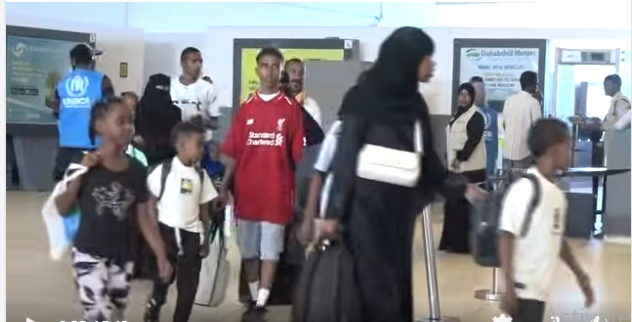
MOGADISHU — The Somali government has repatriated 161 Somali citizens who had been living for years in refugee camps in Yemen, as the civil war in the country continues to affect civilian populations.
The returnees, who arrived at Aden Adde International Airport, included elderly people, children and women. They were received by the Commissioner of the National Agency for Refugees and Displaced Persons, Liibaan Abdi Cigaal, along with officials from the United Nations High Commissioner for Refugees (UNHCR).
According to the National Agency for Refugees and Displaced Persons, up to 200 more Somali refugees are expected to be repatriated in the coming days with the support of UNHCR.
A Long-Standing Repatriation Effort
The repatriation is part of ongoing efforts by the Somali government and international partners to return citizens stranded in Yemen. Yemen has hosted Somali refugees for decades, with many fleeing conflict and instability in Somalia during the 1990s and 2000s. The current civil war in Yemen has made their situation increasingly precarious.
In April 2025, the Somali government repatriated 171 Somali migrants stranded in Libya, as reported in FTL Somalia’s coverage of the Libya repatriation. That operation was organized by the International Organization for Migration and highlighted the broader challenges facing Somali nationals stranded abroad.
UNHCR has been a key partner in facilitating the voluntary return of Somali refugees from Yemen and other countries. The agency has previously assisted Somali refugees in Yemen, many of whom face difficult conditions due to the ongoing conflict and economic crisis in the country.
The Situation of Somali Refugees in Yemen
Yemen has historically been a destination and transit point for Somali refugees. According to UNHCR, Yemen hosted approximately 250,000 refugees and asylum-seekers, the vast majority of them Somali, before the current conflict escalated. Many have lived in Yemen for decades, with some born there to Somali parents.
The war in Yemen has severely affected refugee populations, limiting access to basic services, healthcare and education. Many Somali refugees have been displaced internally within Yemen, and some have attempted dangerous sea crossings to reach other countries.
Critical Note
The repatriation of 161 Somali citizens from Yemen is a welcome development for the individuals involved and their families. However, it also highlights a broader challenge that Somalia has yet to fully address: the situation of Somali nationals stranded abroad, whether in Yemen, Libya, or other transit countries.
Each repatriation operation is a humanitarian response to a specific crisis. The more difficult question is how to prevent the conditions that force Somalis to undertake dangerous journeys in the first place. The drivers of migration, including conflict, lack of economic opportunity, and limited legal pathways abroad, remain unaddressed. Until those underlying conditions change, Somali citizens will continue to seek refuge and opportunity elsewhere, often at great risk.
The government’s efforts to repatriate citizens are commendable, but they are not a substitute for a broader strategy that addresses the root causes of displacement and provides young Somalis with viable alternatives to irregular migration. The 161 returnees now have a chance to rebuild their lives in Somalia. The question is whether the country can offer them the stability and opportunity they need to stay.