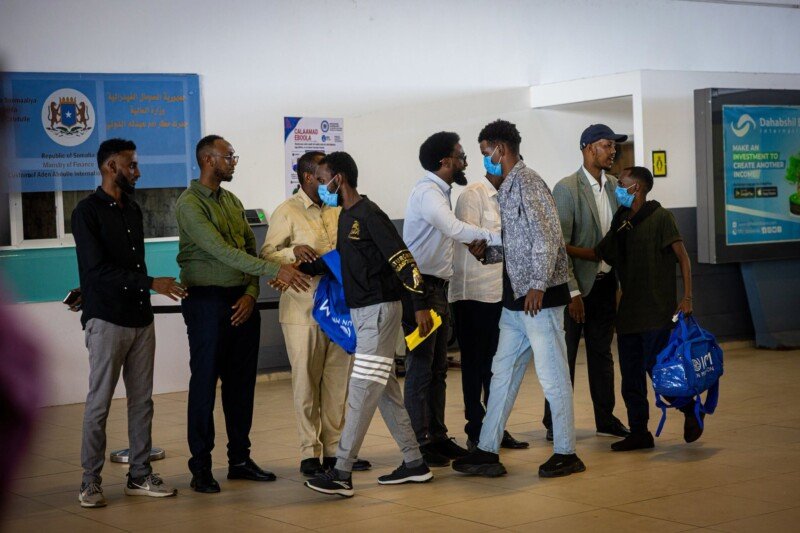
MOGADISHU, The Federal Government of Somalia has repatriated 169 citizens who were held in prisons in Libya, with 140 arriving in Mogadishu and 29 flown to Hargeisa, according to a statement from the Ministry of Foreign Affairs.
The return was carried out through the Voluntary Humanitarian Return programme, supported by the European Union in Somalia and implemented by the International Organization for Migration in coordination with the federal government. IOM described the operation as a “safe and dignified return” that gives the returnees a chance to reunite with their families and begin rebuilding their lives. Ibrahim Guure, director of the diaspora and communities department at the foreign ministry, was among the officials who received the returnees in Mogadishu.
Separately, a debate on preventing youth irregular migration was held in Mogadishu, attended by Prof. Mohamed Omar Dhalxa and representatives of youth organizations.
A Pattern of IOM-Supported Returns
The operation is the latest in a series of repatriations that have become routine. In September 2026, 171 Somali migrants stranded in Libya were assisted to return home on an IOM charter flight, with 42 disembarking in Hargeisa and the remainder arriving in Mogadishu. As FTL Somalia reported, several of the migrants, including three minors, had endured dangerous travel conditions across multiple countries before encountering exploitation and abuse by smugglers in Libya.
In July 2026, the National Commission for Refugees and Internally Displaced Persons provided immediate assistance to nearly 130 Somali nationals repatriated from Libyan detention centres, offering medical check-ups, registration with the National Identification and Registration Authority, and help reuniting with families. Earlier, in April 2026, 174 citizens were repatriated, with Deputy Foreign Minister Hassan Mohamed Ali welcoming them at Aden Adde International Airport.
Since August 2022, the EU-funded Voluntary Humanitarian Return programme has facilitated the voluntary return of more than 2,000 Somali migrants from Libya, with additional charter flights expected in the final quarter of 2026. IOM has consistently stressed that every return under the programme is voluntary and based on the migrant’s informed decision, with counselling provided before departure and support framed around family reunification and dignity.
The Contrast with Forced Removals
The voluntary returns from Libya stand in contrast to the forced deportations Somalia has received from European countries. On the night of October 27-28, Sweden forcibly deported nine Somali nationals on a specially chartered aircraft, the latest in a series of removals that have drawn political scrutiny in Stockholm. As FTL Somalia reported, the deportation follows the case of Abas Bashir, a Somali father of six who appealed to President Hassan Sheikh Mohamud after alleging that three officials from the Office of the Prime Minister were involved in his forced removal.
The Swedish government has acknowledged conditioning development assistance on Somalia’s willingness to accept deported nationals. Swedish media reported that approximately 100 million kronor in aid was redirected toward projects tied to the Prime Minister’s office, alongside five million kronor routed through the UN migration agency to fund three positions within the Somali government. The Somali government has described the allegations as “baseless and misleading,” while Swedish ministers have denied that funds reached the Prime Minister’s office directly.
The financial architecture behind these returns remains contested. The allegations have not been independently investigated, and the Somali government’s denials, while categorical, do not address the specific claims made by Bashir or the Swedish media reports. What is clear is that the two streams of return operate under different logics: the Libya programme is EU-funded, voluntary, and framed around humanitarian protection and family reunification, while the Swedish removals are enforcement-driven and tied to the conditioning of development aid.
The Drivers and the Debate
The debate in Mogadishu on preventing irregular migration reflects a growing recognition that repatriation alone does not address why young Somalis embark on these journeys. Unemployment, limited economic opportunities, and insecurity continue to push youth toward irregular routes through Libya and the Mediterranean, where the risks of detention, exploitation, and death are well documented.
IOM data shows that between January and March 2026 alone, 1,627 Somali migrants arrived in Libya through the Northern Route, and more than 1,500 were estimated to be stranded in the country as of July 2026, many living in dangerous conditions with limited access to food, shelter, and healthcare. The National Commission for Refugees and IDPs has begun enlisting young Somalis who survived migration journeys to warn others, gathering nearly 100 returnees in Mogadishu to share their experiences and establish a network for awareness campaigns.
Critical Note
The return of 169 citizens from Libyan prisons is a necessary intervention, and the coordination between the foreign ministry, the European Union, and IOM has made these operations possible. But the repetition of these flights, month after month, year after year, is itself the story that deserves more attention than any single repatriation.
Each Voluntary Humanitarian Return represents lives pulled back from abuse and exploitation, and the programme’s emphasis on voluntariness, informed consent, and dignity is a meaningful distinction from the forced removals happening in Europe. Yet the flow of young Somalis toward Libya and the Mediterranean continues, driven by conditions at home that repatriation cannot fix. The debate in Mogadishu and the returnee-led awareness campaigns are welcome, but they operate at the level of warning and persuasion. They do not create jobs, do not improve security in the regions young people are leaving, and do not offer legal pathways abroad for those determined to go.
The government’s focus on rescue operations is understandable, and its diplomatic engagement with Libyan authorities has secured the release of detainees. But a policy that is primarily reactive will keep producing the same scenes at Aden Adde airport: young people arriving with nothing, having survived a journey that many others did not. Meanwhile, the forced removals from Sweden raise questions about the financial arrangements underpinning returns cooperation that the government has not fully answered. Until the economic and security conditions that push young people onto these routes change, and until the transparency of forced returns is addressed, the repatriation flights will continue to be necessary, and the debate in Mogadishu will remain a conversation about symptoms rather than causes.
Recommended Reading On ftlsomalia.com
- 171 Somali Migrants Stranded in Libya Return Home on IOM Charter Flight
- Nine Deported from Sweden as Abas Bashir’s Case Exposes the Human Cost of Returns Cooperation
- Somalia Welcomes Home 130 Citizens from Libyan Detention Centres
- EU Delegation Visits NCRI Return and Reintegration Centre in Mogadishu
- Somalia and Libya Agree to Strengthen Cooperation on Migration and Citizens’ Affairs