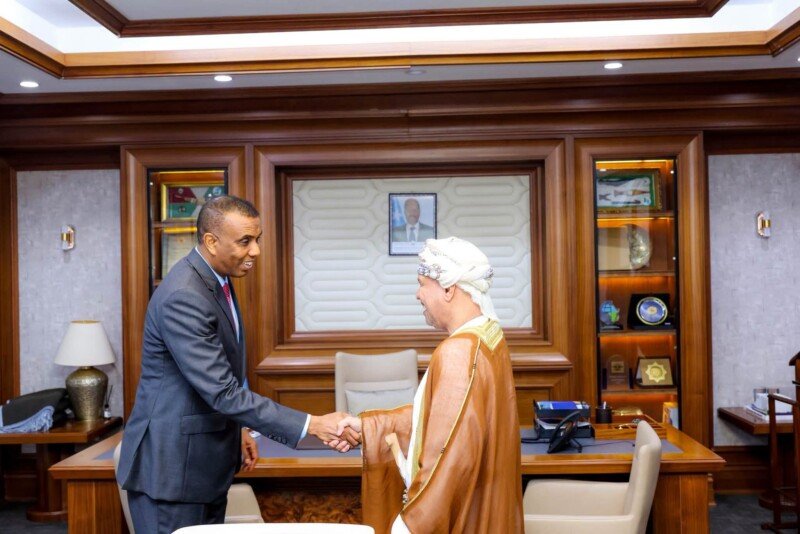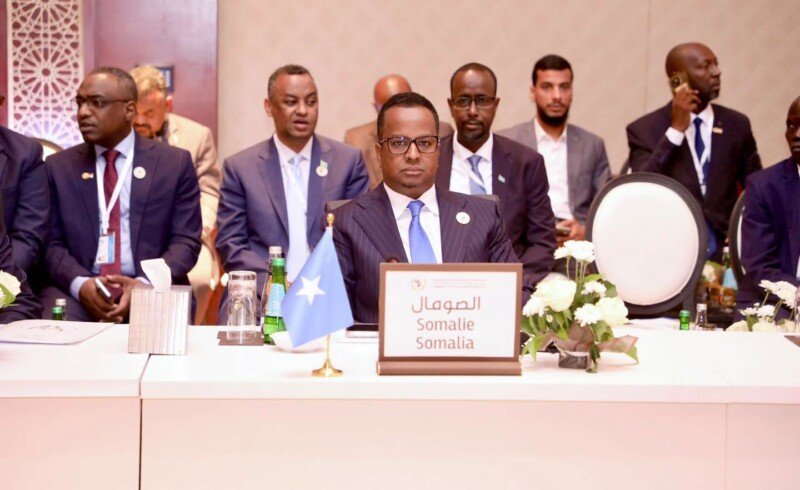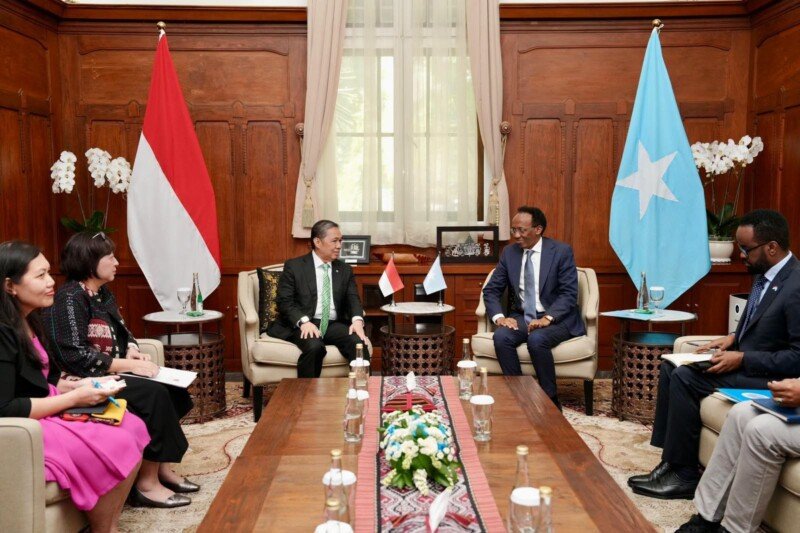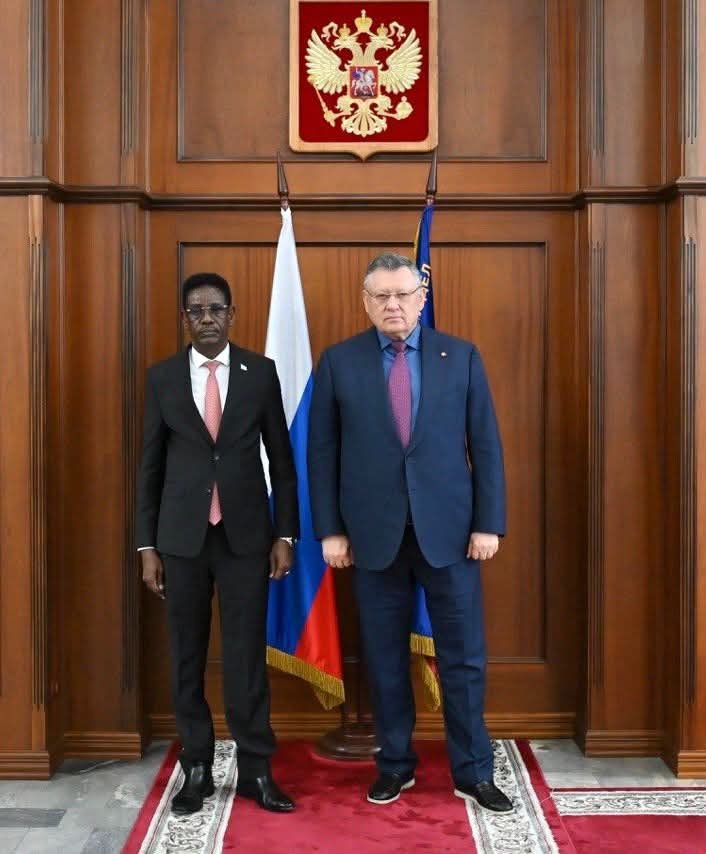
MOGADISHU, Somalia’s Minister of Internal Security, Abdullahi Sheikh Ismail Fartaag, met with Igor Zubov, Russia’s State Secretary and Deputy Minister of Internal Affairs, on the sidelines of the third Russia-Africa Summit to discuss strengthening security cooperation between the two countries.
The talks focused on training and capacity-building for the Somali Police Force, counterterrorism cooperation, and preventing extremist ideology. According to statements from Somalia’s Ministry of Internal Security, the discussions also covered criminal investigations, cybersecurity, and efforts to counter emerging security threats. Zubov expressed Russia’s readiness to share expertise and training programmes with Somalia, though no specific agreements, funding commitments, or implementation timelines were announced.
The meeting comes as Moscow signals a renewed interest in security engagement with Mogadishu, building on a relationship that had lain largely dormant since the collapse of the Siad Barre regime in 1991.
A Relationship Being Rebuilt
The security talks are the latest step in a broader revival of Somalia-Russia ties. In July 2026, four senior Somali police officers graduated with master’s degrees from Russia’s Academy of Management under the Ministry of Internal Affairs, the first such graduation in four decades. The officers specialised in general administration and strategic planning, and Somali authorities described the achievement as one that would strengthen leadership and institutional capacity within the force. The graduation carried particular historical weight given the depth of Soviet-Somali cooperation before the civil war, when hundreds of Somali officers received training in Soviet institutions.
That milestone followed a series of high-level engagements. In May 2026, Somalia’s State Minister for Defence met with Russian Deputy Minister of Defence Vasily Osmakov in Moscow to discuss enhanced defense cooperation. Russia has also provided humanitarian assistance, including two shipments of 25,000 tons of wheat in late 2023 and early 2024, and has supported Somalia’s sovereignty at the UN Security Council, including opposing the extension of the arms embargo in April 2026.
The diplomatic groundwork has been laid over months. Somalia’s Foreign Minister led the delegation at the Second Ministerial Conference of the Russia-Africa Partnership Forum in Cairo in December 2025, attending high-level talks on continental security and economic cooperation. In May 2026, the outgoing Russian Ambassador to Somalia, Mikhail Golovanov, held farewell talks with Foreign Minister Abdisalam Abdi Ali, with both sides reaffirming their commitment to strengthening political dialogue and economic cooperation.
The Diversification Strategy
The outreach to Moscow fits a pattern that has become central to Mogadishu’s foreign policy: expanding the roster of international partners to reduce reliance on any single patron. Somalia already maintains security training relationships with the EU, Türkiye, Egypt, Italy, Uganda, Qatar, and the USA. Russia adds a historically significant but operationally modest option to that list.
Minister Fartaag has been at the centre of this diversification effort. He has led high-level bilateral security missions to Burkina Faso to strengthen counterterrorism cooperation and to Türkiye for discussions on specialized training in counterterrorism and intelligence gathering, among other initiatives. His ministry has also deepened cooperation with INTERPOL on transnational organized crime and signed a police development pact with Italy in July 2026.
The timing is not incidental. Somalia is navigating a security transition as the African Union Support and Stabilization Mission in Somalia faces funding pressures and the drawdown of Ugandan troops. The loss of UN logistical support threatens to pull the foundation from under the AU mission, and Somali forces are expected to assume greater responsibility for security, a dynamic highlighted in recent transition talks. The police, which play a central role in maintaining urban security and investigating attacks, are a logical focus for capacity-building partnerships.
That transition is accelerating. As Uganda begins withdrawing its troops from Somalia, the first flight carrying 109 soldiers departed Aden Adde International Airport this week, with Ugandan positions in Lower Shabelle expected to be vacated by early November. The drawdown follows President Yoweri Museveni’s rejection of President Hassan Sheikh Mohamud’s request to delay the exit, a dynamic detailed in recent coverage of the failed appeal.
The broader AUSSOM mission is facing its own reckoning. With the United States ending funding for the UN Support Office in Somalia, which provides logistics, troop rotations, and medical support, the mission’s operational capacity is under severe strain. The financial squeeze, combined with the Ugandan withdrawal, has placed the security transition at a critical inflection point, as Somali forces are expected to fill a vacuum they may not yet be equipped to hold.
Russia’s interest in Africa is also expanding. The Russia-Africa Summit, where the Zubov-Ismail meeting took place, is part of Moscow’s broader effort to deepen diplomatic and security engagement across the continent. For Somalia, the appeal is access to training and expertise without the political conditionality that sometimes accompanies Western partnerships.
Critical Note
The meeting between Minister Ismail and Deputy Minister Zubov is a diplomatic signal more than a concrete agreement. No funding was pledged, no training schedule was set, and no memorandum was signed. What the two sides produced was a statement of intent, wrapped in the language of shared threats and mutual interest.
That does not make the meeting meaningless. Somalia needs partners, and Russia has demonstrated a willingness to provide training and educational opportunities at a time when other partnerships are under strain. The four officers who earned master’s degrees in Moscow are a tangible outcome of this relationship, and their skills will be useful regardless of the geopolitics behind the programme.
But the history of Somalia’s international security training partnerships is not a clean one. Leaked documents in 2024 revealed that fake Somali police officers had been enrolled in a Russian-supported training programme, raising questions about whether such initiatives are building institutional capacity or providing opportunities for patronage. The government has not disclosed how the four graduates were selected or what criteria were used. Without that transparency, every new training partnership, including the one discussed this week, carries the risk of repeating the same pattern.
Russia’s readiness to share expertise is welcome. But Somalia’s security problems will not be solved by training programmes alone, and the government’s willingness to accept whatever partnerships are offered, without public scrutiny of how they are implemented, is a vulnerability rather than a strength. The question is not whether Somalia should engage with Russia. It is whether the engagement will be managed with the transparency and oversight that genuine capacity-building requires.
Recommended Reading On ftlsomalia.com
- Russia-Somalia Security Ties Revive as Police Officers Graduate with Master’s Degrees After Four Decades
- Somalia, Russia Discuss Enhanced Defense Cooperation
- Security Minister Leads Monthly Meeting on Administrative Reform
- Uganda Begins Somalia Withdrawal as President Mohamud’s Plea for More Time Fails
- The First Domino: Uganda’s Withdrawal and the Unravelling of Somalia’s Security Architecture