MOGADISHU, Somalia’s security sector costs more than $1 billion a year, but only a fraction of that sum passes through the government’s budget. The rest is paid by international partners, outside any consolidated fiscal account, leaving the state with limited visibility, weak control, and a mounting vulnerability as external support begins to contract.
The figures, drawn from the World Bank’s 2026 Public Finance Review, reveal a security architecture that is expensive, fragmented, and structurally unsustainable. The review warns that the planned drawdown of the African Union Support and Stabilisation Mission in Somalia could force the government to assume costs it cannot afford, or preside over a decline in security capacity as external funding recedes. This picture is gloomier than the one FTL documented five years ago in “AMISOM: A Rescue Mission in Need of Rescue,” which traced how a mission originally scoped for 8,000 troops and six months grew into a 20,000-person operation spanning every federal member state.
A Billion Dollars, Mostly Invisible
Total security financing exceeds $1 billion annually, according to the World Bank. But less than 40 percent of that total is on-budget. The remainder comes through AUSSOM, the UN Support Office in Somalia, and bilateral arrangements with partner countries, none of which are fully reflected in the federal budget.
That fragmentation has a history. The 2021 FTL Dhambaal reported that the original AMISOM cost estimate was $4 to $5 million. By 2021, the mission was costing $4 to $7 billion and counting, excluding bilateral support from the UK, the US, and the UN. Each successive UN Security Council resolution extended the mandate and expanded the objectives, adding reconciliation, political mediation, and a large civilian component that funded the AU Peace and Security Council in Addis Ababa. The Dhambaal described that body as functioning as a “retirement arrangement for AMISOM and AU staff,” allowing them to continue working on the EU budget while living in Addis Ababa or Nairobi.
The 2026 federal budget allocated approximately $271 million to defence and national security. About $185 million went to defence and $86 million to national security, with the armed forces receiving roughly $177 million. These figures represent only a slice of the true cost of Somalia’s security apparatus.
The external financing that fills the gap is increasingly uncertain. The UN Support Office has been operating on a depleted trust fund. By January 2026, support for rations and fuel had to be suspended, and only casualty and medical evacuation support remained. A small contribution in March allowed ration support to resume until April 30, but the trust fund was depleted again thereafter.
Sustaining core activities across all mandated categories would require approximately $2.2 million per month, the UN Secretary-General reported in 2026.
The Ghost Soldiers Problem
Within the on-budget security spending, the payroll is the largest single component, and it is also the least verified. The Somali National Army’s payroll nearly doubled between 2020 and 2025, reaching approximately 47,438 personnel. But a 2025 verification exercise through the SNA’s human resource management system found approximately 51,600 personnel in the force, of whom only 42,000 were active.
The gap, roughly 9,600 personnel, represents close to one-fifth of the SNA payroll. These are individuals who are paid but not deployable. The World Bank describes the discrepancy as a failure of reconciliation between personnel records and payroll payments, with significant implications for fiscal leakage and operational readiness.
This is not a new problem. The 2021 Dhambaal documented that troop-contributing countries had developed elaborate systems for deducting from soldiers’ allowances before they reached the individuals. Kenya was deducting $200 per soldier from the EU-funded allowances. Uganda and Burundi deducted the same amount. Djibouti kept $328. Ethiopia unilaterally decided to keep 50 percent of the allowances its soldiers earned serving in Somalia. The Kenyan Auditor-General at the time found that of the KShs.8.5 billion expected in EU reimbursements at the end of June 2019, only KShs.6.5 billion had reached the Treasury.
The problem has now migrated to the Somali national payroll. In late October 2026, reports emerged that nearly 10,000 Somali soldiers had their salaries reduced as part of a military personnel verification process known as suul-saar (finger print), intended to establish who is eligible to receive salaries. Some personnel also received outstanding entitlements unpaid since 2024. The Ministry of Defence has not provided a detailed public explanation of the deductions, the number affected, or the procedures available for complaints.
The World Bank recommends continuous biometric payroll verification for the security sector, integrated with the government’s financial management and human resource systems, to establish a credible staffing baseline and eliminate unverified personnel. The 2021 Dhambaal noted, bluntly, that “the Somali Security Apparatus is aggressively against any monitoring mission as relates to the actual SNA numbers and utilization of resources.”
Wages, Not Warfare
Even where personnel are verified and paid, the composition of security spending undermines effectiveness. The World Bank found that spending is heavily skewed toward salaries and allowances, with limited investment in operational and capital inputs. Since 2020, spending increases have been driven primarily by salaries, allowances, and food and catering. Non-wage operational spending, including fuel, maintenance, training, and communications, has not kept pace with personnel growth. Capital and equipment spending remains negligible and largely externally financed.
The result, the World Bank concludes, is a “high cost, low capability” model in which higher staffing does not translate into improved operational effectiveness. Each dollar of the wage bill financing inactive personnel or unconsolidated allowances is a dollar unavailable for either operational readiness or civilian priorities.
The 2021 Dhambaal documented a similar dynamic in the AU mission. The mission had expanded “far beyond the agreed strategic locations in Mogadishu” to cover almost all federal member states, with more than 20,000 troops on the ground instead of the initial 8,000. The original idea of transitioning AMISOM into a UN peacekeeping operation was “abandoned and actively undermined by AU members who overtly benefit from a protracted AU mission and the status quo, both financially and politically.”
The AUSSOM Cliff
The most immediate risk is the transition from AUSSOM, and the specific terms of that transition are now becoming clear. As reported in FTL Somalia’s coverage of Washington’s position on UNSOS, the United States has proposed a 12-month drawdown of UNSOS followed immediately by liquidation, after the current AUSSOM authorisation expires on December 31, 2026.
That proposal falls short of what Somalia, the African Union, and troop-contributing countries had sought. At the second extraordinary summit of troop-contributing countries in Kampala on July 31, 2026, representatives from Uganda, Kenya, Burundi, Ethiopia, Egypt, and Djibouti appealed for 18 to 24 months of continued UN support to enable the implementation of agreed milestones and the orderly transfer of security responsibilities.
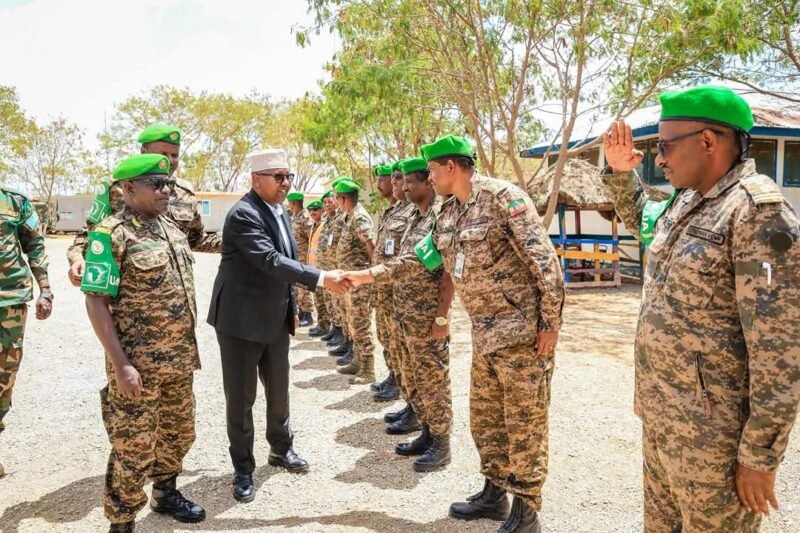
Washington rejected the extension. The financial stakes are significant: the UN General Assembly has approved an appropriation of $481 million for UNSOS for the current financial year, with the US providing approximately 26 percent through assessed contributions. AUSSOM, which fields nearly 12,000 personnel, relies on UNSOS for about 85 percent of its support requirements, including food, water, fuel, medical services, and troop transportation. AUSSOM Commander Lt Gen Sam Kavuma has warned that if UNSOS support ends, it could significantly affect the mission’s capabilities.
The UN support office has already begun preparing for liquidation. As reported in FTL Somalia’s coverage of the UNSOS disposal process, the mission has issued a public tender seeking qualified auctioneers to sell a wide range of UN-owned equipment and vehicles, including generators, medical and laboratory equipment, prefabricated accommodation materials, and heavy construction machinery, valued at approximately $30 million.
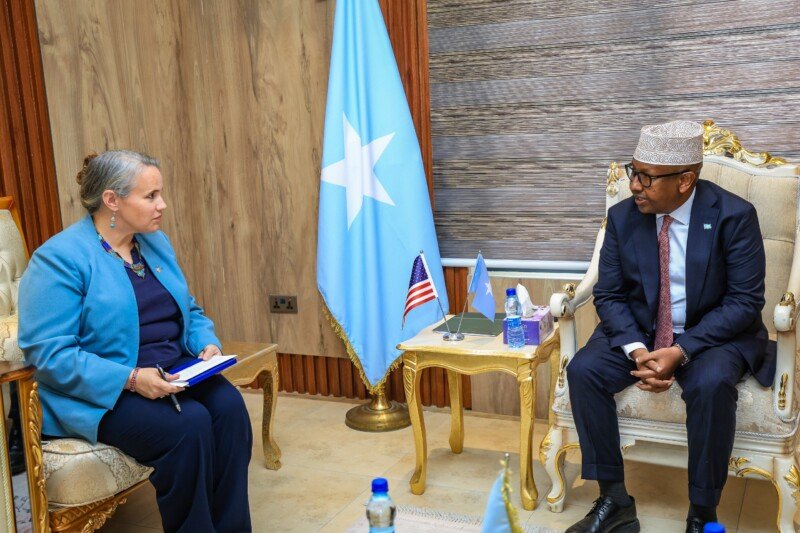
The National Security Adviser and the AUSSOM chief met at Villa Somalia in October to discuss the transition, with the government stating it is ready to take over responsibility. As reported in FTL Somalia’s coverage of the transition talks, the plan envisions a phased transfer of duties, but the financial underpinnings remain precarious.
The closure of the UN political mission, UNTMIS, on October 31 adds another layer of uncertainty. As reported in FTL Somalia’s coverage of the UNTMIS closure, the mission’s mandated functions have been transferred to Somali institutions and UN agencies, but the political good offices that UNTMIS provided will not be easily replaced.
The Dhambaal’s account of the AU’s manoeuvring in 2021 remains relevant. When the UN Independent Assessment recommended a reconfigured AMISOM that would support Somali forces rather than lead security efforts, the AU commissioned its own “independent” assessment, which recommended a hybrid AU-UN multidimensional stabilization mission covering 2022 to 2026. The AU then organized an ad hoc meeting with the Somali government and convinced two ministries, Justice and Defence, to sign an agreement that the Foreign Ministry had not been consulted on. The FGS rejected the hybrid option five days after the AU Peace and Security Council endorsed it. The episode illustrated, as the Dhambaal put it, that “the ‘African solutions to African problems’ narrative is crippled.”
The Fiscal Arithmetic
Somalia’s ability to absorb additional security costs is constrained by its domestic revenue base. Domestic revenue reached an estimated 6.3 percent of GDP in 2025, a level the World Bank describes as insufficient to finance core state functions and development needs, let alone a security sector currently sustained by external partners.
The government’s 2027 draft budget is 9.2 percent smaller than the 2026 budget, as reported in FTL Somalia’s coverage of the Cabinet-approved draft. A smaller budget, combined with a security transition that will require Somalia to assume costs currently borne by international partners, creates a fiscal squeeze that the World Bank has explicitly warned against.
The Bank’s recommendation is to shift from headcount-based budgeting to capability-based security planning that accounts for the full cost of operational readiness, including equipment, maintenance, logistics, and training. It also calls for a joint, costed transition plan with AUSSOM and key partners, grounded in realistic domestic financing capacity and an affordable force structure.
Critical Note
The World Bank’s findings describe a security sector that is expensive but not efficient, large but not capable, and dependent but not sustainable. The 2021 FTL Dhambaal reached the same conclusion about AMISOM: a mission that was supposed to rescue the Somali government had itself become a rescue mission in need of rescue. The $1 billion annual price tag is real, but it is paid largely by others. The 9,600 non-active personnel on the SNA payroll are a symptom of a deeper problem: a state that cannot yet verify, control, or afford its own forces.
The US proposal for a 12-month UNSOS drawdown is a pragmatic compromise that recognises the logistical realities of winding down a mission as complex as UNSOS. A rapid liquidation would leave AUSSOM without critical support before alternative arrangements are in place. The tender for auctioneers to dispose of $30 million in equipment shows that the drawdown is already underway, whether or not the political arrangements are finalized.
The reported salary deductions affecting nearly 10,000 soldiers are a reminder that the fiscal crisis is not abstract. It is measured in the unpaid wages of men who are expected to fight. The government’s failure to explain the deductions publicly, or to provide a clear appeals process, compounds the grievance. A soldier who cannot trust his pay is a soldier whose loyalty is uncertain.
The AUSSOM transition is the central test. The international community has funded Somalia’s security for nearly two decades. That funding is now contracting, and the government has not yet demonstrated that it can replace it. The closure of UNTMIS removes one more layer of international political support at precisely the moment when Somalia needs it most. The World Bank’s recommendations are sound: biometric verification, capability-based budgeting, a costed transition plan. But they require political will that has been in short supply. As the Dhambaal warned in 2021, the donors have an opportunity to learn from Afghanistan and push for a situation in which the Somali government takes full responsibility for its own security. Whether they will seize that opportunity, or preside over another unfinished transition, is the question that the 2027 budget review will begin to answer.
Recommended Reading On ftlsomalia.com
- Washington Proposes One-Year UNSOS Drawdown, Rejects 18-24 Month Extension Sought by Somalia and AU
- UN Closes Political Mission in Somalia After Three Decades
- African Leaders Endorse Phased AUSSOM Withdrawal as Somalia Rejects Internationalization of Domestic Politics
- National Security Adviser and AUSSOM Chief Meet at Villa Somalia to Discuss Transition
- Somali Army Kills 75 Al-Shabaab Militants in Major Operation Near Buurhakaba