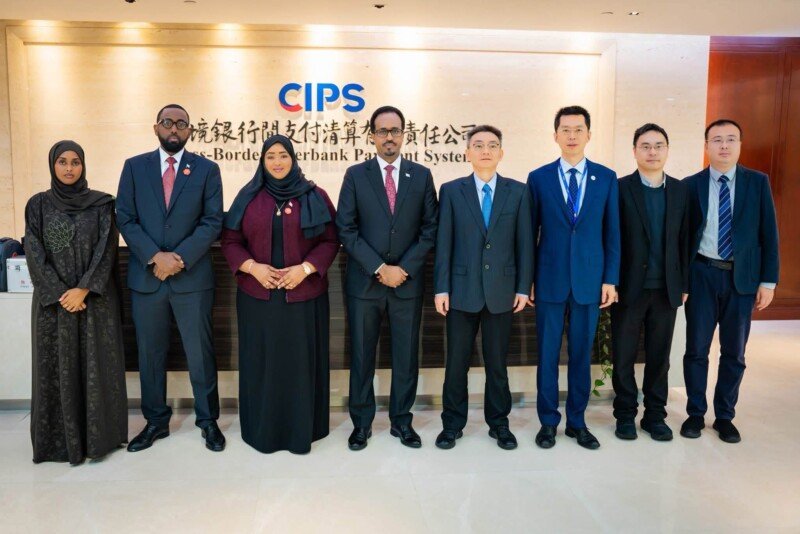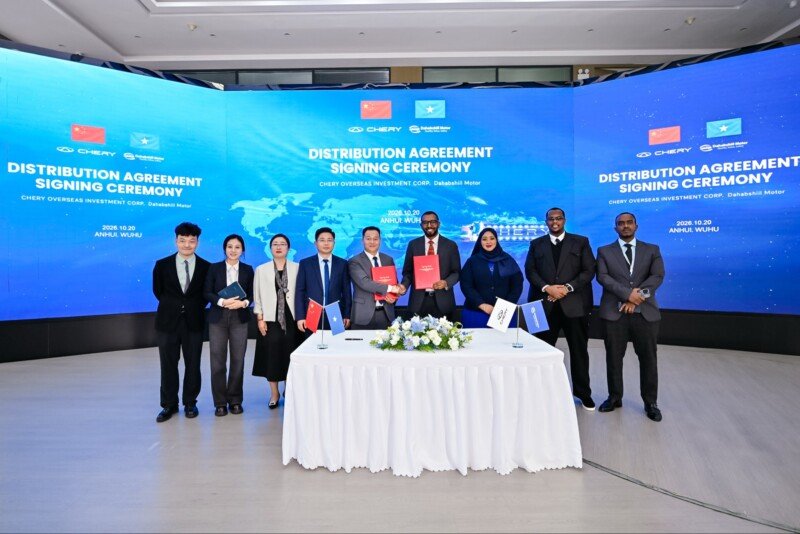
BEIJING, Somalia’s Ambassador to China, Dr. Hodan Osman Abdi, witnessed the signing of an agreement making Dahabshiil Motors the official distributor of Chery automobiles in Somalia, as the two countries continue to deepen commercial ties beyond traditional sectors.
According to a statement from the Somali Embassy in Beijing, Ambassador Hodan welcomed the growing business relationship between Somalia and China and encouraged Chinese companies to establish vehicle assembly plants inside Somalia, moving beyond importation toward local manufacturing.
The agreement marks Chery’s formal entry into the Somali market through Dahabshiil Motors, a subsidiary of the Dahabshiil Group, one of the Horn of Africa’s largest private conglomerates. Dahabshiil Motors previously served as the sole distributor for Hyundai vehicles in the Somali region, having introduced the South Korean brand in 2019, as documented by The Kenyan Wall Street’s coverage of the Hyundai launch.
A Growing Chinese Footprint in Somalia
The Chery deal is the latest in a series of commercial engagements between Somalia and China that have accelerated under Beijing’s zero-tariff policy for African goods. In July 2026, China opened its market duty-free to Somali seafood products, including tuna and lobster, as reported by the Forum on China-Africa Cooperation.
Ambassador Hodan has been at the center of these efforts. In August 2026, she told Hiiraan Online that many Chinese entrepreneurs still view Somalia as an untapped market they have not had the opportunity to assess firsthand, speaking at the first Somalia-China Business Networking Forum in Mogadishu. She has also hosted industrialisation and special economic zone forums in Beijing, bringing together hundreds of Somali and Chinese business leaders to explore partnerships.
The trade relationship, however, remains heavily asymmetric. China’s exports to Somalia stood at approximately $968 million in 2024, while Somalia’s exports to China totaled just $3.1 million, according to figures cited by Hiiraan Online. Chinese exports to Somalia include chemical fibers, telecommunications equipment, and construction machinery.
From Imports to Assembly: The Ambassador’s Push
Ambassador Hodan’s call for Chinese companies to establish assembly plants in Somalia reflects a broader ambition within the federal government to move beyond being a consumer market for foreign manufactured goods. Somalia’s Minister of Commerce and Industry, Gamal Mohamed Hassan, has similarly urged Chinese investors to build processing and manufacturing capacity inside the country, particularly in fish processing, agriculture, livestock, and energy, as reported in SONNA’s coverage of the Beijing industrialisation forum.
The Dahabshiil Group’s experience with Hyundai offers a template. When the group launched Hyundai in Hargeisa in 2019, it also established repair hangars and service facilities, creating local employment and technical capacity. The group’s CEO at the time, Awil Sharif, said the strategic plan included expanding the automotive business to other Somali regions and East Africa, according to Halbeeg News.
Critical Note
The Dahabshiil-Chery agreement is a commercial transaction between a private conglomerate and a Chinese automaker, facilitated by diplomatic engagement. It is a welcome sign that Somali businesses are attracting new international brands and that the embassy in Beijing is actively promoting commercial ties.
But the ambassador’s call for assembly plants, however well-intentioned, confronts the same obstacles that have deterred manufacturing investment in Somalia for decades. Vehicle assembly requires reliable electricity, skilled labor, functioning ports, and a regulatory environment that can certify safety and environmental standards. Somalia’s industrial base remains nascent, and the country’s business climate, while improving, is still constrained by security concerns and political uncertainty.
The trade figures tell a sobering story. China sells nearly a billion dollars in goods to Somalia annually. Somalia sells three million dollars in return. A car distribution deal, while symbolically important, does not change that equation. The path to genuine economic partnership runs through Somalia’s ability to produce and export value-added goods, whether processed fish, agricultural products, or manufactured components. Chery cars on Mogadishu’s roads will be visible evidence of Chinese commercial reach. They will not, by themselves, build a Somali industrial economy.