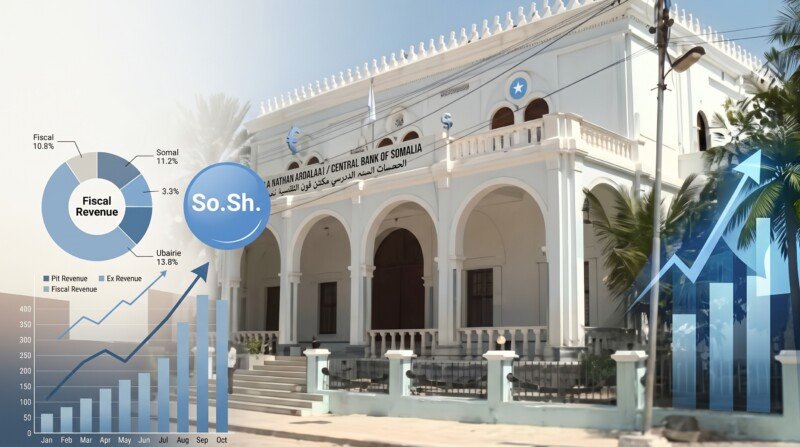
MOGADISHU — Somalia’s domestic revenue increased by 7 percent year-on-year in the first quarter of 2026, reaching US$100.6 million, even as bilateral grants fell to zero and total external grants declined by 18 percent, according to the Central Bank of Somalia’s Quarterly Economic Review.
The figures illustrate a widening gap between the government’s domestic revenue performance and its external financing. Total revenue and grants for the quarter amounted to US$153.9 million, a 3 percent decline from US$158.9 million in the same period of 2025, driven entirely by the fall in external grants.
Domestic revenue accounted for approximately 65 percent of total revenue, up from 59 percent in the first quarter of 2025. The shift reflects both the growth in domestic collection and the contraction in external support.
Composition of Domestic Revenue
| Category | 2025 Q1 | 2026 Q1 | Change |
|---|---|---|---|
| Tax Revenue | US$68m | US$70.8m | +4% |
| Non-Tax Revenue | US$25.6m | US$29.7m | +16% |
| Total Domestic Revenue | US$93.8m | US$100.6m | +7% |
| External Grants | US$65.1m | US$53.3m | -18% |
| Total Revenue and Grants | US$158.9m | US$153.9m | -3% |
Tax revenue rose 4 percent to US$70.8 million, while non-tax revenue increased 16 percent to US$29.7 million. The growth in tax collection reflects continued improvements in tax administration and compliance, according to the Central Bank’s assessment. As reported in FTL Somalia’s coverage of the domestic revenue forum, the government has prioritised strengthening fiscal policy frameworks and improving public service delivery.
Non-tax revenue, which includes fees, licenses, and other government charges, recorded the strongest growth rate of any domestic revenue category. The Central Bank attributed the increase to improvements in collection efficiency and the expansion of revenue sources.
Bilateral Grants Fall to Zero
The most striking element of the fiscal data is the collapse in bilateral grants. No bilateral grant disbursements were recorded during the first quarter of 2026, compared to US$10.3 million in the same period of 2025.
All external grants received during the quarter were multilateral, totalling US$53.3 million. That figure was broadly stable compared to the US$54.8 million received from multilateral sources in the first quarter of 2025.
The absence of bilateral grants is consistent with a broader trend of declining donor support. As documented in FTL Somalia’s report on the 80 percent increase in domestic revenue over three years, the government has sought to reduce its reliance on external assistance. The 2026 federal budget projected US$154.4 million in bilateral grants for the full year, but the first-quarter performance suggests that target may be difficult to achieve if disbursements do not materialise in subsequent quarters.
Fiscal Deficit Narrowed
Despite the decline in external grants, the government’s fiscal deficit narrowed during the quarter. Total expenditure declined 8 percent to US$170.9 million, from US$186.5 million in the first quarter of 2025.
The reduction in spending was driven by lower recurrent expenditure, which fell 4 percent to US$164.4 million, and a sharp decline in capital expenditure, which dropped 58 percent to US$6.5 million from US$15.6 million a year earlier. The contraction in capital spending suggests slower implementation of development and infrastructure projects during the quarter.
The fiscal deficit narrowed to US$17.0 million from US$27.6 million in the first quarter of 2025, an improvement of approximately 38 percent. The smaller deficit reflects stronger domestic revenue collection and lower government spending, despite reduced external grant inflows.
Critical Note
The growth in domestic revenue is a positive signal for Somalia’s fiscal sustainability. A 7 percent increase in domestic collections, driven by improvements in tax administration, suggests that the government’s revenue mobilisation efforts are producing results. The narrowing of the fiscal deficit, despite the decline in external grants, demonstrates that the government can adjust spending in response to reduced external financing.
However, the collapse in bilateral grants is a significant development that deserves greater attention. Bilateral grants are typically more flexible and predictable than multilateral funding, which is often tied to specific projects and disbursement schedules. The absence of bilateral disbursements in the first quarter may reflect timing issues, or it may signal a more fundamental shift in donor engagement with Somalia. If bilateral grants remain at zero for subsequent quarters, the government will face increasing pressure on its budget.
The decline in capital expenditure is also concerning. While lower capital spending contributed to the narrowing deficit, it also means fewer resources are being invested in infrastructure and development projects. Capital expenditure at US$6.5 million for the entire quarter, just 3 percent of the approved annual capital budget, suggests that implementation capacity remains a constraint. The government has repeatedly stated its intention to increase investment in infrastructure, but the data shows that spending on development priorities is actually declining.
The reliance on domestic revenue to compensate for falling external grants is a necessary adjustment, but it has limits. Somalia’s tax base remains narrow, and the government’s ability to further increase domestic collections without imposing burdensome taxes on a fragile economy is constrained. As documented in FTL Somalia’s coverage of the 2026 budget approval, the government has set ambitious revenue targets, but the first-quarter performance suggests that meeting them will require sustained effort. The coming quarters will show whether the first-quarter domestic revenue performance can be sustained, and whether bilateral donors will resume disbursements.