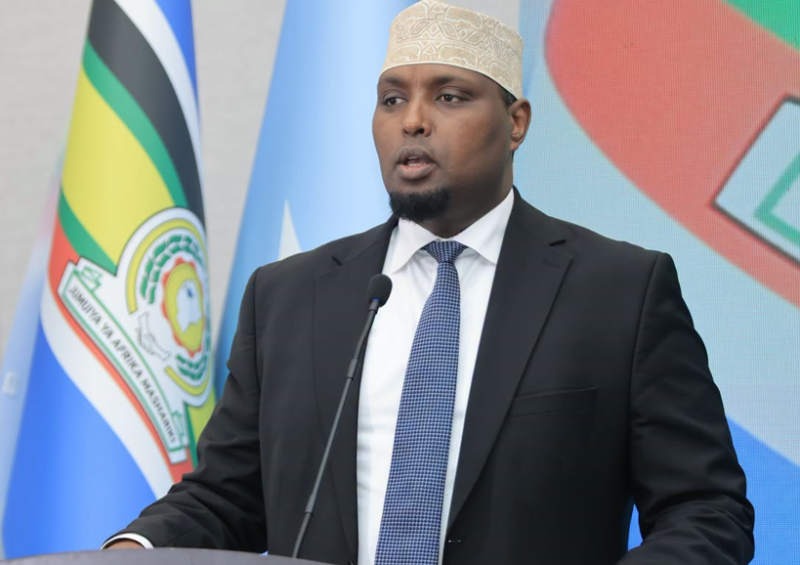
MOGADISHU — Somalia’s Minister of Planning, Investment and Economic Development, Mohamud A. Sheikh Farah (Beenebeene), has said the federal government has created opportunities for Somali citizens who operate businesses in African countries, describing this as the primary reason Somalia joined the East African Community.
Speaking at the third East African Community Conference (EACON 2026), which entered its second day in Mogadishu on Tuesday, the Minister said: “The Somali government has created an opportunity for Somali people who had businesses in African countries, and that is why we joined the East African Community.”
The Minister also addressed Somalia’s national investment agenda and the country’s investment plans within the East African Community. He focused on Somalia’s investment priorities and how they can be linked to economic opportunities in East African countries, emphasizing the importance of regional cooperation, investment promotion, and aligning national and regional development plans.
Somalia’s EAC Membership
Somalia formally joined the East African Community in 2024, becoming the bloc’s eighth partner state alongside Kenya, Uganda, Tanzania, Rwanda, Burundi, South Sudan and the Democratic Republic of Congo. The EAC represents a combined market of over 300 million people and an economy exceeding $300 billion.
The Cabinet reviewed the benefits of Somalia’s EAC membership in October 2026. As reported in FTL Somalia’s coverage of the Cabinet meeting, the review highlighted that Somali students can now attend universities in East Africa at fixed regional tuition rates, while tourists are exempt from foreigner tourism fees. Somali businesses and professionals have also gained greater opportunities to operate in EAC member states without being subject to certain restrictions imposed on foreign nationals.
Somalia has also taken steps to align its trade framework with regional commitments. In August 2026, the Cabinet approved a draft Rules of Origin Law designed to strengthen the country’s trade framework, promote domestic production and help Somali businesses gain greater access to regional and continental markets. Trade and Industry Minister Jamaal Mohamed Hassan said the law would allow Somali exporters to qualify for preferential tariff treatment under the EAC and the African Continental Free Trade Area.
EACON 2026 and Regional Integration
EACON 2026, held from 12–13 October 2026 in Mogadishu, is organized around four strategic pillars: domesticating EAC integration and institutional readiness; competitive markets, trade and regional connectivity; strategic investments, bankable projects and economic transformation; and human capital, innovation and future workforce development.
The conference brings together government institutions, EAC representatives, investors, development partners, businesses, universities, civil society and young leaders to promote practical dialogue, strategic partnerships and actionable solutions that strengthen Somalia’s implementation of EAC commitments.
The theme of this year’s conference, “Deepening Somalia’s EAC Integration Through Treaty Domestication, Trade Competitiveness and Human Capital Development,” reflects the shift from general dialogue on regional integration to the practical conditions required to turn Somalia’s EAC membership into measurable economic and institutional outcomes.
Somalia’s integration into the EAC has also advanced on multiple fronts. As reported in FTL Somalia’s coverage of Somalia’s EAC staffing push, the country is expected to secure 11 staff positions within the bloc’s institutions, strengthening its representation in EAC governance structures.
At a recent EAC Business Council CEOs Trade and Investment Roundtable in Mogadishu, Commerce Minister Jamal Mohamed Hassan reaffirmed Somalia’s commitment to translating its EAC membership into increased trade, investment, stronger businesses and job creation, stressing that regional economic integration must deliver tangible benefits for people and economies.
Critical Note
Somalia’s EAC membership represents a significant strategic shift. For a country whose economy has long been characterized by informal cross-border trade and reliance on remittances, formal integration into a regional bloc with shared rules on trade, labour mobility and investment offers a pathway to institutionalize economic relationships that have historically operated outside formal frameworks.
The Minister’s emphasis on creating opportunities for Somali businesses operating across Africa is well-placed. Somali entrepreneurs have established commercial networks throughout East Africa and beyond, often navigating complex regulatory environments without the protections that formal trade agreements provide. EAC membership, if properly implemented, could give these businesses legal standing and preferential access that they have previously lacked.
However, the gap between accession and tangible benefits remains substantial. As Somalia’s National Trade Facilitation Committee has acknowledged, market access alone will not generate economic gains without urgent reforms to customs administration, border procedures and regulatory coordination. The Rules of Origin Law approved by the Cabinet is a necessary step, but its implementation will determine whether Somali exporters can actually claim the preferential treatment it promises.
The broader challenge for Somalia is institutional capacity. EAC membership requires alignment of laws, policies and institutions with regional commitments. For a federal government still building its administrative systems, meeting these obligations while managing domestic political crises and security challenges will not be straightforward. The EACON conference provides a platform for dialogue, but the real test will be whether the commitments made in Mogadishu translate into tangible improvements in the lives of Somali traders, workers and consumers.