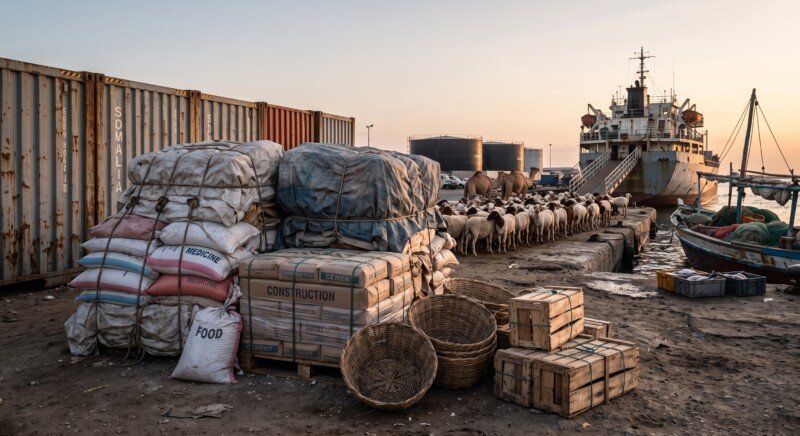
MOGADISHU — Somalia’s merchandise trade deficit widened to US$2,133.82 million in the first quarter of 2026, up from US$1,843.80 million in the same period last year, as import growth continued to outpace export gains, according to the Central Bank of Somalia’s Quarterly Economic Review.
Total merchandise imports rose 16 percent year-on-year to US$2,478.74 million, while exports increased 20 percent to US$344.91 million. Despite the stronger export performance, the gap between imports and exports widened by US$290 million, reflecting Somalia’s continued structural dependence on imported goods and a narrow export base.
The export-to-import coverage ratio improved marginally from 13 percent to 14 percent, but export receipts continued to finance only a limited share of merchandise imports, underscoring the fragility of Somalia’s external position.
Import Composition: Food, Medicine and Construction Dominate
Food remained the largest import category at US$472.02 million, accounting for 19 percent of total imports. While food imports declined 8 percent year-on-year, they remained the single largest drain on foreign exchange.
Medical products ranked second at US$398.77 million, or 16 percent of total imports, up 31 percent year-on-year. Construction materials accounted for 14 percent at US$356.88 million, up 26 percent, reflecting continued investment in construction activity. Clothes and footwear also accounted for 14 percent at US$343.89 million, up 34 percent.
Oil and gas imports totalled US$265.72 million, or 11 percent of total imports, recording the strongest growth among major categories at 41 percent year-on-year and 56 percent quarter-on-quarter. The increase was driven by higher energy demand following the surge in global fuel prices linked to the Middle East conflict, which more than doubled domestic fuel prices during the quarter, as detailed in FTL Somalia’s reporting on the economic impact.
Electronics and electrical machinery imports rose 86 percent year-on-year to US$120.43 million, the fastest annual growth of any category. Cosmetics imports increased 138 percent to US$73.21 million.
In contrast, several categories declined. Cars and spare parts fell 30 percent to US$117.32 million, khat imports dropped 11 percent to US$85.42 million, and beverages and tobacco recorded the weakest performance, falling 68 percent to US$10.94 million.
Exports: Livestock Still Dominant
On the export side, livestock remained the backbone of Somalia’s external sector, contributing US$257.76 million, or 75 percent of total merchandise exports. The country exported 1,424,413 heads of livestock during the quarter, comprising 1,293,931 sheep and goats, 71,921 cattle, and 58,561 camels.
Among the smaller export categories, animal skins increased substantially to US$32.68 million from US$11.72 million a year earlier, raising their share to 9 percent. Fishery exports also strengthened, rising from US$1.83 million to US$15.18 million, accounting for 4 percent of total exports, though the sector’s contribution remains modest relative to its estimated potential.
Crops and vegetable oil exports accounted for only US$10.36 million, or 3 percent of total exports, a significant decline from the elevated levels observed in the second half of 2025. Livestock products, primarily meat, remained broadly unchanged at US$9.02 million, while forest products increased to US$5.54 million.
Long-Term Trajectory
The trade deficit has widened steadily over the past eight years. Merchandise imports increased from approximately US$683.56 million in 2018Q1 to US$2,478.74 million in 2026Q1, while the quarterly trade deficit expanded from US$589.73 million to US$2,133.82 million over the same period.
The structural nature of the deficit is well documented. According to Central Bank Governor Abdirahman M. Abdullahi, Somalia’s financial exclusion from direct correspondent banking costs the country an estimated US$210 million annually, with trade settlement routed through intermediary banks in Nairobi, Djibouti, and Istanbul, as reported in FTL Somalia’s coverage of the cost of financial exclusion. Somalia imported roughly US$9.2 billion worth of goods in 2024, but less than one-third of those imports were financed through the formal banking system.
Critical Note
Somalia’s trade deficit widening to US$2.13 billion is not a new problem, but the first quarter of 2026 illustrates why it is becoming more difficult to manage. Imports are rising across almost every category, driven by population growth, urbanisation, and reconstruction demand. Exports, meanwhile, remain concentrated in a single commodity, livestock, which accounts for three-quarters of total export receipts.
The 20 percent export growth is welcome, but it is measured against a low base and driven largely by seasonal livestock shipments to Gulf markets. The diversification that would meaningfully narrow the deficit, fisheries, agriculture, and manufacturing, remains limited. Fishery exports, despite Somalia’s 3,333-kilometre coastline, accounted for just 4 percent of total exports, though the recent fisheries agreement with China granting tariff-free access to its market may begin to shift that trajectory.
The oil and gas import surge is particularly concerning. Fuel costs more than doubled during the quarter, and with no domestic refining capacity and no strategic reserves, Somalia has no buffer against external price shocks. Every dollar spent on imported fuel is a dollar unavailable for investment or consumption.
The structural imbalance between imports and exports is unlikely to narrow without significant investment in productive sectors and export infrastructure. The trade deficit is financed largely by remittances, which declined 6 percent year-on-year to US$1,587.9 million in the first quarter. The U.S. remittance tax threatens this lifeline for millions in Somalia. If remittance inflows continue to fall while imports rise, Somalia’s external position will come under increasing pressure.
Recommended Reading On ftlsomalia.com
- Somalia Loses $210 Million Annually in Costly Aid and Remittance Transfer Chains
- Somalia Launches Modernized CPI to Strengthen Economic Data Systems
- U.S. Remittance Tax Threatens Lifeline for Millions in Somalia
- Drought, Fuel Prices and Falling Aid Push Somalia’s Growth to Four-Year Low
- Somalia, China Sign Landmark Fisheries Agreement Granting Tariff-Free Access to Chinese Market
- Somalia to Begin Fish Exports to China in September Under Landmark Tariff-Free Deal