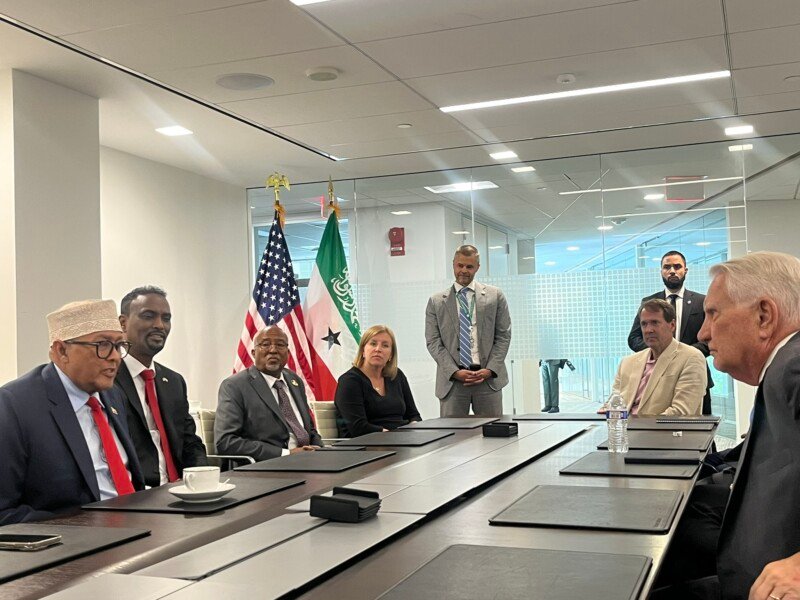
WASHINGTON — Somaliland President Abdirahman Mohamed Abdullahi (Irro) delivered a keynote address at the Hudson Institute on September 14, presenting Somaliland as a stable and democratic strategic partner for the United States and making the case for deeper ties based on security, economic cooperation, and the modernized Port of Berbera.
The event, titled “Somaliland as a Strategic Partner in the Horn of Africa,” was President Irro’s first major public appearance in Washington since winning Somaliland’s November 2024 presidential election . Following his remarks, he participated in a fireside chat with Joshua Meservey, a senior fellow at Hudson who focuses on African affairs .
Irro said Somaliland had spent more than three decades building a functioning government, strong national institutions, a growing economy and a free-market system. He pointed to a series of competitive elections and peaceful transfers of power as evidence of Somaliland’s democratic record .
Berbera and the Red Sea Corridor
A central element of Irro’s pitch was the Port of Berbera, which he described as a modern deep-water facility that the United States Africa Command has assessed and in which DP World has invested $442 million. “Berbera is a port ready for cooperation with and use by the United States government,” he said .
Irro highlighted Somaliland’s proximity to the Bab al-Mandab Strait, the narrow passage connecting the Red Sea with the Gulf of Aden. “Bab al-Mandab is one of the world’s most important commercial waterways. More than 12% of global maritime trade passes through it every day,” he said .
Attacks on commercial vessels and wider regional tensions have disrupted shipping through the Red Sea, forcing some operators to divert vessels around southern Africa and increasing transport times and costs. Maersk suspended new cargo bookings to and from Berbera in April 2026, citing rising political tensions in the Red Sea and warnings from Yemen’s Houthi group about expanding Israeli influence in the Horn .
Security Record and Countering Foreign Influence
Irro said Somaliland had protected its territory and coastline from militant groups and piracy despite operating for decades without international recognition. “For 35 years, no American soldier has been harmed or attacked in Somaliland, and no American ship or aircraft has been threatened from our land or waters,” he said. “Somaliland will never become a sanctuary for groups hostile to the United States” .
The president also criticized Somalia’s federal government, accusing it of lacking the legitimacy and capacity to exercise authority beyond Mogadishu and of using its internationally recognised sovereignty to obstruct Somaliland. “The government of Somalia lacks the legitimacy and capacity to govern beyond Mogadishu and has become an epicentre of instability in the Horn of Africa,” he said .
Historical Case and the 2005 AU Report
Irro framed Somaliland’s quest for recognition not as secession but as the restoration of statehood following the dissolution of a failed union. “Somaliland is not seeking to redraw the borders left by colonialism; it is seeking to return to the borders it previously had,” he said. “Our case is not one of secession. It is based on the dissolution of a failed union and the restoration of our statehood within the internationally recognised colonial borders that existed before the 1960 union” .
This argument draws on the African Union’s own 2005 fact-finding mission to Somaliland, which found that the 1960 union between Somaliland and Somalia was “never ratified” and had “malfunctioned,” bringing “enormous injustice and suffering to the people of the region.” The report stated that Somaliland’s search for recognition was “historically unique and self-justified in African political history” and recommended that the AU find a “special method of dealing with this outstanding case” .
Israel Recognition and Regional Dynamics
Irro cited Israel’s recognition of Somaliland in December 2025 as evidence that governments were beginning to reassess longstanding diplomatic positions in the Horn of Africa through the lens of shared security interests. “Israel did not recognise Somaliland by accident. It recognised it as a political decision based on strategic interests, and it was the right decision,” he said. “Israel’s recognition reflects a new shift towards the Horn of Africa, as governments move beyond outdated diplomatic practices and base their assessments on shared security interests” .
Israel’s Defense Minister Israel Katz has said his country has worked with Somaliland discreetly for years, and that the two sides are now determined to raise security cooperation to new levels. Somaliland opened an embassy in Jerusalem in June 2026 during Irro’s first official visit to Israel.
However, US recognition remains uncertain. AFRICOM Commander General Dagvin Anderson has stated that the United States has no plans to establish a military base in Somaliland, dismissing widespread speculation. President Donald Trump said in December 2025 that he did not back recognizing Somaliland, telling the New York Post “No” when asked about the issue . Trump also reacted dismissively when asked about Somaliland’s suggestion to offer the US access to a port on the strategically important Gulf of Aden, saying “Big deal” .
Irro acknowledged that discussions with Washington had produced no commitment on recognition. “There are talks with the United States, but I cannot say there are currently any American promises,” he said .
Critical Note
President Irro’s address at the Hudson Institute represents a carefully calibrated effort to reframe Somaliland’s recognition campaign around American strategic interests rather than diplomatic principle. By emphasizing Berbera’s potential as a logistics hub, Somaliland’s proximity to the Bab al-Mandab Strait, and its record of stability, Irro is attempting to position recognition as a practical opportunity for Washington rather than a controversial diplomatic concession.
Yet the challenges remain substantial. The United States has consistently reaffirmed its recognition of Somalia’s sovereignty and territorial integrity, and President Trump’s public skepticism about Somaliland suggests the White House is not yet prepared to follow Israel’s lead. The State Department’s June 2026 report to Congress identified areas for expanded practical engagement with Somaliland on maritime security, counterterrorism, and trade, while maintaining the formal US position on Somalia’s sovereignty. This dual-track approach reflects Washington’s effort to balance strategic interests with diplomatic consistency.
Somaliland’s case also faces regional headwinds. The Maersk suspension of Berbera bookings, Houthi threats against shipping, and the ongoing dispute with Somalia all complicate the narrative of Somaliland as a stable, low-risk partner. Irro’s criticism of Somalia’s federal government, while understandable, may reinforce concerns in Washington that closer ties with Hargeisa could destabilize the wider region. The coming months will test whether Somaliland’s diplomatic outreach can overcome these obstacles, and whether the strategic logic Irro has articulated can persuade Washington to move beyond practical cooperation toward formal recognition.