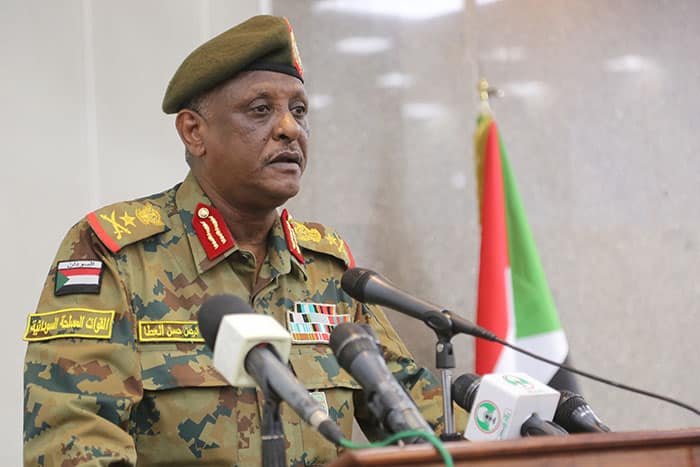
KHARTOUM, Sudan’s Chief of Staff General Yasser Al-Atta has said the Sudanese Armed Forces will continue the war against the Rapid Support Forces, insisting that the campaign is not directed against any tribe or community and that there will be no revenge for crimes committed by the militia.
In an address on Sunday to troops stationed in the field, Al-Atta said Darfur and Kordofan are “cherished parts of Sudan” and that all their tribes are held dear by the Sudanese people. He said the army was fighting “thousands of mercenaries” belonging to the RSF, which he described as a militia owned by the Dagalo family, and claimed that fighters had arrived from several countries, including Niger, South Sudan, Ethiopia, northern Somalia and Colombia.
Al-Atta further said the Armed Forces were fighting to thwart what he called the conspiracies of the “state of evil,” referring to the United Arab Emirates, and Mossad, Israel’s intelligence agency. The statement marks one of the most direct public accusations by a senior Sudanese military official against Abu Dhabi and Tel Aviv since the war began in April 2023.
The Somalia Reference and the UN Evidence
The mention of northern Somalia is not a baseless claim. A United Nations Independent International Fact-Finding Mission report published in September 2026 found “reasonable grounds to believe” that a transnational network spanning the United Arab Emirates, Chad, southeastern Libya, and Puntland in Somalia facilitated RSF operations through interconnected air, land, and maritime routes. As FTL Somalia reported on the UN findings, the report identified Bosaso, the commercial capital of Puntland, as a “recurring logistical hub and transit point.”
Witnesses cited by the UN described Ilyushin-76 cargo flights linking Bosaso with Kufra and Benghazi in Libya and with Chad, before personnel and cargo moved onwards into Sudan. The shipments reportedly included NORINCO AH-4 155mm howitzers, FK-2000 air-defence systems, radars, armoured vehicles, and ammunition. Investigators compared witness accounts with authenticated imagery and confirmed the presence of some of these weapons at RSF operational sites.
Bosaso also featured in routes used to deploy Colombian military contractors to Sudan. The UN mission documented the deployment of up to 2,000 former Colombian military personnel who operated combat drones, artillery, and advanced weapons alongside RSF units. Witnesses said initial groups travelled through the UAE, Bosaso, and Benghazi before crossing southern Libya into Darfur.
The UN report did not conclude that Puntland or Somalia’s federal government supplied the weapons or knowingly participated in the network. It said private companies, intermediaries, and associated individuals operating across several countries facilitated the support network. However, Puntland formally rejected the federal government’s authority to annul its UAE agreements, declaring the move “null and void” within its jurisdiction and vowing to maintain the Bosaso Port deal.
Somaliland: The Other Half of the Network
While the UN report focuses on Bosaso, the wider architecture that Al-Atta describes has another Somali node: Somaliland. The territory has cultivated relationships with both the UAE and Israel, the two powers the Sudanese general named in his speech, and those relationships have deepened in ways that directly intersect with the Red Sea security complex.
Somaliland’s ties to the UAE are longstanding and institutional. The Hargeisa government has publicly affirmed that its agreements with the UAE are “lawful, valid, and fully binding,” rejecting Mogadishu’s claims of authority over the Berbera port arrangements. As Le Monde reported and FTL Somalia covered, satellite imagery analyzed by the French newspaper showed extensive construction at Berbera Airport between October 2025 and March 2026, including deep holes dug into the sandy soil that European security sources said appeared to be storage facilities for ammunition, weapons, or fuel tanks. The project is being carried out by the UAE under a defence agreement signed with Somaliland in 2017, but the work is ultimately intended to support U.S. and Israeli interests, according to sources cited by Le Monde.
The Israeli relationship is newer but no less significant. Israel formally recognized Somaliland in December 2025, and the two countries have since exchanged ambassadors and opened embassies. As FTL Somalia reported on Israel’s intelligence presence, investigative outlet Drop Site News confirmed that Israel already has an intelligence footprint at Berbera Airport, with a unit of Somaliland’s presidential guard having returned from training in Israel and intelligence officers also receiving training there. A Somaliland official told Drop Site that in talks between the two sides prior to the establishment of diplomatic ties, Israel raised its security challenges in the region as a factor. “It was a key issue for them,” the official said.
The convergence is not coincidental. As FTL Somalia reported on Netanyahu’s geopolitical map, both Somaliland and Puntland were shaded as territories that “Israel and UAE consider friendly,” with Somaliland’s inclusion reflecting its formal recognition and Puntland’s stemming from its deep security and economic ties with the UAE. Mogadishu has alleged that the UAE facilitated Israel’s recognition of Somaliland to integrate Israel into the Red Sea security architecture.
For Mogadishu, this is the core of its objection. The federal government has condemned Israel’s recognition and the UAE’s role in Somaliland as violations of Somalia’s sovereignty. But its protest has been largely rhetorical. The UAE agreements were annulled in January 2026, yet DP World continues to operate Berbera, and the base construction has proceeded. As FTL Somalia reported, the UAE has frequently been accused of using Bosaso as a transit point for transporting weapons and mercenaries to support Sudan’s RSF, and the federal government’s authority over Somaliland’s foreign and security arrangements is, in practice, non-existent.
Somalia’s Own Acknowledgment
The allegation that Somali territory has been used to facilitate the Sudan war is not new to Somali officials. In November 2025, Somalia’s Defence Minister, Ahmed Moalim Fiqi, told the Senate that flights of undisclosed cargo had left Bosaso for Chad, Niger, and western Sudan. “It is true, and I acknowledge before the Senate and the public, that planes have flown from Bosaso, Somalia, to Chad, Niger, and even western Sudan, delivering undisclosed logistics,” Fiqi said. He added that reports of Colombian mercenaries being flown from Bosaso had been received but could not be confirmed. Puntland’s regional government rejected his account within a day, as FTL Somalia reported on Puntland’s denial.
The UN mission said it contacted Somalia on June 11 seeking information about activities identified within or through its territory but received no substantive response before completing the report. Somalia’s federal government later told Reuters that it took the findings seriously and had not permitted its territory, airspace, or ports to be used by parties to Sudan’s conflict for military purposes. It acknowledged, however, that there had been “gaps” in information-sharing between the federal government and regional administrations.
The UAE and Mossad Accusations
Al-Atta’s reference to the “state of evil” (the UAE) and Mossad is part of a broader diplomatic offensive by Khartoum. Sudan has accused the UAE of a “bloody partnership” with the RSF, including arms procurement and foreign mercenary recruitment. The UN report itself does not accuse Israel or Mossad of involvement in the Sudan war. That element of Al-Atta’s speech appears to be a rhetorical addition by the Sudanese general rather than a finding of the investigation.
The UAE has repeatedly denied supporting the RSF. In a statement responding to the UN report, Abu Dhabi insisted it was “not involved in the civil war in Sudan, nor has it provided arms or any related material to any party in Sudan since the outbreak of the conflict.”
Critical Note
General Al-Atta’s speech is a wartime address to troops, and it should be read as such. Its purpose is to motivate, to justify, and to externalize the conflict by framing it as a fight against foreign mercenaries and foreign conspiracies rather than a civil war with Sudanese actors on both sides.
The claim that the war is not against any tribe is welcome, but it is not supported by the evidence of the past two years. The war has been devastating for civilians in Darfur and Kordofan, and the military’s own forces have been accused of abuses. A statement of intent from a chief of staff does not erase the documented record.
The reference to Somalia is not a rhetorical flourish, and it is not confined to Puntland. The UN’s findings on Bosaso place one Somali territory inside a network that moved weapons and foreign fighters to a force accused of genocide. Somaliland’s relationships with the UAE and Israel, the two powers Al-Atta named, place another Somali territory inside the same strategic architecture, even if the UN report does not directly link Somaliland to the RSF supply chain. The Berbera base, the Israeli training mission, and the reported convergence of Emirati, Israeli, and American interests on Somaliland’s coast are not separate stories. They are the same story, told from different angles.
The federal government’s admission that flights left Bosaso, and its acknowledgment of “gaps” in information-sharing with Puntland, are not a denial. They are a partial confirmation. The question now is whether Mogadishu will investigate what happened at Bosaso, and whether it will confront the reality that Somaliland, a territory it claims as its own, has become a base of operations for the very powers Al-Atta accuses of conspiring against Sudan.
The UAE’s denial is categorical, but the UN’s evidence is detailed: aircraft, weapons systems matching UAE exports, Colombian contractors, and a base through which they transited. The denial does not answer the evidence. It simply asserts that the evidence is wrong. Somalia, as the state whose territory was used, owes its own public a fuller accounting than either Abu Dhabi or Garowe has provided. And it owes an explanation for why Hargeisa, which it claims as Somali territory, is hosting the infrastructure of a war it says it opposes.
Recommended Reading On ftlsomalia.com
- UN Report Exposes Transnational Networks Fuelling Sudan’s War Through Puntland
- Le Monde Reports UAE Building Secret Military Base in Berbera for U.S. and Israel
- Israel Opens Somaliland Intelligence Base
- Somaliland and Puntland Designated as “Friendly” in Israeli Security Framework
- Puntland Denies Involvement in Sudan War, Accuses Mogadishu of Defamation