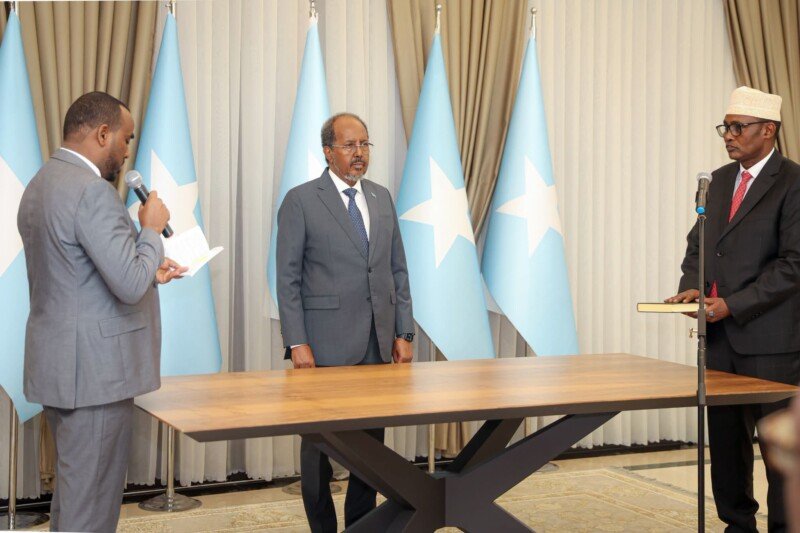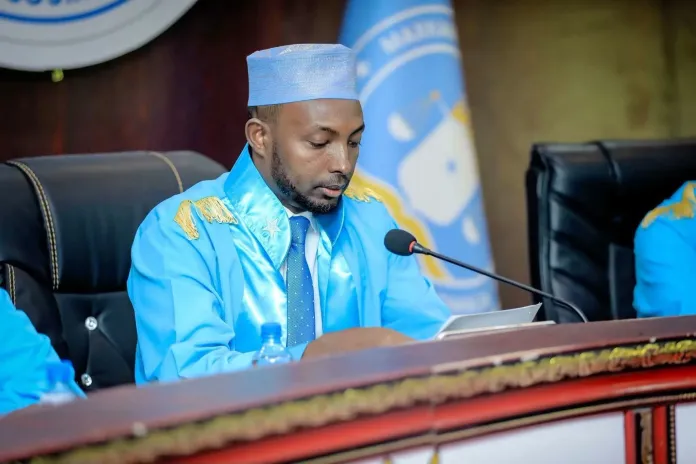
MOGADISHU, Somalia’s Supreme Court has issued a sweeping ruling declaring that the constitutional mandates of the federal parliament, the president, and the government expired in 2026, ordering elections within 90 days, and declaring all actions taken by those institutions after their terms ended to be “unconstitutional, unlawful and null and void.”
The ruling, issued by the court’s five-member Constitutional Division, is a direct rebuke to President Hassan Sheikh Mohamud and the federal institutions that have been operating under a contested constitutional extension. It comes one day after the President dismissed Chief Justice Baashe Yusuf Ahmed and installed a political ally in his place, a move the court had already declared null and void.
As FTL Somalia reported on the dismissal, the President removed Baashe on November 4, the same day the Prime Minister dismissed two junior officials, in a coordinated exercise of executive authority that unfolded against the backdrop of a contested electoral transition, a looming security vacuum, and a shrinking budget. The move was widely seen as an attempt to pre-empt a ruling on the constitutional amendments, and that prediction has now been proven right.
The Ruling: Mandates Expired, Elections Ordered
The court’s decision addressed a petition filed by former President Sharif Sheikh Ahmed on October 11, which challenged the constitutional amendment process and the legal consequences of changes made to the 2012 Provisional Constitution. The court rejected the first part of Sharif’s petition, ruling that he lacked legal standing to challenge the amendment process itself under Article 86 of the Provisional Constitution.
However, it accepted the second part, which questioned the legality of measures arising from the constitutional changes, particularly the extension of the mandates of elected federal institutions. The court ruled that because the 2026 amendments did not explicitly state that the new five-year term would apply to institutions already in office, the sitting institutions retained their original four-year mandates under the 2012 Constitution.
Applying that interpretation, the court determined that the mandates of both houses of the Federal Parliament and the federal government expired on April 14, 2026, while President Mohamud’s term ended on May 15, 2026. It declared that all actions taken by these institutions after those dates were unconstitutional and legally invalid.
The court said the Federal Government is the only institution constitutionally authorized to oversee a caretaker administration, but stressed that its powers are limited to conducting routine government affairs and that it cannot take decisions beyond day-to-day administrative responsibilities. It ordered all parties concerned with the electoral process to reach a consensus on a workable election framework within 30 days, and directed that elections be held within 90 days.
The ruling was signed by five judges led by Justice Salah Sheikh Ibrahim Dhiblawe.
The Chief Justice Standoff and the Military Deployment
The ruling on the constitutional case is inseparable from the confrontation over the Chief Justice. On November 4, President Mohamud dismissed Baashe and reappointed Ibrahim Idle Suleiman, a member of the ruling Justice and Solidarity Party (JSP) and a close associate of the President, citing complaints from judges and legal professionals about the administration of justice. The presidency did not identify specific allegations against Baashe, explain whether disciplinary proceedings had taken place, or cite any constitutional provision for the removal.
The Supreme Court responded on November 5 with a statement declaring the dismissal “null and void,” ruling that the President lacked the constitutional authority to remove the Chief Justice unilaterally. The court cited Article 135 and Article 138 of the 2026 Constitution, which require a proposal from the Judicial Service Commission and approval by both houses of Parliament for both appointment and removal. It also directly accused the President of attempting to obstruct the constitutional case, stating that “the purpose of the dismissal was to interfere with a constitutional case already before the court.”
Social media reports indicate that Baashe returned to Mogadishu from Nairobi on the same day, and that troops were deployed around the Supreme Court building while he was inside meeting. The reports, which could not be independently verified, suggest that the standoff between the executive and the judiciary has moved from the legal arena to the physical one.
The new Chief Justice, Suleiman, has a history that raises questions about his independence. He previously served as Chief Justice from 2016 until his dismissal in May 2018 by then-President Mohamed Abdullahi Farmaajo. After President Mohamud returned to power in 2022, he appointed Suleiman as his special legal adviser. As the Galmudug electoral process had already raised questions about institutional credibility, the appointment of a ruling party official to head the court that had annulled a Galmudug vote was seen by critics as a further erosion of judicial independence.
Why This Was a Purge
The sequence of events confirms the analysis that the dismissal of Baashe was a calculated move to clear a legal obstacle. As former President Farmaajo has warned of parallel elections and former President Sharif Sheikh Ahmed had challenged the constitutional amendments, the Supreme Court was the venue where that dispute was being litigated.
Local Media, citing sources, reported that Baashe had been expected to travel to Mogadishu and announce a Supreme Court decision on the constitutional amendments, a ruling that was expected to deal a significant blow to the President’s administration. The sources said the President’s decision to remove Baashe was intended to pre-empt that ruling. Somali Guardian reported that Baashe was on the verge of delivering a verdict when he was dismissed.
The court’s ruling has now vindicated that analysis. The decision that Baashe was expected to deliver, and that the President sought to prevent, has been issued by the court despite the attempt to change its leadership. The ruling declares the President’s own mandate expired and orders new elections within 90 days.
The broader context makes the stakes clear. The unravelling of Somalia’s security architecture as Ugandan troops withdraw, and the gap between petroleum promises and fiscal realities, have created a sense of urgency that makes the judicial confrontation even more destabilizing. A government with an expired mandate, a contested election calendar, and a security vacuum is now facing a court that has ruled its actions invalid.
Critical Note
The Supreme Court’s ruling is a remarkable act of institutional defiance. A judiciary that has often been criticized for its deference to executive power has, in this instance, drawn a clear line and refused to accept the President’s authority to remake it at will. The court’s reasoning is grounded in the text of the constitution, and its conclusion is unambiguous: the President and the parliament have been operating without a valid mandate since April and May 2026.
But a ruling is not a resolution. The President has already appointed a replacement Chief Justice, and he has shown no sign that he intends to reverse course. The court’s declaration that the dismissal is “null and void” does not change the reality on the ground, where Ibrahim Idle Suleiman is now sitting in the Chief Justice’s chair, and where troops have reportedly been deployed around the court building. The standoff is a test of whether Somalia’s institutions can resolve a constitutional crisis through law, or whether the outcome will be determined by whoever controls the guns and the money.
The timing is deeply troubling. Somalia is facing a contested election, a security vacuum as Ugandan troops withdraw, and a fiscal crisis that shows no sign of easing. The last thing the country needs is a confrontation between the presidency and the judiciary. But that is precisely what it has. The President’s decision to remove the Chief Justice was a calculated move to clear a legal obstacle. The court’s decision to declare that removal void, and to rule that the President’s mandate has expired, is a refusal to be cleared. The question now is whether either side is prepared to de-escalate, or whether the standoff will become another front in a conflict that Somalia can ill afford.
The court has ordered elections within 90 days. That is a deadline that the President’s government, which insists it has a mandate until 2027, is unlikely to meet. If the ruling stands, Somalia could be heading toward a constitutional vacuum, with a caretaker government of limited powers and a parliament whose term has expired. The alternative, if the ruling is ignored, is a judiciary that has been publicly overruled by the executive, and a legal system that has lost whatever independence it had left. Neither outcome is good for Somalia. The only path out is a negotiated settlement that both sides can accept, and there is little evidence that either side is willing to compromise.
Recommended Reading On ftlsomalia.com
- Somalia’s President Fires Chief Justice on Same Day Prime Minister Dismisses Two Officials
- Former President Farmaajo Rejects Election Timetable, Warns of Parallel Elections
- The First Domino: Uganda’s Withdrawal and the Unravelling of Somalia’s Security Architecture
- Petroleum Promises and Fiscal Realities: The Gap Somalia Cannot Afford to Ignore
- Electoral Commission Clears 12 Groups for Galmudug Vote as September 30 Deadline Nears