MOGADISHU, The closure of the United Nations Transitional Assistance Mission in Somalia (UNTMIS) on October 31 was framed as a historic handover of political responsibilities to a sovereign Somali state. But as the UN hands over the mandates for human rights monitoring, rule of law, and political good offices, a new World Bank report reveals that the institutions inheriting these functions lack the permanent staff to execute them.
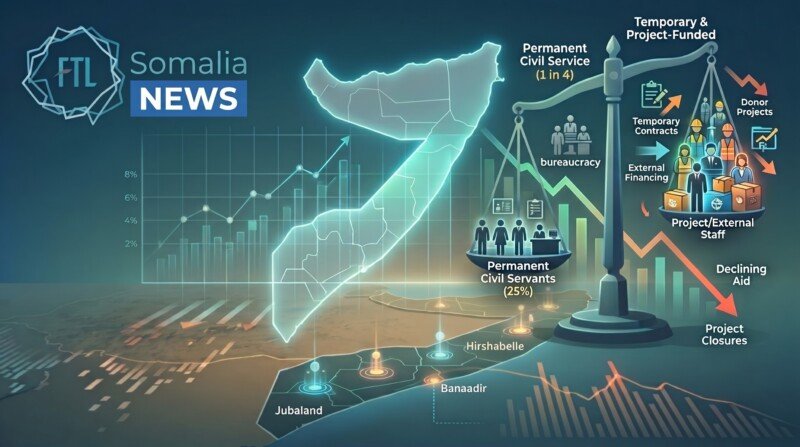
According to the World Bank’s 2026 Public Finance Review, only about one in four federal employees, and one in five state-level employees, are formal civil servants. The vast majority of the workforce delivering administrative and public service functions operates under temporary, project-funded, or externally financed arrangements. In material terms, the Somali state is not a permanent bureaucracy, but a temporary republic built on donor projects.
As FTL Somalia reported at the time of UNTMIS’s closure, the transition transferred the “title and the obligation, not the resources.” The World Bank’s data explains why this is a structural crisis, not just a funding gap. The government cannot absorb the UN’s functions because it does not have a permanent civil service to absorb them into.
The Project-Funded State
The World Bank report outlines a workforce characterized by high fragmentation and multiple employment modalities. At the federal level, only a fraction of personnel are formalized civil servants subject to established legal frameworks, pay scales, and payroll processing. A large share operates as temporary workers, public workers funded by external programs, or project-funded consultants.
In 2024, project-financed and non-project advisory positions exceeded formal federal civil service posts by about 26 percent. These are the staff who run the government’s technical ministries, manage donor programs, and provide the analytical capacity that keeps the state functioning.
As international aid declines, this model is reaching its breaking point. The report warns that as projects wind down, the fiscal system will be unable to absorb these positions at current pay and staffing levels. This risks either an abrupt disruption of policy-making and service delivery or an unsustainable expansion of recurrent spending, as the government attempts to put temporary staff onto a permanent payroll it cannot afford.
The Vanishing Capacity
This dynamic directly undermines the UN’s transition strategy. The UNTMIS closure was predicated on the assumption that Somali institutions could take over its functions. But the institutions receiving those functions are staffed by the very people whose contracts are tied to the donor funding that is now receding.
The human rights office handed over in September is a stark example. As FTL Somalia reported, the National Independent Human Rights Commission has a constitutional mandate to monitor abuses. But the UN’s own reporting noted that the funding for the UN country team may not be adequate to absorb its new tasks. If the commission’s staff are project-funded, and the projects are closing, the mandate becomes a dead letter.
The same applies to the political good offices function, which UNTMIS provided during electoral disputes and constitutional negotiations. The skills required for mediation and political analysis are precisely the kind of specialized capacity that is typically hired on a consultancy or project basis in Somalia, rather than embedded in a permanent civil service.
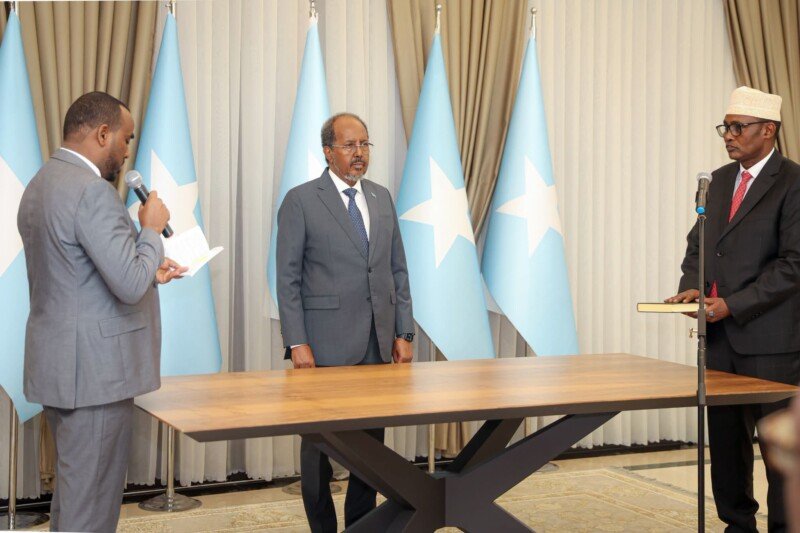
The justice sector faces a similar reckoning. In August, the Minister of Justice commended UNTMIS as the mission concluded 13 years of UN rule-of-law support, as FTL Somalia reported. But the handover of rule-of-law programming to national institutions does not automatically come with the lawyers, judges, and legal drafters needed to sustain it, many of whom were funded through the departing mission.
The 4.5 Formula and the Merit Deficit
Why has the state relied so heavily on temporary staff? The report points to the 4.5 clan power-sharing formula, which has stabilized post-conflict governance but often prioritizes representation over merit. Nearly one-quarter of appointments occur outside open competition, and temporary recruitment channels allow senior officials to make direct appointments without vacancy notices or standardized pay.
This has created a cycle where the formal civil service is weakened by patronage, and capacity gaps are filled by external consultants and project staff. The government has effectively outsourced its technical capacity to donors because it cannot build a meritocratic, permanent bureaucracy at home.
The report notes that as external assistance declines, a significant number of public employees, including teachers, health workers, and project staff, remain outside the formal civil service envelope. There is a need for an explicit and realistic discussion of the social contract, the report states, about what citizens can expect the state to finance and deliver, and how staffing, pay, and assumed functions can be aligned with affordability.
Critical Note
The UNTMIS closure ceremony celebrated the end of a “guardian-led” model. But the World Bank’s data shows that the Somali state has not yet built the permanent institutions needed to be its own guardian. It has built a temporary, project-funded apparatus that functions as long as the donors are paying.
The transfer of UN functions to Somali institutions was always going to be difficult, but it was premised on the existence of institutions capable of receiving them. The World Bank report reveals that those institutions are hollow at the core. The human rights commission, the justice ministry, the office of the prime minister, all depend on staff who are not permanent civil servants and whose salaries are tied to projects that are winding down.
This is the real risk of the transition. It is not just that the UN left without a budget. It is that the government it left behind cannot afford to keep the people it needs to do the work. The choice the government now faces, to absorb temporary staff into an unaffordable payroll or to lose core administrative capacity, is a choice it cannot win without a massive injection of domestic revenue or a rethink of what the state is actually for.
The report’s recommendation for an explicit social contract discussion is correct but understated. Somalia needs a frank conversation about which functions it can afford to perform permanently, and which it must continue to outsource or abandon. Until that conversation happens, the handover of mandates from the UN will be a transfer of paper, not power.
Recommended Reading On ftlsomalia.com
- The UN Political Mission Ends: Somali Institutions Inherit the Mandate Without the Budget
- Federal Government Completes Handover of UN Human Rights Office, Pledges Stronger National Oversight
- Minister of Justice Commends UNTMIS Support as Mission Concludes Justice Sector Assistance
- National Security Adviser and AUSSOM Chief Meet at Villa Somalia to Discuss Transition