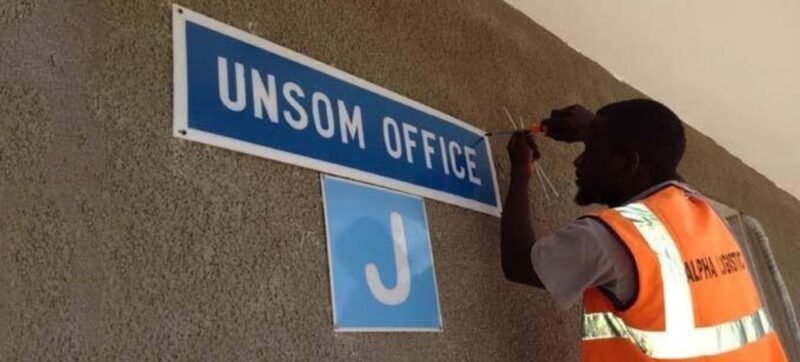
MOGADISHU, The United Nations Transitional Assistance Mission in Somalia (UNTMIS) formally ceased operations today, on October 31, closing more than three decades of UN political missions in the country and transferring its remaining functions to Somali institutions and UN agencies.
The closure follows a two-year transition mandated by Security Council resolutions 2753 (2024) and 2809 (2025), and carried out at the request of the Federal Government of Somalia. A formal ceremony in Mogadishu on October 26 was led by the mission’s Officer-in-Charge, Raisedon Zenenga, and Deputy Prime Minister Salah Ahmed Jama, with former President Sheikh Sharif Sheikh Ahmed, former Prime Minister Mohamed Hussein Roble, civil society representatives, and diplomats in attendance.
UNTMIS succeeded the UN Assistance Mission in Somalia (UNSOM) in November 2024. Its predecessor missions stretch back to 1992, through UNOSOM I and II, UNPOS from 1995 to 2013, and UNSOM from 2013 onward. As FTL Somalia reported, the closure moves the country away from a “guardian-led” model toward a “Somali-managed, Somali-directed” framework. As FTL Somalia noted when the decision was confirmed, the shift to a “lighter footprint” brings both opportunity and peril, removing the neutral buffer the UN provided during domestic disputes with federal member states.
What Was Actually Transferred
The official language describes a transfer of “mandated functions” to Somali institutions and UN agencies. What that means in practice deserves closer scrutiny. The handovers completed in the months before closure were largely procedural: the signing of documents, the designation of Somali officials as the new holders of responsibilities, and the announcement of institutional mandates. What was not transferred was the material basis that made those functions possible.
In August, the Minister of Justice commended UNTMIS as the mission concluded 13 years of UN rule-of-law support, as FTL Somalia reported. In September, the Federal Government completed the handover of the UN Human Rights Office, transferring responsibility for human rights monitoring to national institutions, as FTL Somalia reported. The National Independent Human Rights Commission, now constitutionally mandated, subsequently met with Zenenga to discuss the handover of monitoring responsibilities, with the UN pledging continued support for the Commission’s institutional capacity after UNTMIS closes, as FTL Somalia reported.
These are real responsibilities, and the officials who accepted them are now formally accountable for discharging them. But the transition did not come with the budgets that UNTMIS received from donors, the technical staff it employed, the vehicles and communications equipment it operated, or the operational flexibility that comes with independent funding. The Somali institutions that inherited these functions received the title and the obligation, not the resources. The UN’s resident agencies, funds and programmes remain in the country, but their funding is separate, contested, and in several cases shrinking.
Guterres: Progress Made, Challenges Remain
In a statement issued by his Spokesperson, UN Secretary-General António Guterres commended the progress achieved over the past decades towards building peace and security in Somalia, praising “the determination and resilience of the Somali people despite the many challenges they face.”
But the Secretary-General also recognized “the significant political, security, humanitarian and development challenges that remain.” He called for sustained international support to consolidate progress, advance inclusive political dialogue and reconciliation, strengthen institutions, and promote and protect human rights. He specifically underscored the importance of continued support to address the threat posed by Al-Shabaab and enable a gradual and sustainable security transition.
Zenenga described the closure as the culmination of a carefully coordinated two-year transition. “The closure of UNTMIS does not signal the end of UN support, nor does it diminish Somalia’s partners’ commitment. Instead, it opens a new chapter in the UN’s partnership with Somalia,” he said. The United Nations will continue to support Somalia through its resident agencies, funds and programmes, working with Somali authorities, the African Union and other international partners.
The Funding Shadow
The closure comes against a backdrop of severe financial constraints across the UN system in Somalia. A report of the Secretary-General pursuant to resolution 2809 (2025) warned that the transition is “taking place against the backdrop of increasing divisions among Somali stakeholders over the country’s political transition and severely constrained global resources allocated to Somalia.” The Secretary-General expressed deep concern about “the sharp decline in funding for Somalia” and appealed to partners to ensure the Federal Government and UN country team are adequately funded to absorb the relevant tasks of the Mission.
That concern extends to the security file. The same report noted that AUSSOM “remains indispensable in supporting Somali security forces to consolidate peace and security gains,” and warned that “operational continuity is essential to prevent the reversal of the significant gains achieved over the past decade.” The closure of UNTMIS coincides with Uganda’s withdrawal of troops and the broader funding crisis facing the African Union mission. As FTL Somalia reported on the AUSSOM handover in Buurhakaba, the transfer of security responsibilities was already unfolding “at a critical juncture as both the AU mission and the UN political presence in Somalia face imminent closure,” with the United States having notified the African Union that it would end support for the UN Support Office in Somalia.
Critical Note
The closure of UNTMIS is a milestone that the Somali government has sought and now celebrates. It represents a formal recognition that the country has moved beyond the phase of direct international political stewardship that began in the 1990s. Deputy Prime Minister Jama captured the significance of the moment: “You are leaving a Somalia that is drastically different from the one that you arrived in.” That is true. The Somalia of 2026 has constitutional and federal institutions, a national security architecture, and a debt relief process completed, none of which existed when the first UN political office opened in 1992.
But the transfer of responsibilities also transfers risk, and the risk is not evenly matched by the means to manage it. The UN mission supported the constitutional review, electoral processes, political dialogue, reconciliation, human rights, and security sector reform. Somali institutions have now been formally assigned these functions. What they have not been given is the funding that UNTMIS drew from donors, the staff it deployed, or the operational infrastructure it used. The transition, in material terms, transferred paperwork and titles, not capacity or funding.
The funding crisis is the most immediate test. The Secretary-General’s own report warned that the transition is occurring amid “severely constrained global resources” and that the UN country team may not be adequately funded to absorb the tasks it is inheriting. The human rights office has been handed over, but the question of whether the National Independent Human Rights Commission has the resources and independence to monitor abuses without the UN’s protective umbrella remains unanswered. The same applies to the political good offices function, which UNTMIS provided during electoral disputes, political and constitutional negotiations.
The closure is not the end of the UN’s engagement, as Zenenga and Guterres both stressed. But it is the end of a particular kind of engagement, one in which the international community carried direct responsibility for Somalia’s political trajectory. What comes next depends less on the statements issued at the ceremony than on whether Somali institutions can fill the space the UN has vacated with resources they do not currently have, and whether the international partners who funded the mission are prepared to fund its successors with the same seriousness. On the evidence of the transition so far, the answer to both questions is highly uncertain.
Recommended Reading On ftlsomalia.com
- UN Closes Political Mission in Somalia After Three Decades
- Federal Government Completes Handover of UN Human Rights Office, Pledges Stronger National Oversight
- Minister of Justice Commends UNTMIS Support as Mission Concludes Justice Sector Assistance
- AUSSOM Handover in Buurhakaba Signals Progress Amid Looming Mission Closure
- UN to Close Somalia Political Office, Extend AU Mission Until 2026