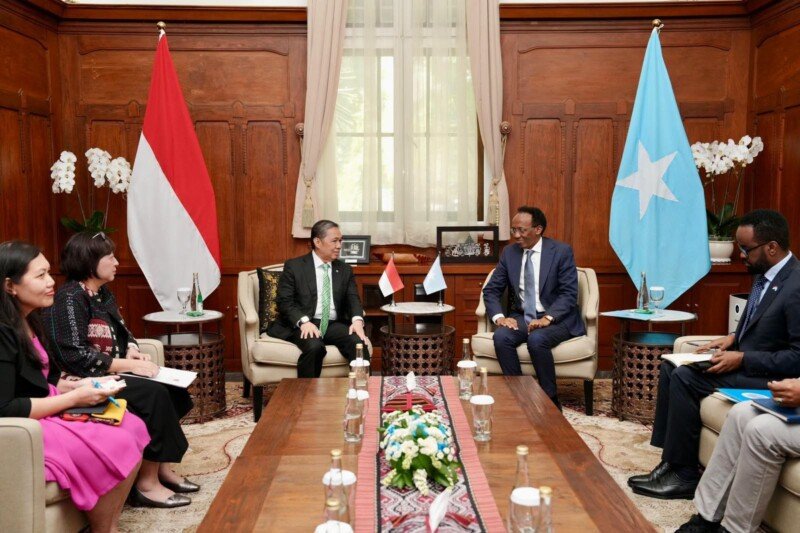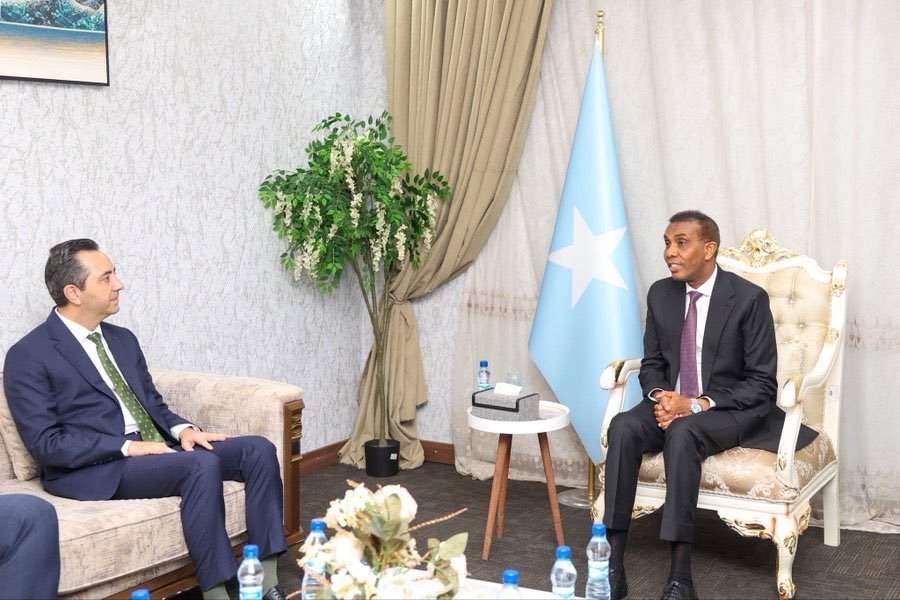
MOGADISHU, Türkiye’s Ambassador to Somalia, Ferhat Alkan, paid a courtesy visit to Prime Minister Hamza Abdi Barre on Wednesday, reaffirming the two nations’ commitment to strengthening their historical and deep-rooted relations across a wide range of sectors.
According to a statement from the Turkish Embassy in Mogadishu, the meeting focused on the common will to further enhance bilateral ties and friendly human connections. The discussions covered ongoing cooperation projects in energy, infrastructure, fisheries, security, health, education, space, and connectivity. The embassy thanked Prime Minister Barre for his reception and his support for Türkiye-Somalia friendship.
The Prime Minister’s Office has previously expressed gratitude for Ankara’s role in rebuilding the Somali Armed Forces and modernising government institutions, highlighting the security dimension of the partnership [citation:10].
A Comprehensive Diplomatic Tour
Wednesday’s meeting with the Prime Minister is part of a broader diplomatic tour Ambassador Alkan has undertaken since arriving in Mogadishu in September 2026. His engagement with Somali leadership has been extensive, signaling Ankara’s intent to maintain its deep footprint in the country.
Ambassador Alkan began his tenure by presenting his credentials to President Hassan Sheikh Mohamud in early October, marking the start of his mission during the 60th anniversary of diplomatic relations between the two countries, as reported in FTL Somalia’s coverage of the credentials ceremony. He also visited the spaceport facility under construction in Warsheikh district, inspecting progress on a project that underscores the strategic and technological depth of the relationship, as detailed in FTL Somalia’s coverage of the visit.
Beyond the executive branch, Alkan has engaged with security leadership. He recently met with the Somali Police Commissioner, Brigadier General Asad Osman Abdullahi, to discuss enhancing bilateral cooperation in the security sector, with a particular emphasis on advancing training programs and building the capacity of the Somali Police Force, especially the elite Haramcad unit, as noted in FTL Somalia’s coverage of police cooperation. In previous months, his predecessor, Alper Aktaş, held similar talks with the National Security Advisor and the Defence Minister, maintaining a consistent line of communication between Ankara and Mogadishu’s security apparatus.
His diplomatic activity also extends to the legislative and informational branches. In May, the Turkish Embassy engaged with the Ministry of Information to develop frameworks for media modernization and cross-cultural exchange, as reported in FTL Somalia’s coverage of the information ministry talks.
The Strategic Depth and Its Complications
Türkiye’s relationship with Somalia is among the most comprehensive of any external actor. It spans humanitarian aid, infrastructure development, military training, and economic investment. Turkish firms operate Mogadishu’s port and airport, and the 2024 defense agreement has given Ankara a significant role in Somalia’s maritime security.
However, this deepening engagement has not been without controversy. The federal government’s political opponents, including former South West State President Abdiaziz Laftagareen, have accused Türkiye of enabling a “clan-based agenda” through its military support, specifically citing F-16 airstrikes in the Baidoa region, as reported in FTL Somalia’s coverage of the complaint. The complaint adds a layer of political risk to Ankara’s military presence, entangling it in Somalia’s internal disputes.
Critical Note
Ambassador Alkan’s meeting with Prime Minister Barre is a routine diplomatic engagement, but the breadth of sectors discussed, from energy and fisheries to space and connectivity, reflects a relationship that has moved far beyond traditional aid. Türkiye is embedded in Somalia’s security architecture, its economic infrastructure, and even its technological ambitions.
The diplomatic tour Alkan is conducting is a testament to the institutional depth of the relationship. He is not just meeting with the President and Prime Minister; he is engaging with the police, the information ministry, and visiting strategic projects like the spaceport. This is the behavior of an ambassador whose country has significant, long-term interests to protect.
But the partnership’s intensity also carries risks. As the Laftagareen complaint demonstrates, Türkiye’s military role has made it a participant, willing or not, in Somalia’s internal political conflicts. The Somali government values Turkish support, but it also uses it as a shield against domestic and international criticism. The question for Ambassador Alkan is whether he can manage a relationship that is expanding in scope while navigating the political sensitivities that come with such deep involvement. The meeting on Wednesday was a reaffirmation of friendship. The challenge lies in what that friendship requires in practice.