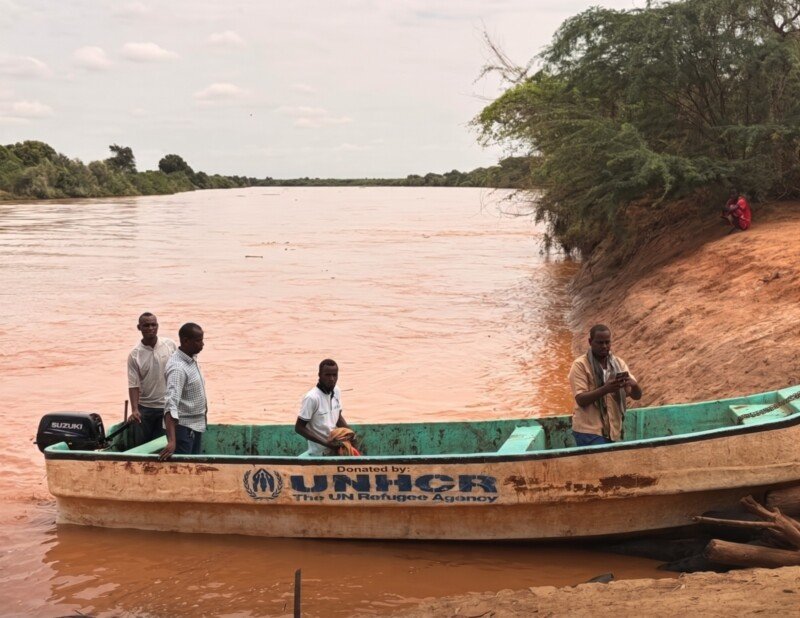
MOGADISHU — The United Nations Office for the Coordination of Humanitarian Affairs (OCHA) has warned that just two boats are on standby to reach more than 30 villages in Doolow district, Gedo region, as Somalia braces for projected El Niño floods during the October-December Deyr rainy season.
In a statement released on Wednesday, OCHA recalled that in 2023, boats saved lives in Doolow, evacuating flood-isolated families and delivering supplies. Ahead of the projected floods this year, only two boats are available for the district, and OCHA said more are needed to reach everyone at risk.
The warning was accompanied by testimony from a Doolow resident identified as Guled, who explained the situation on the ground. OCHA did not release further details of his account, but the agency’s message was clear: the gap between the scale of the threat and the resources available to respond remains wide.
Doolow’s Vulnerability
Doolow district sits on the Juba River at the border with Ethiopia, making it one of the most flood-prone areas in Somalia. According to a disaster risk assessment conducted in the district, 76 percent of respondents identified riverine floods as the most common natural disaster affecting their communities, while 45 percent said no disaster risk assessments had been conducted in their area.
The district also hosts a large displaced population. Data from the International Organization for Migration shows that Doolow has 8,628 IDP households, comprising 51,770 individuals, alongside 876 resident households. These populations often live in low-lying settlements that are particularly exposed to flooding.
Radio Ergo’s weekly feedback report for early October 2026 confirmed that callers in Doolow were expressing fears about the anticipated El Niño rains. One caller said they were facing drought conditions despite hearing about El Niño coming, noting that they had received only a little rain that was not enough to help their livestock. Another caller in Doolow, Gedo, expressed concerns about the risks of flooding.
The 2023 Precedent
Doolow’s experience in 2023 illustrates both the value of boats and the scale of the need. During the 2023 Deyr floods, more than 100,000 people who were cut off from market supplies in Doolow and Bardheere were reached by boat. At the peak of the response, 26 boats were conducting humanitarian missions across seven locations, including two in Doolow.
SoDMA sent two boats each to Baardhere, Burdhuo and Doolow, and one to Luuq. The UN released $25 million to help prevent loss of life and address food insecurity. Local authorities and the community in Doolow also provided $80 in cash assistance to 1,200 families.
The contrast between the 2023 response and this year’s pre-positioning is stark. While 26 boats were deployed during the actual flood response three years ago, only two are currently on standby in Doolow before the anticipated floods.
Broader Preparedness Gaps
OCHA’s warning about Doolow is part of a broader pattern of under-preparedness across Somalia. The Somali Disaster Management Agency (SoDMA) has urged communities in 29 districts across 14 regions to prepare for potential heavy, flood-causing rains, including Doolow, Luuq, Baardheere, Belet Weyne, Jowhar and Kismayo.
Forecasters project a greater than 90 percent probability of El Niño conditions developing and intensifying during the Deyr season. The 2026 El Niño could reach similar or higher levels of severity than previous events, with 97 to 100 percent probability of severe flooding across Somalia between October and December.
FAOSWALIM has identified 388 sites along the Shabelle River as having flood-related conditions, including 150 sites where water is overflowing the riverbanks. These figures underscore the scale of the risk facing riverine communities across southern Somalia.
Pre-positioned financing for flood preparedness stands at approximately $17 million against a credible worst-case scenario in the range of the 2023 floods, which cost $176 million in damages and losses alone. The 2026 Somalia Humanitarian Needs and Response Plan is only 15.2 percent funded.
Critical Note
OCHA’s warning about Doolow is a specific and measurable indicator of a much larger problem: Somalia is approaching a forecasted major flood event with a fraction of the resources that will be needed to respond.
Two boats for 30 villages is not a preparedness posture. It is a calculation that some people will be left behind. In 2023, when floods hit, the international community mobilized 26 boats and $25 million in emergency funding. This year, before the floods, two boats are on standby and the response plan is 15 percent funded.
The gap between what is known and what is done is the defining feature of Somalia’s climate crisis. The forecasts are accurate. The warnings are issued. The vulnerability is documented. What is missing is the investment in pre-positioned resources, infrastructure, and community-level capacity to act before the water rises. Doolow’s residents, many of them displaced and living in low-lying areas, will bear the consequences of that gap.
Share your story. FTL Somalia is continuing to investigate flood preparedness and response across Somalia. If you have information or insights to share, contact us at info@ftlsomalia.com. Your identity will be protected.
Recommended Reading On ftlsomalia.com
- SoDMA Urges 29 Districts Across 14 Regions to Prepare for Super El Niño Flooding
- Over 300 Sites on Shabelle River Identified as Flood-Prone, FAOSWALIM Reports
- Environment Ministry Gathers Experts in Mogadishu for Climate Forecast and Early Action
- Jubaland Warns of Heavy Rains and Floods as Deyr Season Approaches