MOGADISHU — A drone strike carried out by the United Arab Emirates killed four members of a single Somali family, including three children, in the Cal Miskaad mountains of Puntland’s Bari region, according to an investigation published Friday by Drop Site News.
The January 26, 2025 attack near Togga-Xarago also wounded five other family members and destroyed hundreds of livestock, the report said, citing interviews with survivors and four Puntland security officials who spoke on condition of anonymity because of the sensitivity of military operations.
The Attack
Khadra Abdi Ismael, 38, told Drop Site that her family had gathered for dinner in their traditional Somali hut, known as an aqal Soomaali, when she stepped outside to visit a neighbour. She heard the roar of an aircraft approaching moments before an explosion struck the shelter.
“The aqal Soomaali was engulfed in flames, and smoke was everywhere,” Khadra said. “Once the smoke cleared, the true horrors emerged: I saw shrapnel from the missile and body parts strewn everywhere. Even the livestock were ripped to pieces.”
The strike killed Khadra’s older sister, Ladan Abdi Ismael, and Ladan’s 13-year-old son, Abdisamad Yusuf Mohamud. Also killed were seven-year-old Mohamed Abdiqani Mohamed and 17-year-old Hawa Ahmed Salah, who was four months pregnant. Hawa was holding her eight-month-old baby when the missile hit. The infant survived.
“The child survived, but she didn’t,” Khadra told Drop Site.
Among the wounded was Habibo Yusuf Mohamud, who was pregnant at the time of the strike. More than a year later, she still has shrapnel lodged in her neck and limited movement in one arm, according to the report.
Ordered to Move to a “Safe Zone”
Just weeks before the strike, the family had been living in Dhadaar, a settlement in the Cal Miskaad mountains where relatives said their community had lived for generations.
In early December 2024, government forces informed the family and other residents that ISIS fighters were operating nearby and ordered them to relocate to designated safer areas, according to the investigation. Ahmed Abdi Ismael, Khadra’s brother, said the family followed those instructions after receiving assurances that their new location would be safe.
“They were told to move and that this new area would be safe from the fighting, but they were bombed anyway,” Ahmed told Drop Site.
After the strike, survivors used camels belonging to neighbouring families to transport the wounded to Balidhidin, before those requiring more intensive treatment were taken to Bosaso. The family lost six camels and approximately 400 goats, their main source of livelihood, and has not returned to Togga-Xarago.
UAE Base at Bosaso Airport
Four Puntland security officials told Drop Site that the drones involved in the strike had operated from a UAE military facility at Bosaso airport. The base supports counterterrorism operations against ISIS militants in the mountains, they said.
One official contrasted what they described as more cautious US surveillance with the Emirati approach, telling Drop Site: “The Emirates fire on anything that moves. It’s like target practice for them.”
According to the report, Emirati drone strikes stopped by November 2025, after which the United States assumed the leading role in aerial operations against ISIS in Puntland. US Africa Command has confirmed conducting strikes against ISIS positions near Bosaso during 2026, saying it carried out the operations in coordination with Somalia’s federal government.
The UAE embassy in Mogadishu and the UAE Ministry of Foreign Affairs did not respond to Drop Site’s requests for comment about the strike or Emirati military operations in Puntland.
The Hilaac Offensive
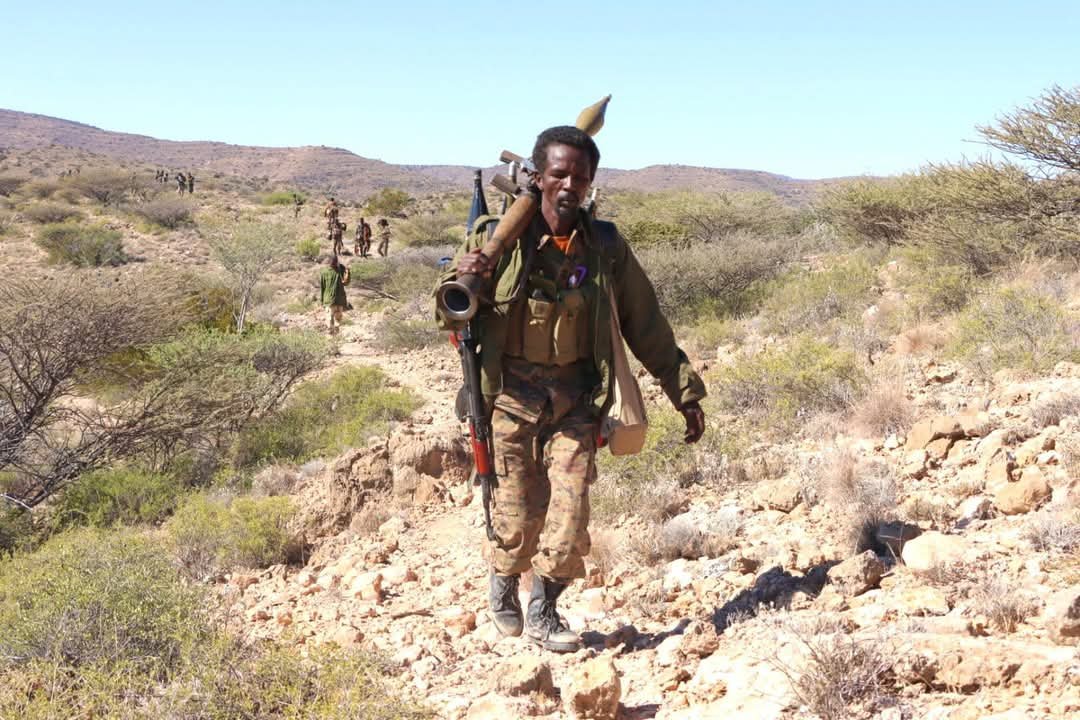
The strike occurred during Operation Hilaac, a Puntland-led military campaign launched in late 2024 to dislodge ISIS from its strongholds in the Cal Miskaad mountains. The operation received aerial support from the United States and the UAE, whose aircraft targeted militant positions while Puntland troops advanced on the ground. As reported in FTL Somalia’s coverage of Operation Hilaac, Puntland forces made significant territorial gains during the campaign, seizing critical territory and pushing ISIS fighters closer to their final refuge in the Baallade Valley.
The humanitarian impact of the campaign has been significant. The International Committee of the Red Cross warned in January that prolonged insecurity and severe drought were disrupting pastoralist livelihoods across the Bari region, displacing tens of thousands of people.
Renewed ISIS activity in 2026 prompted Puntland forces to intensify operations once again. As reported in FTL Somalia’s coverage of the blockade on ISIS fighters, Puntland authorities established a severe blockade around the remaining militants concealed in the rugged mountains, designed to sever all supplies sustaining the group.
Puntland has also faced challenges with the financial networks supporting ISIS. As detailed in FTL Somalia’s coverage of ISIS financing, a Puntland minister revealed that the group earned at least $10 million monthly from protection schemes, unlawful gold extraction, and charcoal trafficking to finance its operations.
Political Context
The investigation comes amid ongoing tension over the UAE’s military presence and political influence in Somalia. In January 2026, Somalia’s federal government annulled agreements with the UAE related to security, defence, and management of strategic ports, accusing Abu Dhabi of violating the country’s sovereignty and unity.
Puntland’s administration rejected that decision, arguing that the federal government could not unilaterally void agreements affecting Puntland without consulting the regional administration. Despite the diplomatic dispute, the UAE has continued to support Puntland’s security forces, particularly the Puntland Maritime Police Force, providing training, salaries, and intelligence.
Puntland President Said Abdullahi Deni was reported to be in Abu Dhabi on October 9, according to security officials who spoke to Drop Site. The officials did not disclose the purpose of his visit.
Critical Note
The killing of four civilians, including three children and a pregnant teenager, in a UAE drone strike is a grave incident that demands accountability. The survivors’ account, that they were ordered by government forces to relocate to a designated “safe zone” and were then bombed, raises serious questions about how targeting decisions were made and whether adequate precautions were taken to protect civilians.
The Puntland security officials’ description of Emirati strikes as “catastrophic” and “reckless,” and their characterization of US surveillance as more thorough, suggests internal concerns about the UAE’s rules of engagement. The absence of any response from Emirati authorities to Drop Site’s requests for comment is troubling. The UAE owes an explanation to the family and to the Somali public.
This case also exposes the broader problem of civilian harm in Somalia’s counterterrorism operations. The airstrikes occur in remote, mountainous terrain, making independent verification and casualty documentation extremely difficult. There is no comprehensive official data on civilian casualties from the war against ISIS in Puntland. The international community, including the UAE and the United States, should support mechanisms for transparent investigation and accountability when civilians are killed in their operations.
Recommended Reading On ftlsomalia.com
- Operation Hilaac Approaches Finale as Puntland Forces Close in on ISIS Stronghold
- Puntland Tightens Blockade on ISIS Fighters in Al-Miskaad Mountains
- Puntland Minister Reveals ISIS Earned $10 Million from Illegal Gold and Charcoal
- Puntland Sends Reinforcements to Al-Miskaad as Anti-ISIS Operation Nears Completion