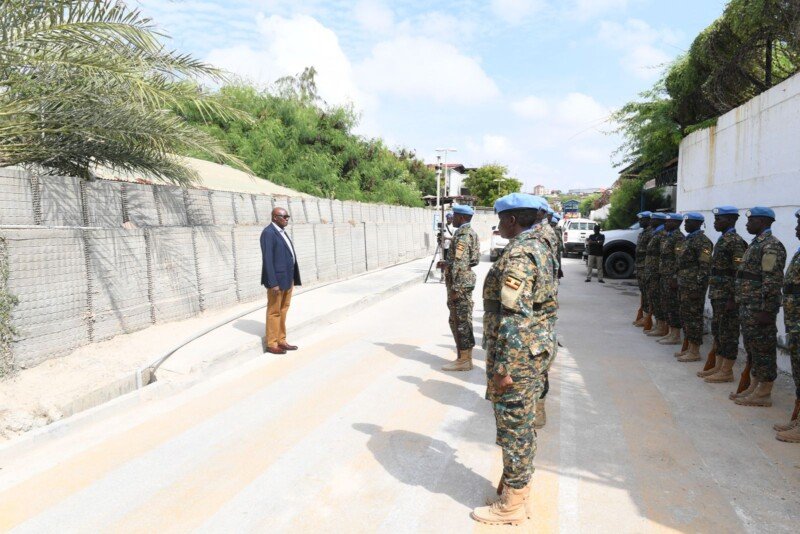
MOGADISHU, A day after the United Nations Transitional Assistance Mission in Somalia (UNTMIS) formally concluded its mandate, the mission’s Officer-in-Charge and UN Secretary-General’s Deputy Special Representative for Somalia, Raisedon Zenenga, was accorded a Guard of Honour by the United Nations Guard Unit (UNGU) ahead of his departure from the country.
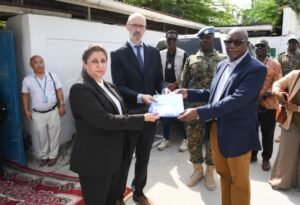
The ceremony in Mogadishu was attended by the UN Resident and Humanitarian Coordinator for Somalia, George Conway, and the Acting Assistant Secretary-General and Head of the United Nations Support Office in Somalia (UNSOS), Qurat-ul-Ain Sadozai. It marked the final formal act of a mission that has been closing its operations over the past two months.
The departure follows the mission’s formal closure on October 31, which ended more than three decades of UN political missions in Somalia and transferred its remaining functions to Somali institutions and UN agencies. A ceremony in Mogadishu on October 26, led by Zenenga and Deputy Prime Minister Salah Ahmed Jama, had already marked the political conclusion of the transition, as the final handover of mandates took place without the accompanying budgets or staff.
A Departure Amidst Funding Constraints
Zenenga’s exit comes as the UN system in Somalia confronts severe financial constraints. A report of the Secretary-General pursuant to resolution 2809 (2025) warned that the transition is “taking place against the backdrop of increasing divisions among Somali stakeholders over the country’s political transition and severely constrained global resources allocated to Somalia.”
That concern extends to the security file. The loss of UN logistical support threatens to pull the foundation from under the African Union Support and Stabilization Mission in Somalia, and Somali forces are expected to assume greater responsibility for security. The UN’s human rights monitoring and justice sector support have already been formally transferred to national institutions, and the conclusion of 13 years of rule-of-law assistance means these functions now rest entirely on domestic capacity.
Zenenga’s departure leaves the UN’s remaining presence in Somalia concentrated in its resident agencies, funds, and programmes, which are themselves facing funding pressures. The political transition from AUSSOM to Somali-led security remains a central concern for the remaining international presence, as the mission draws down.
Critical Note
The Guard of Honour is a fitting ceremonial close to a mission that has been part of Somalia’s political landscape for a generation. It is also a reminder of what is leaving. The UN’s political mission provided good offices, mediation, and a neutral platform that Somali actors could use when their own disputes threatened to spiral. That function has now been handed over to Somali institutions, but the resources that sustained it have not.
Zenenga’s departure marks the end of an era in which the international community carried direct responsibility for Somalia’s political trajectory. What comes next depends on whether Somali institutions can fill the space the UN has vacated, and whether the international partners who funded the mission are prepared to fund its successors with the same seriousness. The Guard of Honour honours the mission’s service. It does not answer the question of what replaces it.
Recommended Reading On ftlsomalia.com
- The UN Political Mission Ends: Somali Institutions Inherit the Mandate Without the Budget
- Federal Government Completes Handover of UN Human Rights Office, Pledges Stronger National Oversight
- Minister of Justice Commends UNTMIS Support as Mission Concludes Justice Sector Assistance
- National Security Adviser and AUSSOM Chief Meet at Villa Somalia to Discuss Transition