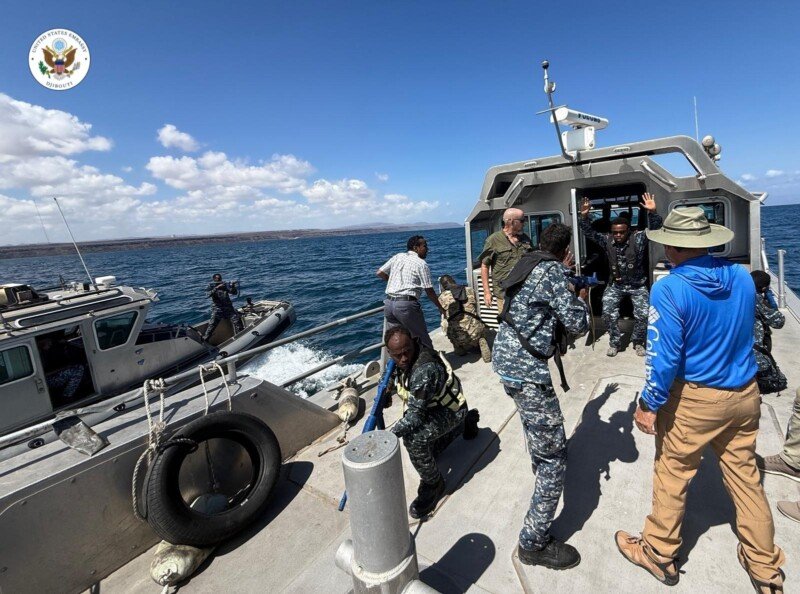
DJIBOUTI, American and Djiboutian naval forces have continued their collaboration to strengthen maritime security in the Red Sea and the Bab el-Mandeb Strait, with U.S. instructors recently working alongside the Djiboutian Navy to bolster its maritime interception capabilities, enhance operational planning, and maintain U.S.-provided patrol boats, according to a statement from the U.S. Embassy in Djibouti.
The training is framed as a routine component of longstanding security cooperation between Washington and Djibouti, aimed at improving Djibouti’s capacity to protect its territorial waters and secure essential maritime routes for international trade. For Somalia, however, the announcement carries a more uncomfortable implication: the security architecture of the Bab el-Mandeb is being reinforced at its narrowest point, while the Somali coastline that opens onto the same corridor remains largely unguarded.
The Asymmetry of Maritime Capacity
Djibouti and Somalia share proximity to the same strategic waterway, but their maritime capabilities exist in different orders of magnitude. Djibouti hosts the largest permanent U.S. military base in Africa and has received sustained international investment in its navy, including patrol boats, radar surveillance systems, and training programmes designed to monitor the vessels that transit the Bab el-Mandeb annually.
Somalia’s maritime-security apparatus, by contrast, remains underdeveloped and fragmented. The Somali Navy and Coast Guard operate primarily around Mogadishu, with limited reach beyond territorial waters, and remain reliant on sporadic international support. The lack of adequate seagoing vessels, training, and maritime infrastructure means that counter-piracy and anti-smuggling measures are often restricted to land-based operations rather than active sea patrols.
This asymmetry is not new. It reflects a decade of international prioritisation of Djibouti as a stable platform for power projection, while Somalia’s coastline, the longest in mainland Africa, has been treated as a problem to be managed rather than an asset to be developed. As FTL Somalia reported in its coverage of recent attacks on Red Sea shipping, the diversion of global navies toward the northern Red Sea has left the Gulf of Aden’s southern approaches increasingly vulnerable.
What the Djibouti Training Means for Somalia
The U.S.-Djibouti training focuses on interception, operational planning, and maintenance of patrol boats. These are precisely the capabilities that Somalia lacks. The consequence is a security perimeter that ends at Djibouti’s territorial waters, leaving the Gulf of Aden’s southern approaches, the waters off Puntland and Somaliland, and the Somali coastline itself outside any effective maritime enforcement framework.
This gap has tangible consequences. Somali piracy re-emerged in late 2023, coinciding with the Houthi attacks on Red Sea shipping, as international naval assets pivoted toward protecting commercial vessels closer to the Bab el-Mandeb. Pirates exploited the distraction, launching attacks from the Somali coast with relative impunity. As detailed in FTL Somalia’s coverage of the piracy resurgence, the diversion of global navies to counter Houthi threats allowed Somali piracy to once again thrive, with pirates holding dozens of seafarers hostage and demanding multimillion-dollar ransoms. The Djibouti training does nothing to address this. It strengthens the northern gate of the Bab el-Mandeb while leaving the southern approaches to the Gulf of Aden unguarded.
The EU’s decision to double its support for Djibouti’s navy is similarly framed as a contribution to regional security. But regional security, in practice, means the security of the shipping lane, not the security of the Somali littoral. A stable Bab el-Mandeb benefits global trade. It does not necessarily benefit Somalia, whose waters remain a transit zone for arms, narcotics, and human smuggling, and whose fishermen face illegal incursions by foreign vessels.
Somalia has taken steps to address its legal framework. The Senate unanimously passed an Anti-Piracy and Anti-Kidnapping Bill in September 2026, updating legislation first enacted in 1975. As reported in FTL Somalia’s coverage of the legislation, the law’s effectiveness will depend on implementation. Somalia lacks sufficient patrol vessels, trained personnel, and coordination between institutions to effectively police its waters. Without sustained investment in maritime security capacity, the law risks remaining strong on paper but weak in practice.
The Political Dimension
The U.S.-Djibouti partnership also carries political weight. Djibouti is a sovereign state with a functioning government that has successfully positioned itself as an indispensable security partner. Somalia is a federal state whose control over its own territory is contested, whose coastline is divided between the federal government and regional administrations with divergent external alignments, and whose maritime policy is entangled in disputes with Puntland and the UAE.
When Washington trains Djibouti’s navy, it reinforces a model of sovereign partnership. When it engages Puntland on security agreements or Somaliland on port access, it bypasses Mogadishu. The result is a regional maritime security architecture that treats Somalia not as a partner but as a collection of discrete access points, each valuable for its location but none treated as a unified sovereign entity. Somalia has sought to counter this by joining the Saudi-led maritime coalition. As reported in FTL Somalia’s coverage of the coalition, the 14-member bloc aims to protect navigation in the Bab al-Mandab, but the coalition’s operational effectiveness remains uncertain, and Somalia’s capacity to contribute meaningfully is limited.
Critical Note
The U.S.-Djibouti naval training is a legitimate exercise in bilateral security cooperation, and Djibouti’s capacity to protect its waters serves a genuine regional interest. But the announcement should be read alongside what it does not say. It does not mention Somalia. It does not address the coastline from which pirates launch their attacks, or the waters where illegal fishing and arms trafficking proceed with minimal interdiction.
The international community has made a calculated choice. It will invest in the stable partner and manage the unstable one through targeted interventions, drone strikes, and agreements with sub-national authorities. This approach may keep the Bab el-Mandeb open for commercial shipping. It will not build a Somali maritime capability, and it will not address the root causes of piracy, smuggling, and illegal fishing.
Somalia’s new maritime coalition membership and its blue economy ambitions are, in this context, aspirational. The country cannot regulate its fisheries, patrol its waters, or interdict smugglers without the vessels, training, and institutional capacity that Djibouti is receiving. Until that changes, Somalia will remain a spectator to the security of its own coastline, while its neighbours reap the benefits of international investment. The anti-piracy law passed in September is a necessary first step, but a law without a navy is a promise without a means of enforcement.
Recommended Reading On ftlsomalia.com
- UN Maritime Agency Warns of Worsening Humanitarian Crisis as Piracy Resurges in Somali Waters
- Somalia’s Senate Unanimously Passes Anti-Piracy Bill as Attacks Surge Off Coast
- Saudi Arabia, Somalia and 11 Nations Form New Maritime Coalition to Secure Red Sea and Bab al-Mandab
- Red Sea Shipping Under Threat: Tanker Hit by Unknown Projectile Off Saudi Coast