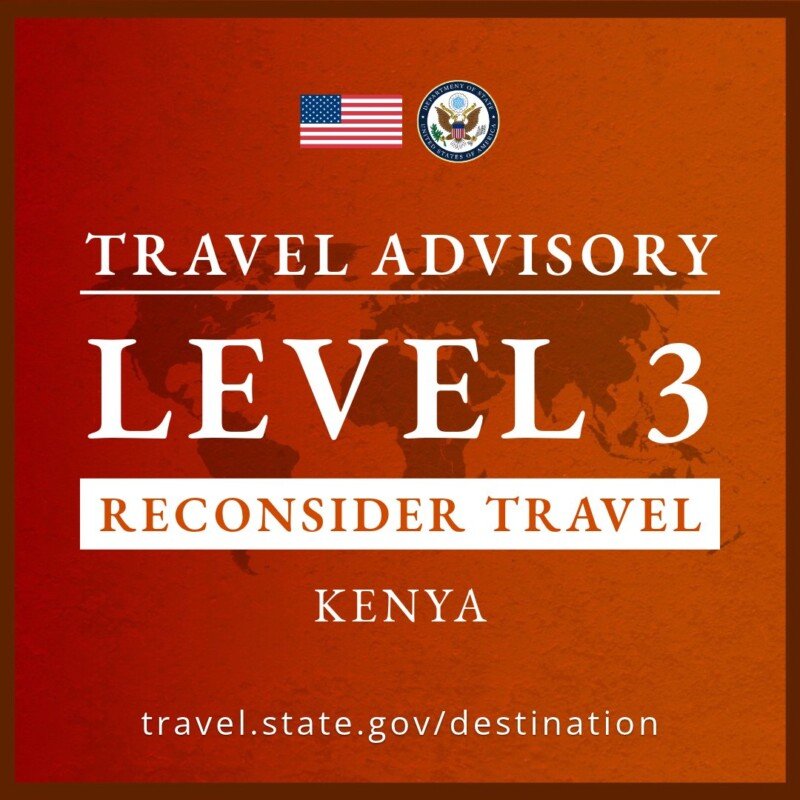
NAIROBI, The U.S. Department of State has increased its Travel Advisory for Kenya from Level 2 (Exercise Increased Caution) to Level 3 (Reconsider Travel), a significant downgrade in the regional security assessment that carries direct implications for Somalia’s economy, aviation sector, and security partnerships.
While the advisory is issued for American citizens traveling to Kenya, the shift to Level 3 reflects a broader deterioration of security conditions in the region. The U.S. State Department advises citizens to reconsider travel due to serious risks, which often include terrorism, civil unrest, or health emergencies.
The Economic and Aviation Lifeline
For Somalia, Kenya is not just a neighbor; it is a critical logistical and economic lifeline. Nairobi’s Jomo Kenyatta International Airport (JKIA) serves as the primary transit hub for international travel to and from Mogadishu. Many international carriers route their flights to Somalia through Nairobi, and numerous humanitarian and diplomatic missions operate out of the Kenyan capital.
A Level 3 advisory can lead to the suspension or reduction of U.S. corporate travel, insurance coverage complications for flights, and a chilling effect on the international business community operating in the region. As reported in FTL Somalia’s coverage of Somalia’s IATA-BSP rollout, the country’s aviation sector is only just beginning to integrate fully into global financial and ticketing systems. Disruptions in regional travel hubs like Nairobi could slow that momentum.
Furthermore, Kenya hosts a significant Somali diaspora and is a major destination for Somali students, medical patients, and business travelers. A downgrade in security perception complicates these movements. The reopening of the Kenya-Somalia border and the push for enhanced trade integration make this advisory particularly ill-timed for regional economic recovery, as detailed in FTL Somalia’s coverage of the border reopening.
Security and Counterterrorism Coordination
Kenya is also a crucial partner in the fight against Al-Shabaab. Kenyan troops are part of the African Union mission in Somalia, and the two countries share intelligence and conduct joint cross-border operations. A U.S. advisory highlighting instability in Kenya could complicate the coordination of these security efforts, particularly if it signals a broader deterioration of governance or rule of law in Nairobi.
The U.S. maintains a significant security footprint in the region, and its partnership with Kenya is a cornerstone of its East Africa strategy. As reported in FTL Somalia’s coverage of the U.S.-Kenya defence framework, the two nations recently signed a cooperation agreement aimed at strengthening regional security and counterterrorism operations.
A Pattern of Regional Volatility
The U.S. advisory for Kenya comes amid a broader pattern of regional volatility. As reported in FTL Somalia’s coverage of U.S. security alerts, the State Department recently issued heightened vigilance warnings for the Middle East and Red Sea region due to Houthi hostilities, which have already disrupted Somali trade routes and aviation. The addition of Kenya to the Level 3 list suggests that the security challenges affecting the Horn of Africa and the Red Sea are spilling over into the broader East African neighborhood.
Critical Note
A U.S. travel advisory is fundamentally a consumer protection tool for American citizens, not a comprehensive assessment of a nation’s stability. However, in the Horn of Africa, where Kenya serves as the logistical and financial clearinghouse for much of the international engagement with Somalia, the perception of security in Nairobi is inseparable from the perception of security in Mogadishu.
The escalation to Level 3 is a warning sign that regional instability is not confined to Somalia’s borders. When the U.S. signals that travel to Kenya requires “reconsideration,” it undermines the assumption that Nairobi is a safe rear base for diplomatic, humanitarian, and security operations in Somalia. For a Somali federal government already grappling with a constitutional crisis, a contested election, and an impending El Niño disaster, a destabilized or less accessible Kenya removes a critical buffer.
The State Department has not publicly detailed the specific triggers for this escalation in the provided announcement. But the effect is clear: it raises the cost of doing business, increases the risk premium for international engagement in the region, and serves as a stark reminder that Somalia’s stability cannot be achieved in isolation from the security of its neighbors.
Recommended Reading On ftlsomalia.com
- Somalia’s Red Sea Neighbor in Crisis: US Security Alert Highlights Regional Fallout
- Kenya, Somalia Reopen Border Crossings in Historic Move to Boost Trade and Security
- US and Kenya Sign Defence Cooperation Framework to Strengthen Regional Security
- EASA Warns Airlines Over Saudi, Somalia and Mali Airspace Risks
- Somalia Set to Roll Out IATA BSP Nationwide After Successful Pilot Phase