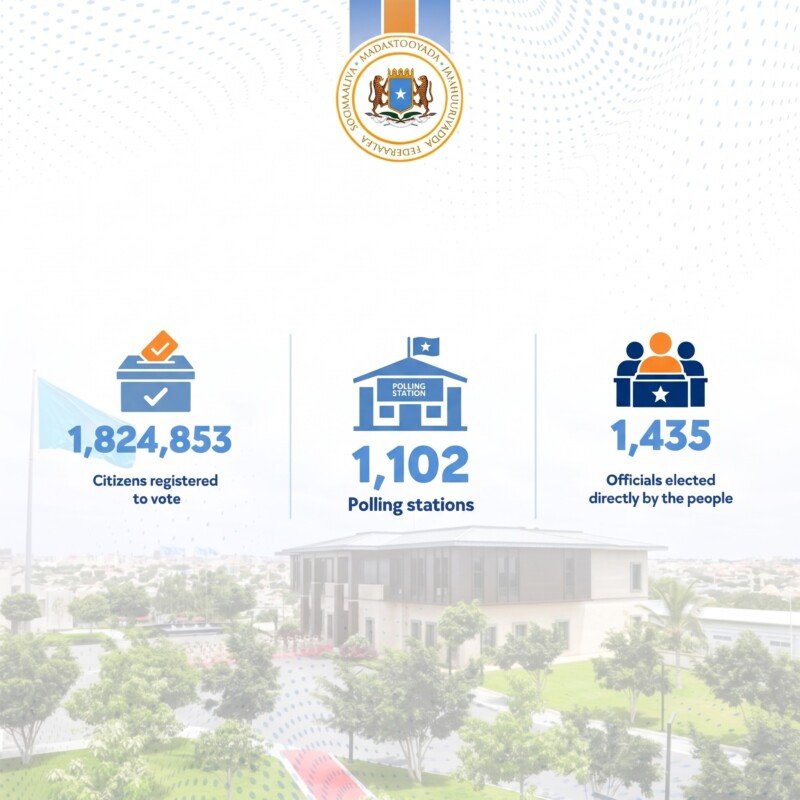
MOGADISHU, Villa Somalia has released detailed figures on its electoral process, announcing that 1,824,853 citizens have registered to vote across 1,102 polling stations in 50 of the 92 districts that existed in 1991, and that 1,435 officials have been elected directly by the people.
The figures were shared by the Presidency’s official account, quoting President Hassan Sheikh Mohamud, who has repeatedly framed the introduction of one-person, one-vote elections as Somalia’s return to a democratic path abandoned 57 years ago. The president has also claimed that “not a single armed incident occurred at any polling station across the country” and commended politicians who accepted the results despite their disagreements.
A Partial Picture
The president’s numbers are technically accurate for the districts where voting has taken place, notably in South West State, Galmudug, Hirshabelle, and the Banadir region. In Hirshabelle, the Justice and Solidarity Party secured 78 of 99 parliamentary seats with 114,633 votes cast, as reported in FTL Somalia’s coverage of the election results.
But the figures describe a process that remains incomplete and deeply contested. The 50 districts covered represent just over half of the 92 districts that existed in 1991. More importantly, the opposition Somali Future Council, which includes the Puntland and Jubaland administrations, has rejected the federal government’s electoral timetable and the constitutional amendments that extended the president’s term.
The opposition has not rejected direct elections as a principle. It has rejected the process by which they are being implemented, arguing that major decisions on elections should be reached through dialogue and consensus rather than unilateral action. The Somali Future Council has stated it is ready for “genuine dialogue to reach an electoral agreement and a realistic, implementable timetable,” but has demanded that the president halt what it describes as unilateral measures.
The Timing of the Announcement
Villa Somalia’s decision to release these figures now, rather than waiting for the National Consultative Forum it has invited the opposition to attend from November 14 to 18, is politically significant. As reported in FTL Somalia’s coverage of the invitation, the government has extended a formal invitation to Nabad iyo Nolol, the Somali Future Council, the National Unity Forum, and the Civil Society Coalition to discuss federal election matters.
But by presenting the electoral process as a success with concrete numbers before those talks begin, the president is establishing facts on the ground. The implicit argument is that if 1.8 million Somalis have registered and 1,435 officials have been elected, the process has a legitimacy that its opponents cannot deny. Those who reject it are rejecting the will of the people.
Critical Note
The figures are real, but they are not the whole story. A process can produce real votes and real officials while still being politically contested. The JSP’s victories in Hirshabelle and Galmudug were achieved in elections that the principal opposition parties either boycotted or were excluded from. The Galmudug rerun excluded Towfiiq, the party that had successfully challenged the original vote in court. The Hirshabelle vote proceeded despite the Xawaadle clan’s declaration that it would not accept any election without a prior political agreement.
The president’s claim that no armed incidents occurred at polling stations may be technically true in some districts, but it ignores the armed Macawiisley fighters who seized voter registration centres in Beledweyne, the curfews and security restrictions that accompanied the votes, and the broader political violence engulfing South West State, where Laftagareen-aligned forces are fighting federal troops. As reported in FTL Somalia’s coverage of the political crisis, Puntland President Said Abdullahi Deni has warned that Somali statehood is at risk and called for urgent national dialogue.
The real test of the government’s electoral project is not the number of registered voters or elected officials. It is whether the process can produce a result that the opposition and the regional administrations are willing to accept. The November forum is the government’s opportunity to demonstrate that it is serious about consensus. Releasing triumphalist statistics before the talks begin suggests the opposite. It suggests that the government sees the forum not as a negotiation, but as a ratification exercise. If that is the case, the figures will not resolve the crisis. They will deepen it.