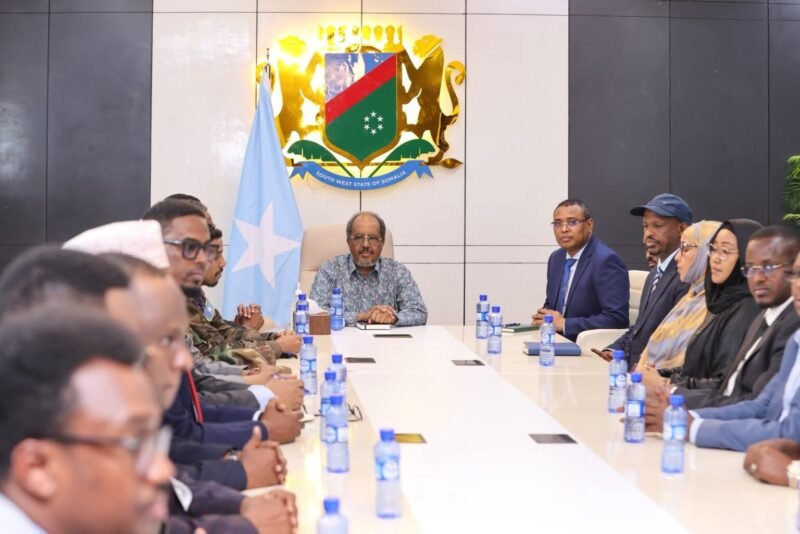
MOGADISHU — The Somali Federal Government’s Council of Ministers convened its weekly session on Thursday under the chairmanship of Prime Minister Hamza Abdi Barre. The meeting addressed pressing national matters, with a primary focus on internal security, the worsening drought situation, and a thorough assessment of the country’s aviation safety protocols.
Aviation Safety Crackdown and Suspensions
The Cabinet received a critical update from the Ministry of Transport and Civil Aviation regarding the performance of domestic airlines. In a decisive move to protect travelers, the Somalia Civil Aviation Authority (SCAA) has officially suspended eight aircraft from operating in the country after rigorous ramp inspections revealed severe maintenance and safety violations.
In a formal directive dated February 16, the SCAA revoked the air operator certificates of the affected aircraft, citing an “unacceptable safety risk” if operations were to continue. The regulatory body reported that the deficiencies constituted a direct non-compliance with both national aviation regulations and the Standards and Recommended Practices established by the International Civil Aviation Organization (ICAO).
Most of the grounded planes, which had been operating domestic routes across Somalia, are registered in Malawi. This enforcement action marks the largest single suspension of aircraft within Somalia’s aviation sector. Officials at Aden Adde International Airport confirmed that the suspensions are effective immediately, and operators will only be allowed to resume flights once their aircraft have undergone comprehensive maintenance verification to meet ICAO airworthiness standards.
The sweeping crackdown comes amid a wave of public complaints and directly follows an incident last week where a civilian aircraft crash-landed off the coast of Mogadishu. Fortunately, all 55 passengers on board were safely evacuated. To maintain ongoing compliance, a specialized committee has been established to perform a comprehensive evaluation of airline quality and submit a detailed assessment to the Council.
Humanitarian and Environmental Response
In addition to aviation safety, the Council made significant improvements to the country’s humanitarian framework. Following a proposal from the Ministry of Interior, Federal Affairs and Reconciliation, the Cabinet sanctioned the appointment of Liban Abdi Igal as the new Commissioner of the National Commission for Refugees and Internally Displaced Persons (NCRI).
This appointment aligns with the government’s urgent focus on organizing relief initiatives to combat severe drought conditions and growing environmental challenges, including sand dune migration, as outlined in a recent report from the Ministry of Environment and Climate Change.
Global Maritime and Diplomatic Frameworks
To further integrate Somalia into the international legal system, the Council endorsed three key global maritime agreements: the International Convention on the Establishment of an International Fund for Compensation for Oil Pollution Damage (1992), the International Convention on Oil Pollution Preparedness, Response and Co-operation (1990), and the Convention on the International Regulations for Preventing Collisions at Sea (1972).
Finally, the Cabinet sanctioned the National Policy on International Cooperation, a strategic roadmap intended to direct the nation’s diplomatic relations and collaborative development initiatives moving forward.