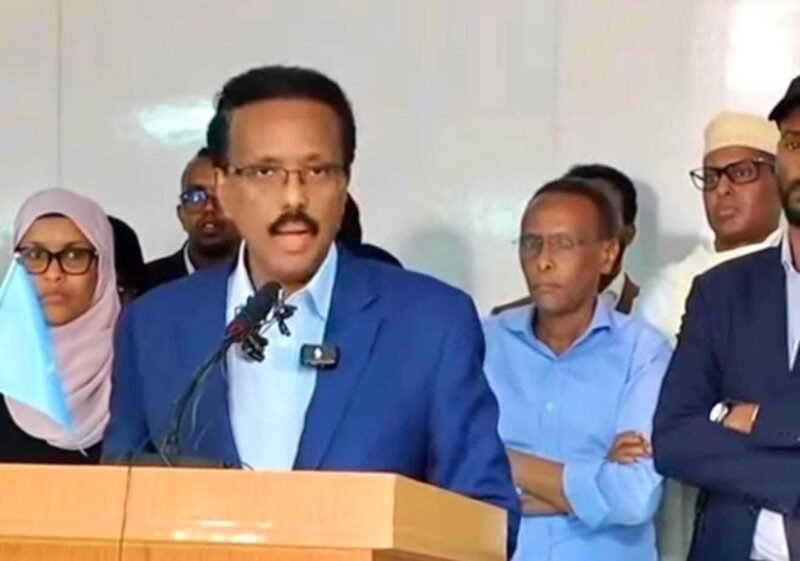
MOGADISHU — Former Somali President Mohamed Abdullahi Farmajo issued a stark warning on Sunday, stating that President Hassan Sheikh Mohamud’s unilateral signing of a new constitution heightens governance challenges and directly threatens the unity of the Somali people.
A Lack of National Consensus
In a formal statement, Farmajo indicated that the strong opposition from regional states, diverse legislators, and former national leaders demonstrates that the initiative lacks the popular support and political consensus strictly required for constitutional legitimacy.
The former president contended that President Mohamud’s actions fundamentally violate the established procedures outlined in the provisional constitution, warning that this unilateral approach could deeply fracture societal cohesion in Somalia.
“I urge him to return to the mutually agreed-upon approach and to conduct elections within the timeframe remaining in his term, based on legal processes and principles with widespread national acceptance,” Farmajo stated.
Widespread Political Opposition
Farmajo’s opposition reflects a broader political crisis. He is joined by former President Sharif Sheikh Ahmed, multiple former prime ministers, and regional administrations who have voiced identical concerns. As recently documented, key regional leaders have explicitly rejected the constitutional amendments, arguing the process bypassed mandatory political agreements.
Last week, Somalia’s legislature formally approved changes to the provisional constitution. However, critics vehemently maintain the vote failed to achieve the necessary two-thirds majority in the bicameral parliament, particularly noting that numerous opposition MPs were controversially barred from participating in the session.
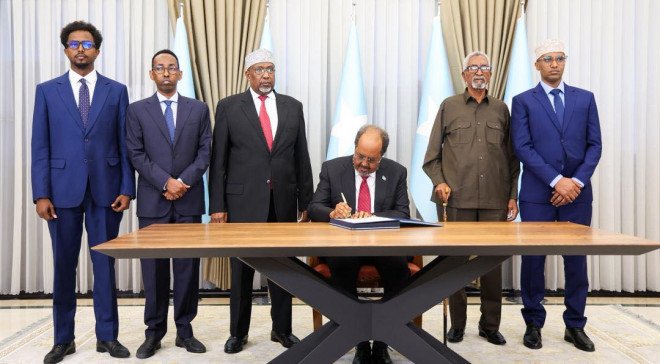
Despite the highly contentious nature of the vote, the Parliament Speaker and President Hassan Sheikh Mohamud announced the completion of the country’s constitution, declaring an end to decades of provisional governance. Crucially, the amended charter grants an immediate one-year extension to both the executive and legislative branches, whose terms were due to expire shortly. Opponents continue to argue that the new framework is actively being utilized as a mechanism to indefinitely extend the current administration’s grip on power and circumvent scheduled elections.