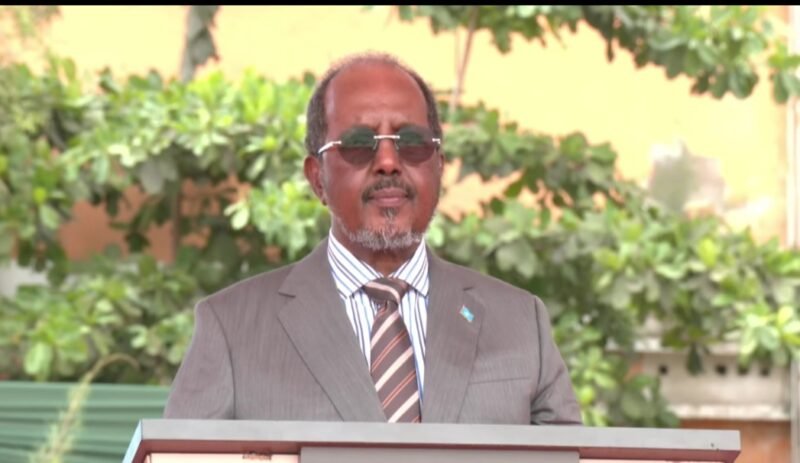
MOGADISHU — President Hassan Sheikh Mohamud has highlighted Uganda’s enduring military support for Somalia, noting that Kampala independently finances troop deployments outside the African Union mandate and has suffered significant uncompensated losses of military equipment during operations against Al-Shabaab.
The president’s remarks serve as a diplomatic response to recent controversial statements made by Uganda’s Chief of Defense Forces, Gen. Muhoozi Kainerugaba, regarding foreign influence in the Horn of Africa.
President Acknowledges Ugandan Sacrifices
Mohamud recognized the significant sacrifices made by Ugandan forces, who were the first to deploy under the original African Union mission in 2007. He specifically noted that Uganda has incurred the destruction of expensive military assets without receiving financial reimbursement from international partners.
President Mohamud has previously reaffirmed Somalia’s commitment to strengthening bilateral ties with Uganda, congratulating President Yoweri Museveni on his re-election and acknowledging Uganda’s contributions to regional stability.
Clarifying Misinformation on Social Media
Following the president’s remarks, social media analyst Rashid Abdi published a post on X claiming that President Mohamud told Uganda “We can manage our security, thank you, and bye bye” and that the president concluded by saying the Somali National Army could now take over security duties and it was time to bid Uganda farewell.
This characterization is inaccurate and does not reflect the president’s actual statements. President Mohamud did not issue any directive for Ugandan troops to leave Somalia nor did he dismiss their continued presence. Instead, he expressed gratitude for Uganda’s longstanding contributions while noting that Somali forces are progressively assuming greater security responsibilities as part of the ongoing transition plan agreed upon with international partners.
Official sources confirm that the president’s remarks were framed within the context of the established Security Transition Plan, which envisions a gradual handover of security responsibilities from African Union peacekeeping forces to Somali national forces. The president did not demand an immediate withdrawal or use dismissive language toward Uganda. His comments were intended as recognition of progress made by Somali forces, not as a rejection of continued international partnership.
Uganda’s Troop Withdrawal Announcement
The comments come amid growing tensions following public criticisms by Kainerugaba targeting Turkey. The general, who is the son of Ugandan President Yoweri Museveni, recently questioned Ankara’s expanding security presence in Somalia, challenging Turkey’s historical role in the early, high-casualty phases of securing Mogadishu.
Uganda has declared its intention to withdraw its military personnel from Somalia following nearly two decades of continuous peacekeeping efforts, with Gen. Kainerugaba announcing that the nation’s military operation is concluding.
“After 19 years in Somalia. We intend to completely withdraw from that country very soon,” Gen. Muhoozi stated, though he offered no further specifics or a confirmed schedule for the departure.
Strategic Security Partnership
While Turkey has emerged as a key provider of military training and maritime defense for the Somali federal government, Uganda remains the largest troop contributor to the African Union Transition Mission in Somalia (ATMIS), now known as AUSSOM.
Uganda has served as a fundamental pillar of international peacekeeping initiatives in Somalia since 2007, when it became the first nation to deploy troops under the African Union mandate. Currently, Ugandan personnel constitute the largest component of the mission, with approximately 5,000 to 6,000 soldiers stationed in the country.
These forces have been instrumental in protecting critical government facilities, including Aden Adde International Airport, the Mogadishu Port, and various strategic locations within the capital.
Diplomatic Observers Assess the Situation
Diplomatic observers suggest that Mohamud’s remarks appear designed to ease tensions with Kampala, a vital security partner, while preserving Somalia’s strategic alliance with Turkey within an increasingly intricate regional security environment.
Security analysts caution that a rapid Ugandan withdrawal, without a robust transition plan, may create vulnerabilities in security coverage, potentially enabling militant groups to escalate operations both within Somalia and throughout neighboring areas.
The declaration arrives amid mounting financial challenges for the peacekeeping mission. Reports indicate the force is contending with budget deficiencies, restricted funding pledges, and arrears in payments to troop-contributing nations. The European Union has adjusted its assistance model, while the United States has paused certain funding streams due to burden-sharing concerns.
Expanding International Partnerships
The Council of Ministers recently approved a memorandum of understanding between Somalia and Uganda on security cooperation, as part of broader efforts to strengthen bilateral ties and enhance regional stability.
The agreement underscores the enduring security partnership between Mogadishu and Kampala, even as Somalia diversifies its international military partnerships with countries including Turkey, Egypt, and Saudi Arabia.
Turkey’s Growing Footprint
Turkey’s engagement in Somalia began as humanitarian outreach in 2011 when then-Prime Minister Recep Tayyip Erdogan became the first non-African leader to visit the country in nearly two decades. Since then, the partnership has evolved significantly, with Turkey training thousands of Somali troops at Camp TURKSOM since 2017, investing in infrastructure, managing the airport and port, and expanding humanitarian projects.
In late January 2026, Turkey deployed F-16 fighter jets to Somalia, marking the most visible escalation yet in Ankara’s long-running engagement in the Horn of Africa. At least three upgraded F-16 Vipers arrived at Mogadishu’s Aden Adde International Airport, accompanied by T129 ATAK helicopters.
Regional Implications
Historically, Ugandan President Yoweri Museveni has also expressed frustration with Somali politics, previously warning that persistent infighting among leaders in Mogadishu undermined efforts to defeat insurgents and restore lasting stability.
As Somalia continues to balance its relationships with multiple international partners, the evolving dynamics between Kampala and Ankara will likely shape the future of security cooperation in the Horn of Africa. The federal government remains committed to maintaining strong ties with both nations while advancing its own security capabilities and national interests.