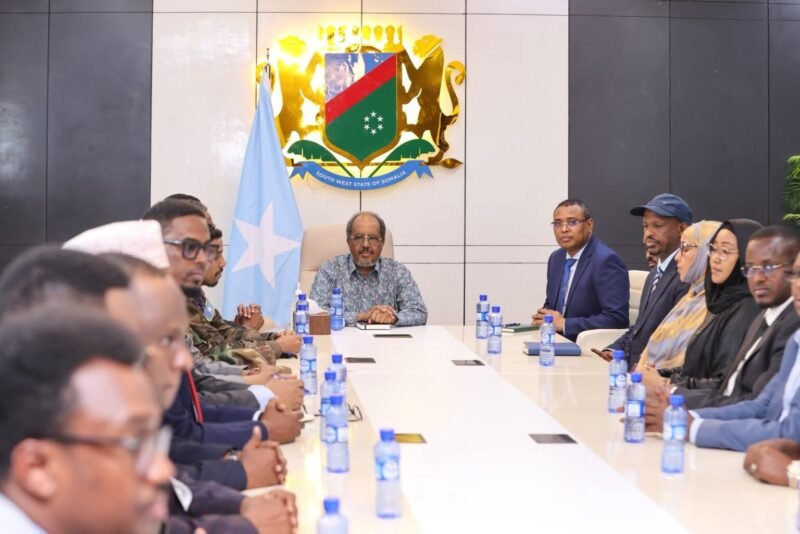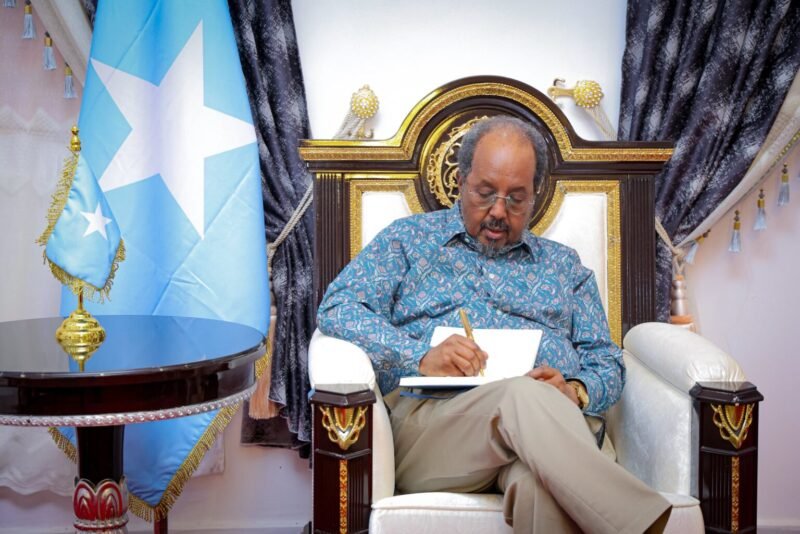
BAIDOA — President Hassan Sheikh Mohamud has concluded several days of intensive meetings in Baidoa aimed at restoring order and managing a political transition following the federal government’s takeover of the South West State capital last week.
The president traveled to Baidoa with an extensive delegation of federal security personnel to stabilize a city affected by unrest, looting, and uncertainty following the military ouster of regional president Abdiasis Laftagareen, who resigned on March 29 and subsequently departed for Nairobi, Kenya.
Federal Forces Consolidate Control
The federal intervention began when heavily armed Somali National Army troops, supported by allied clan militias, entered Baidoa and seized control of the regional administrative capital. Speaker of the House of the People, Sheikh Adan Mohamed Nur (Madobe), arrived at the head of a federal delegation shortly after the takeover to oversee the region’s administrative transition. He has since convened strategic meetings with Somali National Army commanders to evaluate security conditions and bolster stabilization initiatives.
Allegations of Violence and Unrest
However, the federal takeover has not been without controversy. A former regional security official has alleged that two civilians belonging to the clan of ousted leader Laftagareen were killed and their bodies burned inside Speaker Madobe’s Baidoa home in what he described as a reprisal attack.
Mahad Abdirahman, the recently dismissed chief of the regional Custodial Corps, made the allegations in an interview broadcast by Gaylan Media. He claimed the charred remains were still at the doorstep during his interview, though he did not provide the evidence he said he possessed. The allegations remain independently unverified.
Abdirahman also addressed the lack of armed resistance from regional troops, explaining that local forces chose a strategy of survival rather than direct confrontation, noting they were vastly outgunned by a larger federal contingent backed by military aircraft and heavy armored vehicles.
He stated that roughly 2,000 former regional fighters who remain loyal to Laftagareen are currently stationed in nearby Awdinle in a strict defensive posture, with no intention of attacking Baidoa but prepared to defend themselves if federal forces attempt a similar offensive.
Revised Electoral Schedule Announced
During meetings spanning multiple days, President Mohamud and his team have worked to establish foundations for a political transition. A key element of this initiative is a revised electoral schedule.
“These elections are an important step in ensuring public participation and the development of democracy in the Southwest,” Hassan said.
Both elections will employ a one-person, one-vote system, allowing citizens to directly elect members of the state parliament and district councils simultaneously. President Mohamud has described the move as consistent with the government’s broader commitment to expand direct voting nationwide.
“The government is committed to ensuring that the Somali people enjoy their constitutional right to direct elections,” the president said, outlining plans to expand universal suffrage beyond the capital.
Presidential Endorsement Seen as Decisive
While the government strives to project stability, political tensions are escalating beneath the surface. The race to succeed Laftagareen has attracted numerous allies of President Mohamud, several of whom occupy senior positions at the federal level.
Among the frontrunners is parliamentary speaker Adan Mohamed Nur (Madobe). He confronts a competitive field that includes the federal Minister of Ports, Abdulkadir Mohamed Nur, and the Minister of Livestock, Hassan Elay.
Despite the rivalry, a widely shared belief endures among political observers that President Mohamud’s endorsement will ultimately determine who attains the position.
Security Summit and Stabilization Efforts
President Mohamud, alongside interim South West State leader Jibril Abdirashid Haji Abdi, recently co-chaired a large-scale security and administrative summit in Baidoa. The high-level gathering brought together the South West State Council of Ministers and the nation’s top security chiefs, including senior representatives from the Somali National Army, the Somali Police Force, and NISA.
In his closing remarks, the president highlighted the necessity of continued teamwork among all branches of the security forces to preserve stability and safeguard civilian populations.
Precarious Moment for Baidoa
Presently, Baidoa stands at a precarious juncture — torn between the immediate need for stability and a developing political rivalry that could influence the region’s leadership for years ahead.
If completed as scheduled, the April 28 elections would mark one of the most significant electoral experiments in Somalia in decades, testing the country’s capacity to transition from negotiated power-sharing to direct public voting at the regional level.