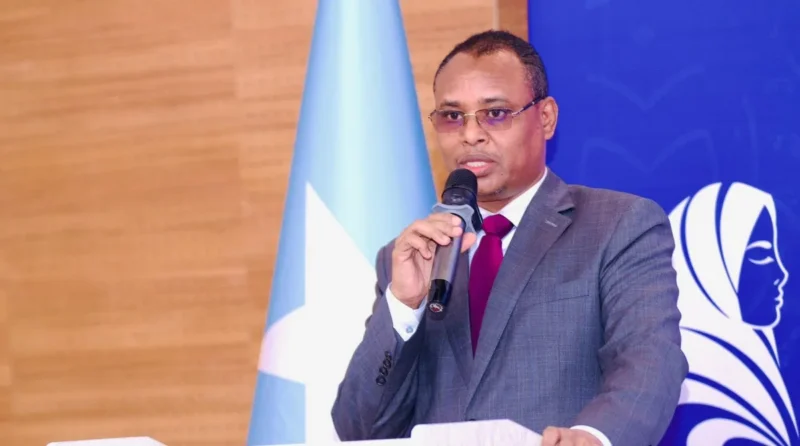
MOGADISHU – Somalia’s Deputy Prime Minister, Jibril Haji Abdirashid, has strongly denied allegations circulating on social media regarding his recent travel to Kenya, describing reports that he was deported from Nairobi as false and unfounded.
In a statement issued on Monday, Haji rejected claims that he had been involved in any activity threatening the security or sovereignty of either Somalia or Kenya.
“At no time did I engage in any activity aimed at undermining the security, sovereignty, stability or territorial integrity of the Republic of Kenya or the Federal Republic of Somalia,” he said.
Haji said he had conducted all official responsibilities in accordance with the rule of law and remained committed to promoting regional peace and maintaining good relations between neighbouring countries.
The denial follows reports that Haji was denied entry and deported from Kenya on June 24 after immigration officials raised questions about a Kenyan passport allegedly in his possession. According to local news reports, Haji arrived at Jomo Kenyatta International Airport on a Saacid Airlines flight from Mogadishu and presented a valid Somali diplomatic passport and visa. However, immigration officers flagged him after receiving information that he was also carrying a Kenyan passport believed to have been obtained fraudulently. He was held at the JKIA VIP Lounge and later escorted onto a Daallo Airlines flight back to Mogadishu on June 25.
The incident comes at a time when Mogadishu and Nairobi are seeking to strengthen their partnership, with both governments previously reaffirming their commitment to advancing key priorities within the bilateral framework.
Commitment to Bilateral Relations
Haji described Kenya as one of Somalia’s closest partners and acknowledged Nairobi’s support across areas including humanitarian assistance, regional security cooperation, economic engagement and state-building efforts.
“The Republic of Kenya remains among the closest and most valued friends of the Federal Republic of Somalia,” he said.
He noted that the government and people of Kenya had supported Somalia during difficult times, particularly in hosting Somali refugees, providing humanitarian assistance, and contributing to regional security and state-building efforts.
“Such support deserves recognition and appreciation,” he said.
The Deputy Prime Minister also reaffirmed his commitment to strengthening ties between Somalia and Kenya, citing priorities such as security, trade, investment, infrastructure and regional integration.
Regional integration remains a key focus for both countries, with Somalia now a full member of the East African Community, although it was excluded when Kenya granted visa-free entry to other EAC states.
Appeal for Responsible Reporting
Haji urged both the public and media organisations to avoid sharing information that had not been independently verified.
“I appeal to members of the public and the media to refrain from spreading unverified information,” he said.
The Deputy Prime Minister concluded by reaffirming his commitment to peace, constitutional governance, regional cooperation, and constructive engagement with the Republic of Kenya.
Way Forward
The incident has generated diplomatic attention, with questions remaining about the circumstances of Haji’s travel to Kenya. As both governments have not issued detailed public statements on the matter, the full context of the events remains unclear. The Deputy Prime Minister’s denial seeks to clarify his position, while Kenyan authorities have yet to publicly respond to the allegations. The case highlights the sensitivity of cross-border travel and document verification between Somalia and Kenya, particularly amid ongoing security concerns in the region.
Recommended Reading On ftlsomalia.com: