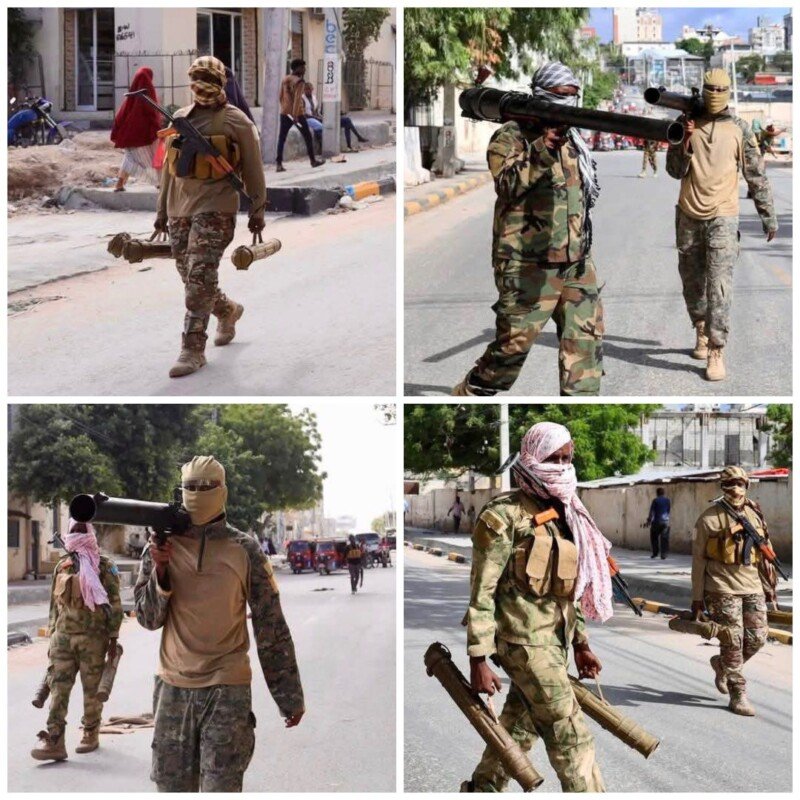
MOGADISHU – The Federal Government of Somalia has confirmed that security forces have fully restored order in the Abdiaziz and Howlwadaag districts following days of intense clashes between government troops and opposition-aligned militias.
In a press release issued on Friday, the government stated that illegally armed opposition group militias have been disarmed and removed, and civilians have returned to their daily lives. The government commended Somali security forces for their professionalism and their commitment to the protection of innocent lives.
The statement was issued entirely in English, marking a significant departure from the Federal Government’s usual practice of releasing official communications in the Somali language. The choice of English suggests that the primary intended audience for this message is the international community rather than the domestic Somali population. By framing the narrative in English, the government appears to be directly addressing its international partners, including the United Nations, the African Union, the European Union, the United States, and the United Kingdom, who have been closely monitoring the political crisis and have repeatedly urged restraint and dialogue.
The severe political crisis escalated after hours of heavy fighting around the Mogadishu residences of former prime minister Hassan Ali Khaire and former president Sharif Sheikh Ahmed, sparking fears of wider conflict. In a strongly worded statement, Defence Minister Ahmed Moalim Fiqi compared the opposition forces to Sudan’s notorious paramilitary Rapid Support Forces (RSF), describing them as the group’s “Somali wing.” “The coup attempt orchestrated by these individuals against the Somali state has been thwarted and is now on the verge of collapse,” Fiqi stated in a social media post.
Government Blames Former Leaders for Violence
The government’s statement asserted that the outcome was made necessary by what it called a deliberate and reckless decision by former President Sheikh Sharif Sheikh Ahmed and former Prime Minister Hassan Ali Khaire. According to the press release, the two former leaders chose to deploy heavily armed opposition group militias into peaceful residential neighbourhoods, placing families and ordinary citizens directly in harm’s way.
“Attacks were launched against police officers, homes were disrupted, and commerce was brought to a halt. What they presented as politics was a dangerous gamble with Somali lives, and the government responded accordingly,” the statement read.
Both opposition leaders have now withdrawn from the strategic positions they had occupied during the height of the crisis, signaling a potential de-escalation after days of intense confrontations that saw heavy fighting across the capital. Former President Sharif moved away from the Mirinaayo area in the Abdiaziz district, where he had been staying, and returned to his home near Aden Adde International Airport. Former Prime Minister Khaire was escorted from his Howlwadaag residence by NISA Director Mahad Mohamed Salad and returned to his home in the Jayga area near the Jazeera Hotel.
Constitutional Dispute at Heart of Crisis
The military standoff stems from a bitter, long-running dispute over controversial constitutional amendments signed into law in March. The sweeping political reforms extended the terms of both the president and parliament from four to five years. The changes have been fiercely rejected by opposition figures, including former presidents Sharif Sheikh Ahmed and Mohamed Abdullahi Farmaajo, who argue the moves lack national consensus and constitute an illegal power grab.
The Federal Government has previously accused regional leaders of orchestrating attacks through loyal militias, describing such actions as “premeditated acts of aggression aimed at undermining national authority and destabilizing the region.” The ministry warned that “all those involved will face legal consequences.”
The current standoff drew direct comparisons to the 2021 crisis, when Mogadishu endured confrontations between competing security forces. Those hostilities concluded only when international pressure and mutual exhaustion compelled a compromise that ultimately resulted in elections installing President Hassan Sheikh Mohamud in power.
Accountability and Prosecution
The government’s statement emphasized that those who organised, financed, and commanded these armed groups will face investigation and prosecution. “Accountability is not a warning. It is a process that has already begun,” the press release stated.
A military court in Mogadishu has previously executed individuals convicted of murder and ties to Al-Shabaab, demonstrating the government’s dedication to accountability for security-related offenses. Judicial authorities have stated that such sentences are carried out following the completion of all legal procedures.
Government Reaffirms Monopoly on Legal Force
The Federal Government reaffirmed that the Somali Security Forces are the sole institution authorised by law to bear arms in defence of the nation. The statement noted that political disagreements exist in every democracy, and the government remains open to dialogue. However, that dialogue must take place through constitutional and peaceful means.
“Armed force is not a legitimate political tool, and any actor who chooses it will be held fully accountable under Somali law,” the government warned.
Former President Sheikh Sharif Sheikh Ahmed, former Prime Minister Hassan Ali Khaire, and federal legislator Abdirahman Abdishakur Warsame have previously called for an immediate end to conflicts, highlighting the importance of dialogue and reconciliation to resolve disputes peacefully. They urged the Somali government to refrain from involving the national army in politically motivated conflicts, warning that such actions could undermine national unity and stability.
International Community Response
International partners including the UN, African Union, EU, IGAD, the United States, and the United Kingdom have urged renewed dialogue between the Somali government and opposition groups following the collapse of US and UK mediated talks earlier this month. The negotiations ended without a breakthrough on May 15, the same day President Mohamud’s four-year term expired under the 2012 Provisional Constitution.
The United States delivered one of its most explicit public statements against the use of force on political protesters in Somalia, with U.S. Chargé d’Affaires Justin Davis stating that violence against peaceful demonstrators was “never acceptable” and calling on Somali political leaders to engage in dialogue and compromise.
Uncertain Path Forward
The restoration of order in Abdiaziz and Howlwadaag districts marks a temporary return to calm, but the underlying political disputes remain unresolved. The opposition’s core demands include immediate agreement on an electoral framework, a peaceful transition plan, and a viable route to free, fair, and inclusive elections.
With both opposition leaders now returned to their homes, attention turns to whether this relative calm will translate into meaningful political dialogue or whether Mogadishu will once again descend into the cycle of term disputes and electoral violence that has characterized Somali politics for years.
Recommended Reading On ftlsomalia.com:
- Somali Minister Accuses Former Leaders of Coup Attempt After Mogadishu Clashes
- Turkey Joins Mediation Efforts as Former President’s Move Away from Marinayo Signals Potential De-escalation
- Federal Government Blames Jubbaland Leader for Beled-Hawo Clashes
- Al Shabaab-Linked Men Executed in Mogadishu
- Former Somali President Calls for End to Ras Kamboni Clashes