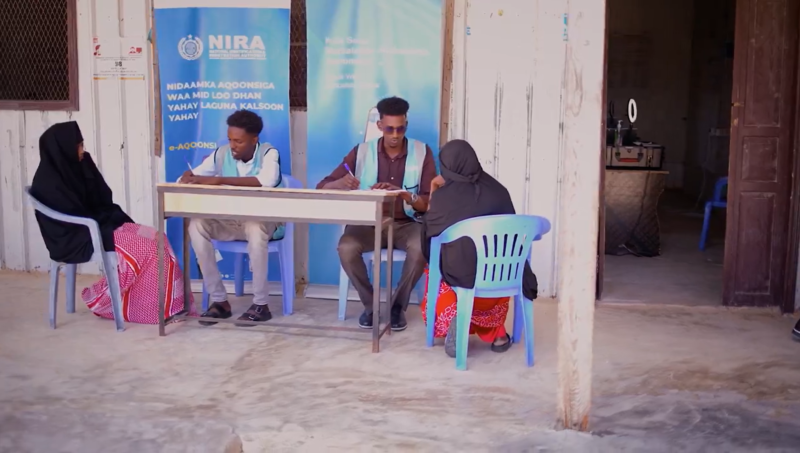
MOGADISHU — The National Identification and Registration Authority (NIRA) has activated mobile registration teams in the Dayniile District to register citizens residing in internally displaced persons (IDP) camps in the area, as part of ongoing efforts to ensure that vulnerable populations are included in Somalia’s national identification system [citation:4].
NIRA stated that it is committed to making the registration service accessible and trustworthy for all citizens, including those in hard-to-reach communities [citation:4]. The deployment of mobile teams represents a significant step in reaching displaced populations who have historically faced barriers to obtaining legal documentation due to distance, cost, and lack of information.
This initiative follows a successful pilot in Baidoa, where a one-month campaign enabled more than 38,000 internally displaced people to obtain their national ID, achieving an average cost of under one dollar per registration [citation:1][citation:2]. The Baidoa pilot demonstrated a scalable model that is fast, cost-effective, and inclusive, with an average of 1,000 enrollments per day and the regular registration fee waived for IDPs [citation:2].
“The NIRA system is processing between 12,000 and 15,000 registrations daily, demonstrating robust operational capacity,” said NIRA’s Director General, Abdiwali Ali Abdulle (Timacadde). “We are intensifying outreach and expansion by opening more permanent centers nationwide and deploying mobile registration teams to reach underserved and remote populations. Early mobile deployments have enabled 38,000+ IDPs to enrol in priority displacement sites in Baidoa.” [citation:1].
NIRA has previously opened a permanent center in Deyniile District, a significant milestone in improving access to national ID services for the Somali people [citation:3]. National IDs are crucial for identity verification, access to services, and participation in civic activities [citation:3].
NIRA has been steadily expanding its service centers across the Benadir region, including a new service center in Boondheere District aimed at streamlining the issuance of national IDs, birth certificates, and other critical documents [citation:6]. This aligns with NIRA’s broader strategy to modernize Somalia’s civil registry infrastructure.
NIRA has also demonstrated its commitment to inclusivity by launching special registration drives for students with disabilities at Al-Basiir School for the Blind, reinforcing its commitment to building an inclusive National ID system that ensures every Somali citizen is recognized and counted.
The authority has also expanded services to the diaspora, with the opening of a NIRA office at the Somali Embassy in Nairobi, Kenya, marking the 30th NIRA center established worldwide, providing Somali nationals residing in Kenya with direct access to essential documentation [citation:7].
The activation of mobile teams in Dayniile comes as the government has made it mandatory for access to key services, including opening a bank account, domestic travel, and other essential public and private services, to be linked to possession of a national ID starting in January 2026 [citation:1]. This makes the national ID a cornerstone for legal identity, protection, and access to rights and services [citation:2].
NIRA aims to establish 150 fixed enrollment centers across Somalia, along with 50 mobile teams to expand coverage, particularly in rural and remote regions [citation:4]. The mobile units are being deployed in phases to reach underserved populations, including IDPs and communities in remote locations [citation:4].
Commissioner Mahamuud Moallim Abdulle of SoDMA has previously stated that NIRA’s mobile teams will conduct census and registration of displaced families in IDP camps to ensure aid reaches those who need it most and to strengthen the country’s humanitarian response systems.
Critical Note
The activation of mobile registration teams in Dayniile District represents a significant step toward including displaced populations in Somalia’s national identification system. The Baidoa pilot demonstrated that it is possible to register IDPs at scale, quickly and at remarkably low cost, when done collaboratively [citation:1][citation:2]. However, significant challenges remain. The requirement that ID cards be used to access essential services risks excluding those who have not yet been registered, particularly in areas where mobile teams have not yet reached [citation:1].
Furthermore, the political fragmentation of Somalia’s federal system has complicated the ID rollout. Puntland has firmly rejected the federal government’s proposal to centralize IDP registration and link humanitarian aid to a national system, warning that the move undermines Somalia’s federal structure and threatens to politicize relief operations [citation:5]. President Said Abdullahi Deni signed a decree creating the Puntland Identification Authority (PID) to issue ID cards independent of NIRA [citation:5]. The federal system, led by NIRA and supported by a $10.5 million agreement with Pakistan’s NADRA biometric agency, aims to issue 15 million biometric IDs ahead of the 2026 elections [citation:5].
International partners, including the European Union Agency for Asylum, have noted the implications of these measures for displaced populations, who often face challenges in obtaining official documentation [citation:7][citation:8]. Without sustained investment in mobile registration capacity and community engagement, the risk is that the national ID system will remain inaccessible to the most vulnerable Somalis. The government must ensure that the registration process is genuinely inclusive and that humanitarian aid is not politicized, as Puntland has warned [citation:5].