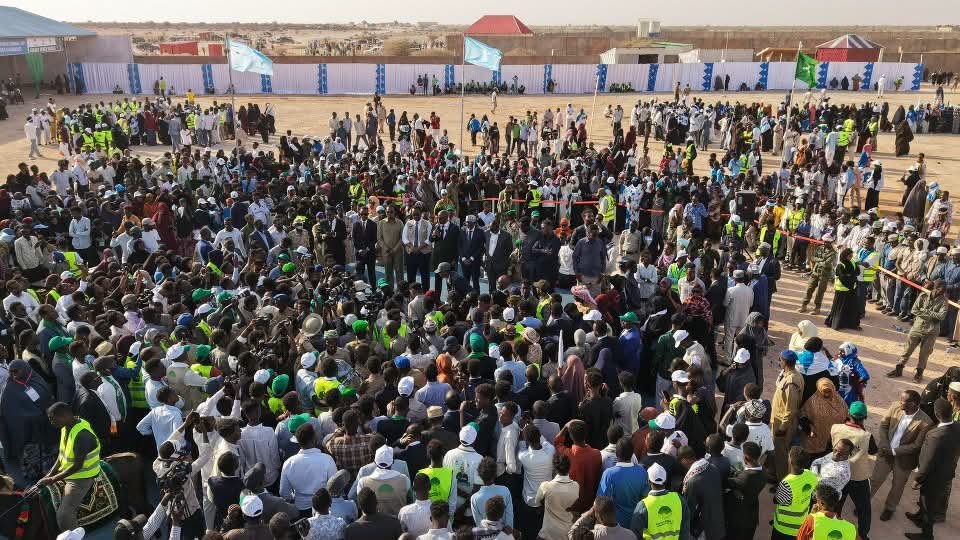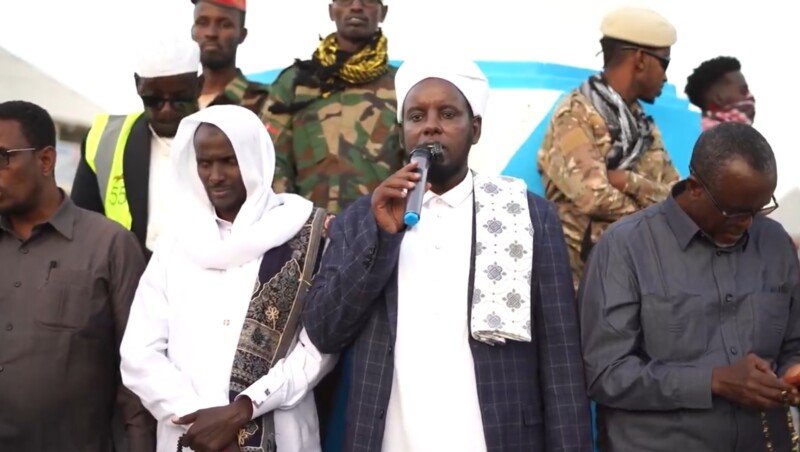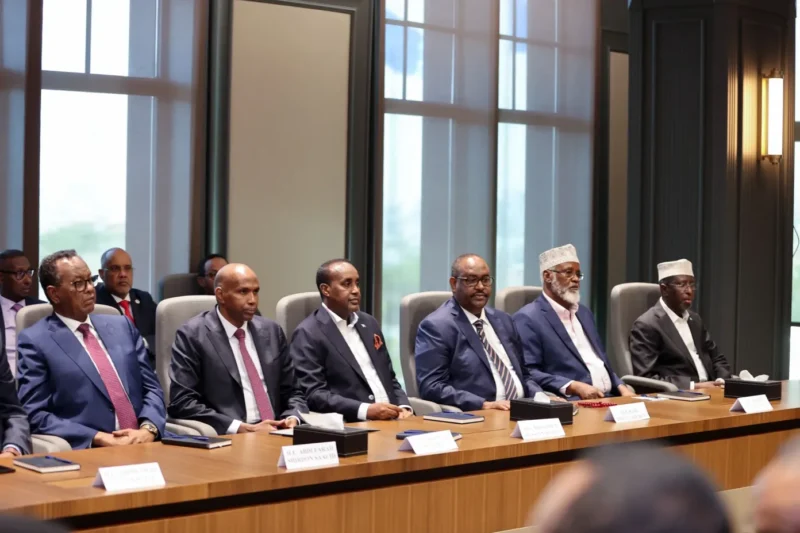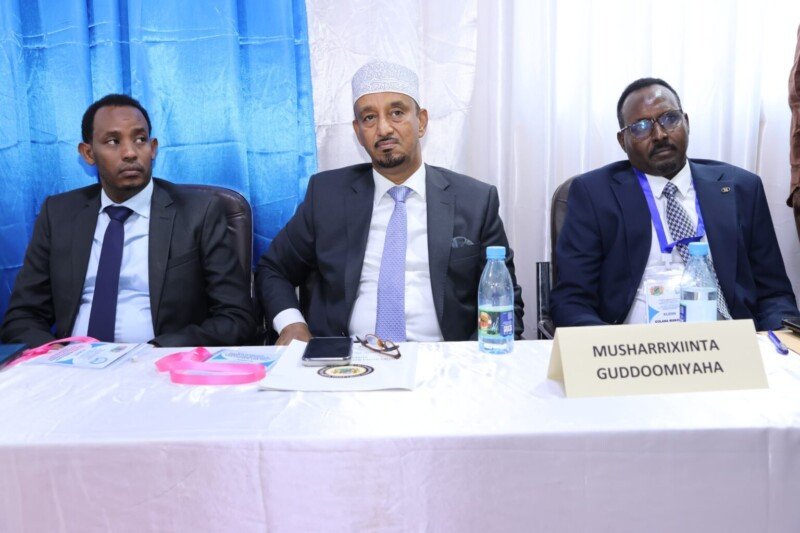
MOGADISHU – President Hassan Sheikh Mohamud has congratulated the newly elected parliamentary leadership of South West State following an election held in the regional capital of Baidoa, but journalists covering the event reportedly faced access restrictions, raising further questions about the transparency of the electoral process.
According to a statement from Villa Somalia, the president congratulated the newly elected Speaker of the South West State House of Representatives, Dr. Mahad Mohamed Sheikh Hassan, along with First Deputy Speaker Aadan Hassan Mohamed, known as Usaama, and Second Deputy Speaker Shamso Mohamed Yarow. All three winning candidates belong to the president’s Justice and Solidarity Party (JSP), which has so far dominated electoral activities across federal member states by wide margins.
The president urged the new parliamentary leaders to perform their duties with transparency and accountability, and to help strengthen governance, advance democratic institutions, and serve the interests of South West State’s people. He also commended the peaceful nature of the election, praising regional parliament members for their role in fulfilling constitutional duties and reinforcing state institutions.
Media Access Restrictions Reported in Baidoa
However, journalists and media personnel covering the election events in Baidoa reportedly faced significant restrictions on their movement and access. According to multiple sources, security forces attached to high-profile political figures, including officials linked to Speaker Aden Mohamed Nur (Adan Madobe), blocked reporters from accessing key venues such as the presidential palace and assembly areas.
The reported restrictions prevented some journalists from covering the election proceedings and related political events in the regional capital. Videos circulating among media professionals have shown security personnel preventing reporters from entering designated areas where political activities were taking place.
The blocking of journalists from election-related venues raises legitimate questions about the transparency and credibility of a process that the federal government has presented as a democratic milestone. When media representatives are prevented from observing political events, it becomes difficult for the public and international observers to verify the fairness of those proceedings.
JSP Dominance Raises Questions About Electoral Fairness
The JSP’s overwhelming success in recent electoral activities, including the South West State parliamentary leadership positions, has drawn scrutiny from political opponents and civil society observers. Critics have questioned whether the outcomes reflect genuine popular will or the federal government’s influence over regional electoral processes.
Opposition figures have previously accused President Mohamud’s administration of employing federal institutions and security forces for narrow political objectives. The Somali Future Council, a powerful political alliance comprising regional governments of Jubbaland and Puntland alongside the Salvation Forum, has explicitly accused the president’s administration of manipulating electoral processes to install loyal candidates across federal member states.
The reported media restrictions in Baidoa only deepen these suspicions. When journalists cannot freely observe and report on electoral events, the gap between government claims and public trust widens. The lack of independent media access makes it harder to verify how votes were cast, counted, or contested.
Election in Context of Federal and Regional Tensions
This election occurs as Somalia works to strengthen federal and regional institutions amid ongoing political discussions about governance reforms and preparations for upcoming elections. South West State, one of Somalia’s federal member states, holds an important position in the nation’s political landscape and ongoing efforts to enhance security and development.
South West State previously conducted one-person, one-vote local council elections across 13 districts, marking a historic shift from indirect clan based selection to direct public voting. However, critics note that the federal government’s heavy involvement in these processes has blurred the line between supporting regional democracy and exerting central control.
The National Independent Electoral and Boundaries Commission announced election dates for multiple federal member states, with South West State, Galmudug, and Hirshabelle scheduled to hold one-person, one-vote elections. Yet in each of these states, candidates aligned with the president’s JSP party have emerged as frontrunners, often with the federal government’s explicit backing.
Federal Government’s Unilateral Electoral Model Under Scrutiny
The federal government’s approach to the electoral process has been described by political opponents as unilateral and lacking in national consensus. President Mohamud has insisted that Somalia must implement a one-person, one-vote electoral system, asserting that recent constitutional amendments effectively extended his administration’s mandate until May 2027.
However, the opposition and several federal member states have rejected this approach, arguing that the constitutional amendments were passed without broad political consensus. Puntland has officially withdrawn recognition of President Mohamud’s administration, while Jubaland has also distanced itself from the federal government’s electoral plans.
The federal government has firmly rejected any alternative political models, confirming that the shift to a one-person, one-vote system is permanent. However, the government has offered limited details on how it will ensure these elections are conducted fairly and transparently, particularly in regions where federal authority is contested.
Media Freedom Concerns and Democratic Accountability
The reported restrictions on journalists in Baidoa are not an isolated incident. Earlier this year, Somali security forces in Mogadishu detained eleven journalists working for various local media outlets for interviewing opposition figures and government critics, a move that sparked concern among media rights groups and press freedom advocates.
Goobjoog Media Group strongly condemned the detention and alleged abduction of journalist Rowdo Hassan Taakilo by Somali government security forces, describing the incident as an unlawful act and a sign of escalating restrictions on the press in the capital.
When journalists are blocked from covering political events, particularly elections, the democratic accountability of those processes comes into question. Free and independent media coverage is essential for citizens to make informed judgments about their leaders and for international partners to assess the credibility of electoral processes.
Somali security forces in Mogadishu have detained journalists for interviewing opposition figures, a move that media rights groups say reflects an increasing crackdown on independent journalism in the country. The reported restrictions in Baidoa suggest that this pattern extends beyond the capital to federal member states.
New Parliamentary Leadership to Oversee Legislative Matters
The new parliamentary leadership will oversee legislative matters in South West State and collaborate closely with regional and federal authorities on governance, security, and development priorities. Speaker Mahad Mohamed Sheikh Hassan received 70 votes in the election, while his opponent Abdihakim Faqi received 25 votes.
The election of the South West State parliamentary leadership follows the broader political framework established by the federal government, which has committed to a one-person, one-vote system across all federal member states. However, without independent media observation and transparent reporting, the credibility of these outcomes remains open to question.
The reported blocking of journalists from election venues does not necessarily prove any impropriety, but it does create an environment of suspicion. In any democratic process, transparency is essential. When the media cannot freely observe and report, public trust in electoral outcomes inevitably suffers.
Goobjoog Media Group has strongly condemned restrictions on journalists, describing such actions as unlawful and a sign of escalating restrictions on the press. The reported incidents in Baidoa suggest that media freedom remains a contested issue in Somalia’s political landscape.
Recommended Reading On ftlsomalia.com:
- South West State Readies for Local Elections in 13 Districts
- Electoral Commission Postpones Deadline, Announces South West State Polling Date
- Somalia Commits to One Person, One Vote by 2026 as Minister Rules Out Return to Clan System
- 11 Somali Journalists Detained in Mogadishu Over Opposition Interviews
- Goobjoog Condemns Journalist Arrest, Demands Release